




BUV launches Vietnam Employability Report 2026: Beware the gap - Are graduates set up for success in a world of new possibilities?
According to the report, digital literacy is the only area in which fresh graduates meet employers' expectations. Yet it is also the standard that is rising fastest.
Latest
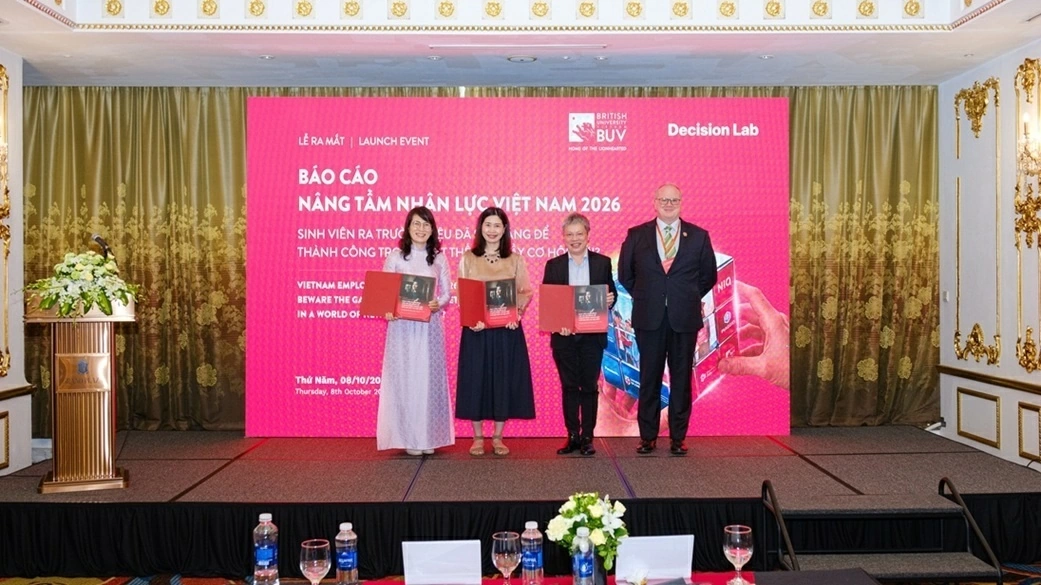 |
| “Vietnam Employability Report 2026: Beware the gap - Are graduates set up for success in a world of new possibilities?”, released by British University Vietnam (BUV) in collaboration with research firm Decision Lab on 8 October 2026. (Photo: BUV) |
Of the seven capability areas assessed among fresh graduates, technology application is the only one in which employers judge graduates to be broadly meeting requirements. Yet 94% of employers say they now expect more digital and AI capability than they did two to three years ago.
This is one of the key findings of the Vietnam Employability Report 2026: Beware the gap - Are graduates set up for success in a world of new possibilities?, released by British University Vietnam (BUV) in collaboration with research firm Decision Lab on 8 October 2026 at the International Conference on Educational Cooperation in the Digital Era and Education & EdTech Exhibition (IECEE 2026), hosted by the Ministry of Education and Training (MOET).
The research team surveyed 375 domestic and international companies on their hiring decisions for fresh graduates.
The gaps are widest when there is no hand-holding
All seven human capabilities were rated important by 74% to 86% of employers. Yet when it comes to how fresh graduates actually perform at work, six of the seven fall short of expectations. The widest gaps are in time management (26 percentage points) and problem-solving (23 points), followed by communication (12 points) and adaptability (11 points). Digital literacy alone exceeds expectations, by 3 points.
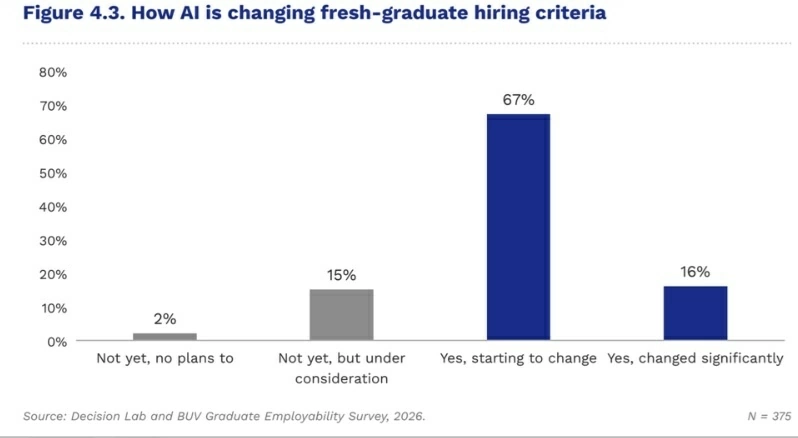 |
| Figure: How AI is changing the criteria for hiring fresh graduates. (Figure: BUV) |
What the under-performing capabilities have in common is that the shortfall becomes apparent when graduates face urgent tasks, incomplete information and work that requires coordination with several people. In these situations, employers need staff who keep their commitments, flag early when work is at risk of slipping, and propose solutions themselves rather than waiting for detailed instructions.
On qualifications, employers tend to place greater value on international degrees, seeing additional value beyond English-language ability, with more than half leaning towards international degrees.
Employers describe international degree graduates as typically showing greater confidence, being more comfortable working in multicultural environments, and being more ready to ask questions, challenge assumptions and present their views to senior colleagues.
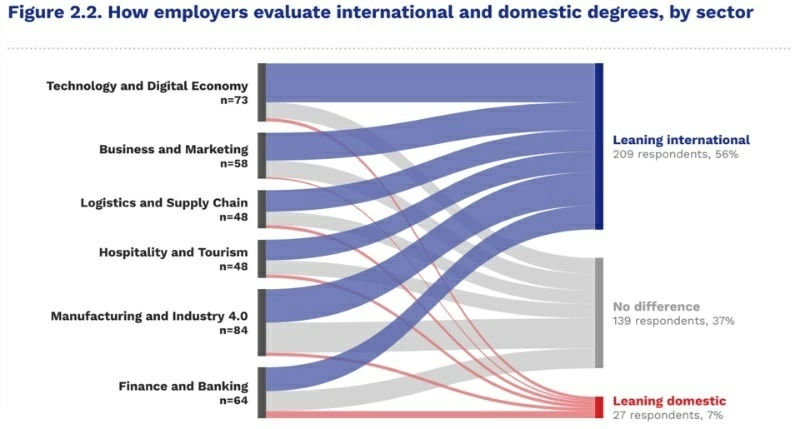 |
| Figure: How employers evaluate international and domestic degrees, by sector. (Figure: BUV) |
AI raises the entry bar
83% of employers say AI has changed, or is beginning to change, their hiring criteria. But they are not looking for AI engineers: Only 3% require AI programming or data analysis skills. 79% want graduates to use common AI tools fluently in their daily work, or to apply AI to the specific problems of their role.
Notably, employers report that collaboration between businesses and universities currently stops largely at recruitment: 59% take on student interns, but only 15% contribute to curriculum design, and 23% do not collaborate with any university at all. The report identifies three conditions for internships to genuinely build capability: Meaningful work, close supervision, and evidence of the student's contribution.
A degree is necessary; capability makes the difference
In response to these findings, BUV introduced its new “Degree Plus” education model at the event. Under the model, every BUV student graduates with a UK university backed by three layers of quality assurance: Recognition by Vietnam's Ministry of Education and Training, quality certification by the UK's Quality Assurance Agency for Higher Education (QAA), and alignment with international standards, including a QS 5-Star rating.
Alongside the degree comes the Global Employment Passport, awarded at graduation. The Passport is built on three skills-development pillars that run in parallel with students' academic programmes.
Professional Skills pillar comprises six 12-week modules, among which Time Management & Project Management and Applied AI & Digital Literacy directly address the report's key findings. Students apply what they learn through internships and real-world projects with more than 500 corporate partners in BUV's network.
Personal Skills pillar comprises five 12-week modules, including Strategy & Problem Solving, and Resilience & Adaptability, all included in tuition fees. All modules are delivered by accredited training providers in Vietnam and internationally.
International Mobility pillar spans the international environment on BUV's own campus through to exchanges, study and internships abroad, via BUV's network of more than 80 partner universities in 19 countries.
BUV's new model, which pairs academic education with workplace skills, aligns with Politburo Resolution No. 71-NQ/TW on breakthroughs in education and training development. The Resolution sets as core requirements raising standards of digital and AI competency, developing the qualities and capabilities of Vietnamese people for a new era, and educating Vietnamese citizens to become global citizens.
 |
| In response to these findings, BUV introduced its new “Degree Plus” education model at the event. (Photo: BUV) |
“The more powerful technology becomes, the sharper human judgement needs to be. The key question is no longer simply what qualification a student holds at graduation, but what their actual capabilities allow them to do on their first day at work,” said Mr Paul Bennett, Chief Marketing Officer, BUV.
No one holds the answer alone
According to the report, government, employers, universities and students each hold part of the solution to closing the gap between qualifications and capabilities. For this reason, BUV is making the full report publicly available and is committed to continuing the research on a regular basis for the benefit of the education sector as a whole, emphasised Mr Rick Bennett, Deputy Vice-Chancellor and Vice-President, BUV.
The expert panel discussion, “Shaping the talent profile for the Industry 4.0 era”, explored in depth how universities, employers and other stakeholders can work together more closely, from programme design and expanding work opportunities to building regular feedback mechanisms from the labour market.
| British University Vietnam (BUV) is the first university in Vietnam to earn a 5-star rating from Quacquarelli Symonds (QS) and the first in Vietnam and ASEAN to achieve global accreditation from the U.K.'s Quality Assurance Agency (QAA)- two of the world's most prestigious education quality organizations. BUV's curriculum is carefully designed and regularly updated to reflect the latest industry trends, emphasizing the seamless integration of theory and practice. Impressively, 100% of BUV graduates secure employment or continue higher education within three months of graduation |