




14th Party Central Committee’s second Plenum: Enhancing the Party’s leadership and governing capacity
WVR/VNA - The second plenum of the 14th Party Central Committee concluded after three days of urgent, serious, and responsible deliberations. One clear takeaway is the very high level of consensus among the Party Central Committee on major issues concerning the Party and the country. This alignment goes beyond rhetoric, signaling a firm determination to put in place substantive operational foundations for the entire term to enable breakthrough and sustainable growth.
Latest
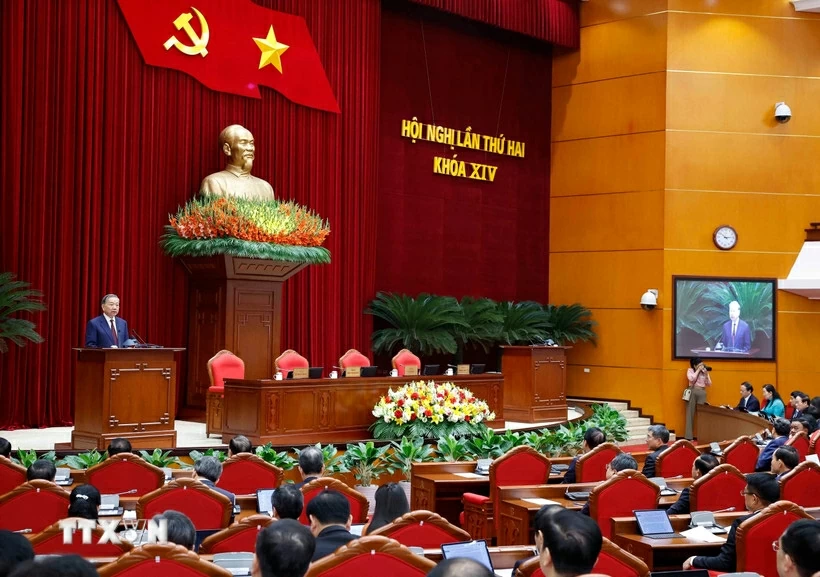 |
| General Secretary To Lam delivers the closing speech at the second plenum of the 14th Party Central Committee. (Photo: VNA) |
Ensuring direct, comprehensive, and unified leadership by the Party Central Committee
In his closing speech at the second plenum of the Party Central Committee, General Secretary To Lam emphasized that the first priority is to focus on political and ideological Party building in the new phase. This effort is crucial to strengthen the Party's resilience, pioneering spirit, combativeness, and leadership and governing capacity.
The General Secretary urged all Party members to deeply understand and strictly adhere to the "Four Constants" in politics and ideology.
These "Four Constants" include: steadfastly applying and creatively developing Marxism-Leninism and Ho Chi Minh's thought; steadfastly pursuing the goals of national independence and socialism; steadfastly following the Party's renewal path; and steadfastly adhering to the organizational and operational principles of the Party to firmly build and safeguard the Socialist Republic of Vietnam.
The General Secretary also affirmed that the regulations on political and ideological work within the Party, issued at this conference, concretize the aforementioned "Four Constants".
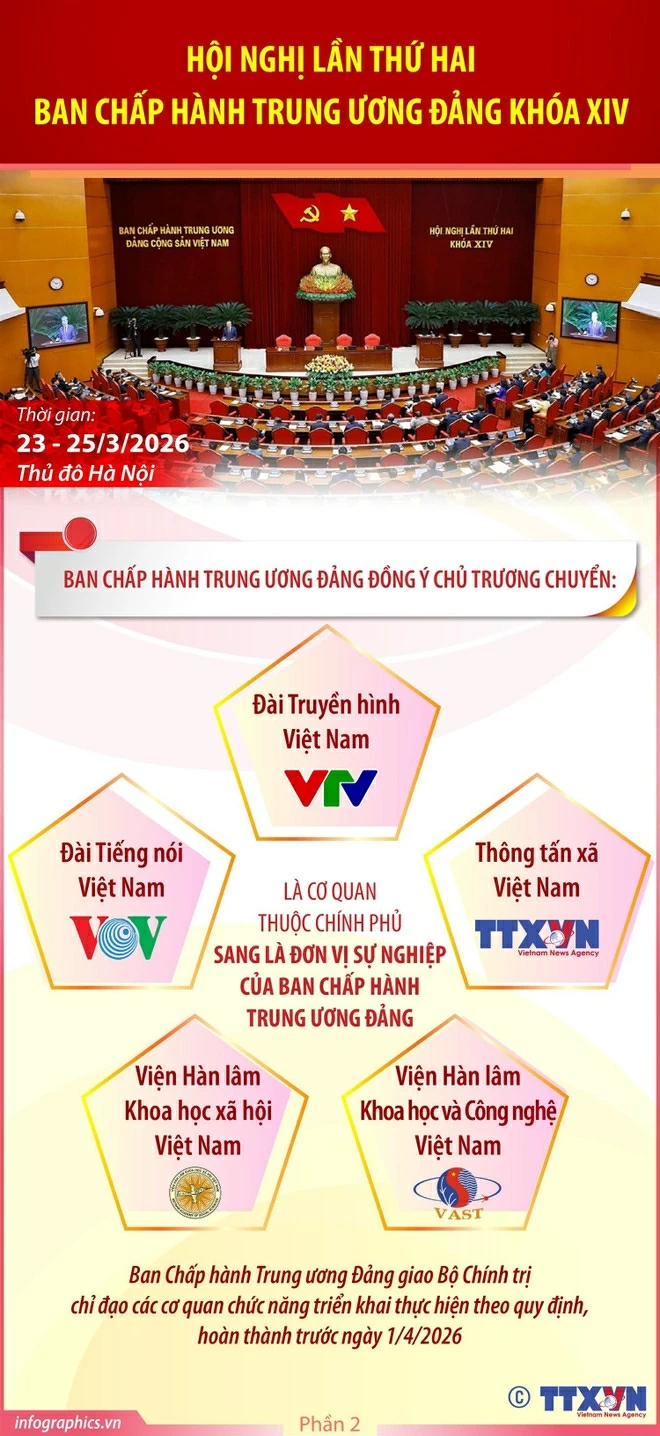
One significant solution related to the Party's leadership and governing capacity is the Party Central Committee's approval to transfer Vietnam Television (VTV), Voice of Vietnam (VOV), Vietnam News Agency, the Vietnam Academy of Social Sciences, and the Vietnam Academy of Science and Technology from government agencies to units under the Party Central Committee.
As we know, the global and regional situation continues to evolve rapidly, with complexity and unpredictability. Strategic competition among major powers is intensifying, and non-traditional impacts, especially those affecting ideology, information, and awareness, are increasing in scale and sophistication. The rapid development of science and technology deeply impacts all fields.
This situation demands an urgent need to strengthen the Party's comprehensive and direct leadership over key areas.
In practice, fundamental science, strategy, and national communication are no longer purely specialized fields. They have become crucial components directly related to the Party's leadership and governing capacity, protecting the ideological foundation of the Party, developing theories, and providing scientific arguments for major Party and State policies. They also play a role in shaping and guiding public opinion.
The three national media agencies, Vietnam News Agency, VTV, and VOV, are pillars of the national information and communication system. They play a key role in disseminating and promoting the Party's guidelines, State policies, and national and global achievements. They guide public opinion, ensure the spread of official information, and conduct domestic and international communications, enhancing the country's image and position.
The two science academies are high-level national research centers, playing a core role in theoretical research and practical summarization. They provide scientific arguments for building and perfecting the Party's guidelines and advise on socio-economic, scientific, technological, cultural, and human development strategies.
Notably, all five agencies directly participate in forming and developing ideological systems, values, and social awareness—core areas linked to the Party's leadership role.
Therefore, when these agencies become units under the Party Central Committee, it aligns with the new political mission requirements. It ensures direct, comprehensive, and unified leadership by the Central Committee over key areas of ideology, information, and strategic scientific research. It fully leverages their key roles in disseminating and promoting the Party's guidelines and ideology, guiding public opinion, and ensuring research activities align with strategic autonomy. This approach drives breakthroughs in domestic science and technology development, closely linking scientific research, policy-making, and strategic decision-making.
 |
A decision with profound strategic significance
Party Central Committee member and General Director of VOV Do Tien Sy expressed that transferring the three national key media agencies to the Party Central Committee reaffirms the Party's innovation in thinking, methods, and approaches in leading political, ideological, and media work today.
This new positioning will enhance the Party's centralized, direct, comprehensive, and unified leadership over the activities of the national key media agencies, meeting the information needs of audiences. It also provides conditions for these agencies to further promote their core, leading roles in the ideological-cultural front, based on their core strengths and traditions.
Professor, Dr. Tran Hong Thai, Party Central Committee member and President of the Vietnam Academy of Science and Technology, also considers this a decision with profound strategic significance. These five agencies represent important pillars in national communication, social sciences, and science and technology.
Placing these pillars under the Party's direct leadership indicates that the Party recognizes these as foundational areas of soft power and national competitiveness, requiring unified leadership from the highest level. This contributes to strengthening the Party's power and accelerating the country's development.
Sharing the same perspective, Professor, Dr. Le Van Loi, Central Party Committee member and President of the Vietnam Academy of Social Sciences, remarked: This is a strategic decision, providing particularly favorable conditions for the Vietnam Academy of Social Sciences to fulfill its mission and scientific strengths. When the Academy's research is directly guided by the Politburo and the Secretariat, the gap between theoretical thinking and political orientation, between fundamental science and practical development, will be significantly shortened. This is the foundational condition to transform the "four constants" from political principles into substantive research and policy advisory actions.
Thus, with the combined efforts of the three national key media agencies and the two academies, the Party's decisions in the field of ideology and strategic development planning will soon be realized in the spirit of action set forth by the 14th Party Congress Resolution, leading our country to robust, prosperous development and ensuring the happiness of the people.


