






Vietnam, China Foreign Ministers step up bilateral cooperation
WVR/VNA - On July 22, Politburo member of the Communist Party of Vietnam Central Committee, Minister of Foreign Affairs Le Hoai Trung met with Politburo member, Director of the Office of the Commission for Foreign Affairs of the Communist Party of China (CPC) Central Committee and Minister of Foreign Affairs of China Wang Yi, in Manila, the Philippines, on the occasion of the 59th ASEAN Foreign Ministers' Meeting (AMM-59) and Related Meetings.
Latest
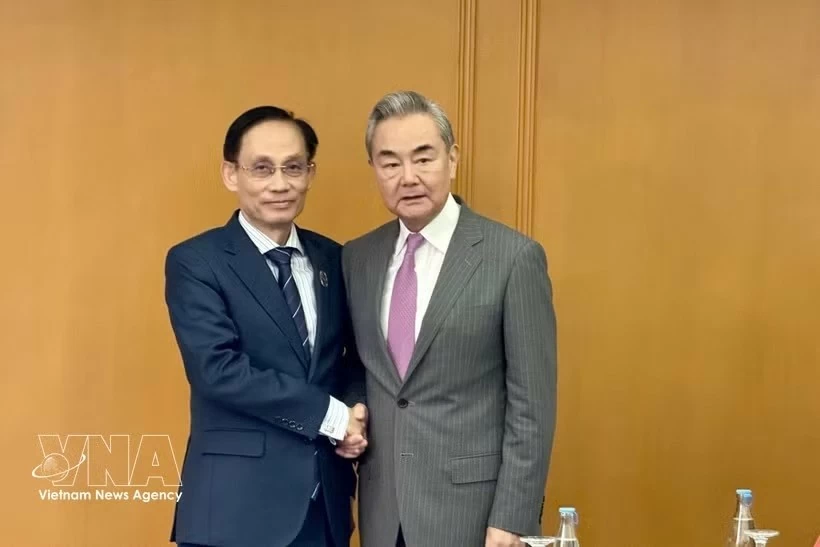 |
| Vietnam, China Foreign Ministers step up bilateral cooperation: Le Hoai Trung, Politburo member of the Communist Party of Vietnam (CPV) Central Committee, Minister of Foreign Affairs (L), meets with Wang Yi, Politburo member, Director of the Office of the Commission for Foreign Affairs of the Communist Party of China (CPC) Central Committee and Minister of Foreign Affairs of China, in Manila, the Philippines, on July 22. (Photo: VNA) |
The two Ministers express their satisfaction with the positive and substantive development of the Vietnam-China Comprehensive Strategic Cooperative Partnership. They emphasised that Party General Secretary and State President To Lam's visit to China in April, together with the recent phone talks between the two countries' prime ministers, have provided fresh momentum for bilateral ties, contributing to strengthening political trust and promoting cooperation across various fields.
Foreign Minister Wang thanked Vietnam's senior leaders for extending their sympathies over the recent flood damage in China. He reaffirmed that China attaches great importance to its relations with Vietnam and supports the country in achieving its development goals in the new stage.
He stressed that, as neighbouring socialist countries and developing nations, China and Vietnam should continue strengthening solidarity, cooperation and mutual support amid the complex international situation, while working together to safeguard the legitimate interests of developing countries and contribute to peace, stability, cooperation and development in the region and the world.
For his part, Foreign Minister Trung highly appreciated China's support for Vietnam's national development, affirming that Vietnam consistently views the development of relations with China as an objective requirement, a strategic choice and a top priority in its foreign policy.
He expressed his hope that the two sides will further enhance exchanges and share experiences, including China's practices in renewing growth models, advancing science and technology, promoting innovation and accelerating the green transition.
The two Ministers agreed to continue seriously and effectively implementing important common perceptions reached by the top leaders of the two Parties and countries; promote the strategic guiding role of high-level exchanges; and advance the building of the Vietnam-China Community with a shared future that carries strategic significance in an increasingly practical and profound manner in accordance with the “six major orientations”.
They agreed to continue well arranging high-level visits and meetings, strengthen relations between the two Parties and the two States, and effectively utilise existing exchange and cooperation mechanisms, including the Steering Committee for Bilateral Cooperation and the "3+3" Strategic Dialogue on diplomacy, defence, and public security.
The two Ministers also consented to strengthen development strategy connectivity and improve the quality and effectiveness of cooperation in economy, trade, investment, infrastructure connectivity, science and technology, education and training, and people-to-people exchanges, while promoting more balanced, sustainable, inclusive and mutually beneficial cooperation.
Foreign Minister Trung proposed China further open its market for Vietnamese goods, particularly agricultural products; facilitate the operations of businesses from both countries; and enable Vietnam to be the featured country in the "Shared Big Market: Export to China Series Activities".
Foreign Minister Wang took this occasion to convey an invitation for Vietnamese leaders to attend the 2026 APEC Economic Leaders’ Meeting in China.
Foreign Miniter Trung expressed his appreciation and confidence that China will successfully host APEC Year 2026. He also congratulated China on the success of the World Artificial Intelligence Conference in Shanghai.
The two Ministers underscored the importance of promoting inclusive and mutually beneficial international cooperation on AI, helping to narrow development gaps and enabling developing countries to access and benefit from the fruits of scientific and technological advances.
They agreed to continue close coordination at global, regional and subregional multilateral mechanisms, and enhance consultation, mutual support and coordination on issues of common concern, thereby contributing to peace, stability, cooperation and development in the region and the world.


