





Vietnam and Timor-Leste open pathways for cooperation in food security and fisheries
WVR - On July 20, in the capital city of Dili, Vietnamese Chargé d'affaires in Timor-Leste Pham Binh Dam held a meeting with Timor-Leste's Deputy Prime Minister, Minister of Coordinating Social Affairs, and Minister of Rural Development and Community Housing Mariano Assanami Sabino Lopes.
Latest
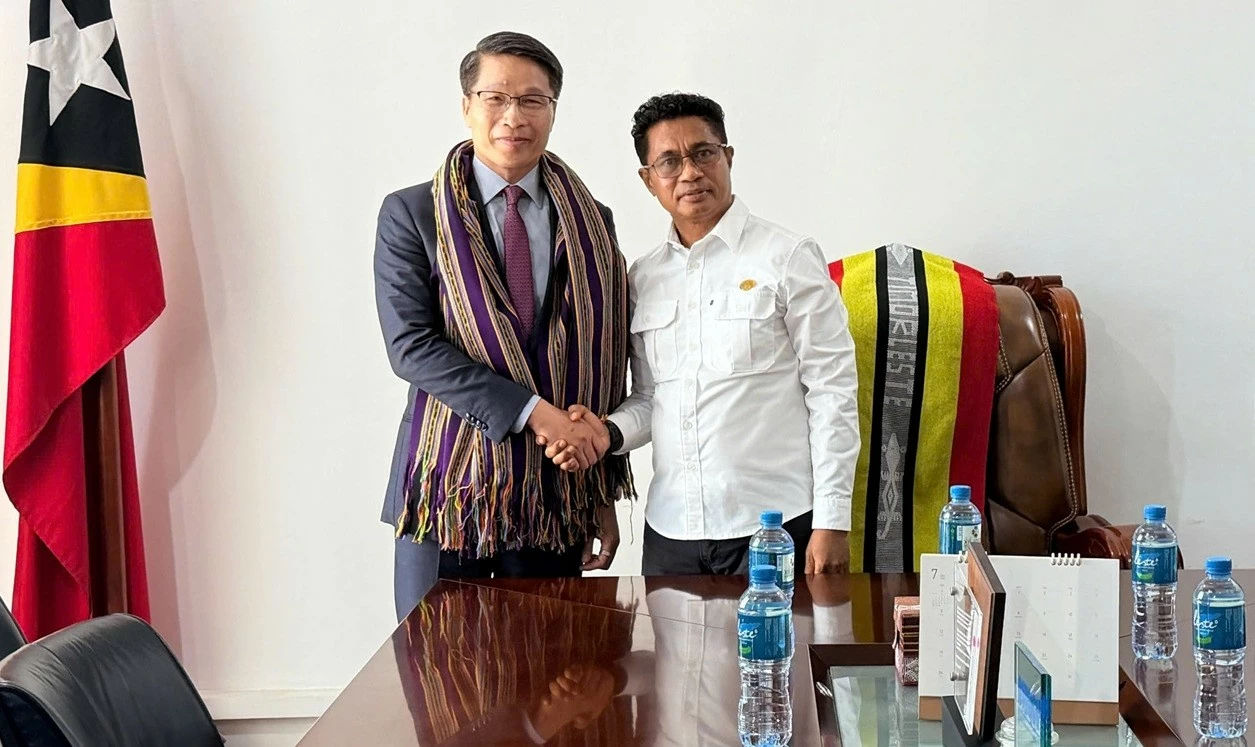 |
| Vietnamese Chargé d'affaires in Timor-Leste Pham Binh Dam met with Timor-Leste's Deputy Prime Minister Mariano Assanami Sabino Lopes. |
The meeting aimed to discuss measures to boost cooperation in food security, rural development, sustainable marine resource exploitation, and human resource training. This comes as Timor-Leste focuses on enhancing domestic production capacity, gradually reducing reliance on imports, and more effectively exploiting marine potential.
During the discussions, Deputy Prime Minister Mariano Assanami Sabino said that domestic production currently meets only about 40% of Timor-Leste's food demand. In this context, enhancing production capacity is not only aimed at increasing food self-sufficiency but is also closely tied to social development goals such as improving nutrition, reducing poverty, creating jobs, and ensuring stable income for rural households.
Sharing Vietnam's development experience, Chargé d'affaires Pham Binh Dam emphasized that food security is one of the crucial foundations for social stability and development. From a country that once faced food shortages, malnutrition, and numerous difficulties in rural areas, Vietnam has gradually increased productivity, ensured food security, expanded agricultural value chains, and improved people's livelihoods.
According to the Chargé d'affaires, food cooperation between the two countries can be implemented in two complementary directions. Initially, Vietnam will continue to contribute to ensuring a stable, quality rice supply that meets the needs of the Timor-Leste market, thereby maintaining the role of rice in bilateral trade exchanges.
In the long term, cooperation should expand from trade to supporting the development of local production capacity. Vietnam is ready to share experiences in crop varieties, farming techniques, irrigation, mechanization, post-harvest preservation, and building agricultural value chains.
Regarding the fisheries sector, Deputy Prime Minister Mariano Sabino Lopes noted that Timor-Leste possesses a maritime area four times larger than its land area, with abundant fisheries potential. However, the capacity for local fishing, preservation, and processing remains limited, and the contribution of the fisheries sector to the non-oil economy is still modest.
The Deputy Prime Minister expressed a desire for the two countries to enhance experience exchange in fishing, aquaculture, and seafood processing, initially to improve domestic food supply, create more jobs, and provide livelihoods for coastal communities, and subsequently to move towards trade and export.
Discussing cooperation directions, Chargé d'affaires Pham Binh Dam suggested that Vietnamese enterprises have many strengths that align with the development needs of Timor-Leste's fisheries sector, from shipbuilding, transferring fishing and aquaculture techniques, to investing in preservation facilities, cold storage, and processing.
On this basis, businesses from both countries can explore building suitable production cooperation models in Timor-Leste, linking investment with local labor recruitment, training, and gradually transferring techniques to people in coastal areas.
This cooperation potential has initially been realized. On the same afternoon, Chargé d'affaires Pham Binh Dam attended the launch ceremony of semi-industrial fishing vessels in Timor-Leste, organized by the Ministry of Agriculture, Livestock, Fisheries, and Forestry of Timor-Leste, with the participation of Timor-Leste Prime Minister Kay Rala Xanana Gusmao, Deputy Prime Minister Mariano Assanami Sabino Lopes, and Minister of Agriculture, Livestock, Fisheries, and Forestry Marcos da Cruz.
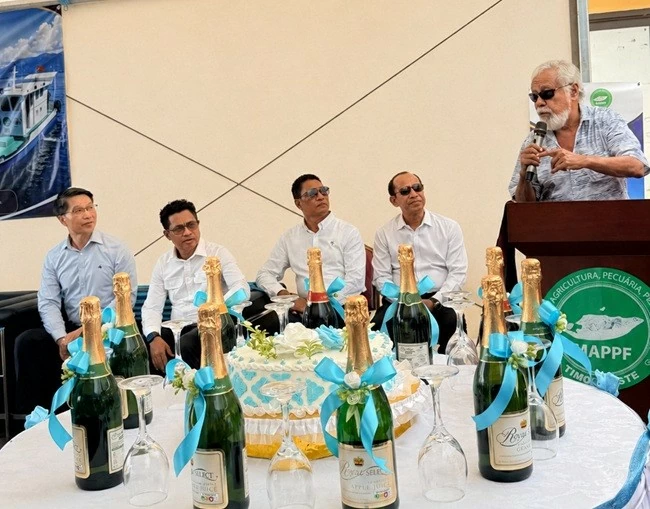 |
| Vietnamese Chargé d'affaires in Timor-Leste Pham Binh Dam attended the launch ceremony of fishing vessels in Timor-Leste, organized by the Ministry of Agriculture, Livestock, Fisheries, and Forestry of Timor-Leste, with the participation of Timor-Leste Prime Minister Kay Rala Xanana Gusmao. |
Among the three vessels launched, one was co-financed by a Vietnamese enterprise, indicating that Vietnamese businesses in the region are gradually shifting from trade to production investment in this field.
For such projects to operate effectively and be replicable, the human resources issue is given special attention by both sides. Deputy Prime Minister Mariano Assanami Sabino Lopes noted that Timor-Leste has a young and abundant workforce, but the lack of specialized skills limits their ability to meet market demands and attract new production projects.
Chargé d'affaires Pham Binh Dam affirmed that Vietnam is ready to cooperate with Timor-Leste in vocational training and capacity building for workers, linking training content with the practical needs of production sectors. This is also a specific implementation direction of the educational cooperation agreements signed by the two countries during the visit of Timor-Leste Prime Minister Kay Rala Xanana Gusmao to Vietnam in June 2026.
Both sides agreed to continue exchanges to soon identify priority areas for implementation into specific cooperation programs. Cooperation in food security should be implemented in tandem with rural development, expanding livelihoods, creating jobs, and improving the quality of human resources, thereby contributing to strengthening the foundation for long-term stability and development in Timor-Leste.


