




Viet Nam’s agriculture: A transition from a social safety pillar to a launchpad for development
Beyond record-breaking export figures, 2025 also marked a strong transformation of Viet Nam’s agriculture.
Latest
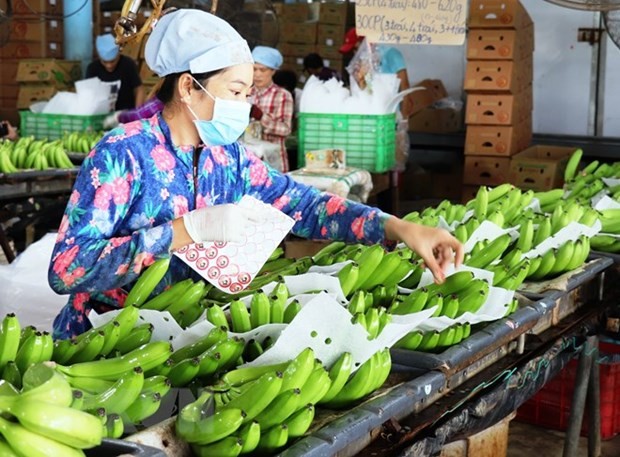 |
| In 2025, fruit and vegetable export turnover surpassed 8.5 billion USD for the first time, rising by nearly 20 percent thanks to deep processing strategies and market opening. (Photo: VNA) |
While continuing to play the role of a “pillar” supporting the economy during difficult times, agriculture has also risen to become a growth driver, proactively creating a “launchpad” for economic development in line with the objectives set by the Party and the State.
Export records and a strategic shift
For more than 80 years, agriculture has made an important contribution to the country’s socio-economic development, while serving as a foundation for many economic sectors and for the achievement of sustainable development goals and Viet Nam’s international commitments. From a country that once had to import millions of tonnes of food each year, Viet Nam has now become one of the world’s major producers and exporters of agricultural, forestry and fishery products.
In particular, in 2025, total national import-export turnover of agricultural, forestry and fishery products was estimated at over 70 billion USD, with a trade surplus of around 21 billion USD, exceeding the Government’s target. The role of agriculture as a “pillar” of the Vietnamese economy was reaffirmed as the sector contributed about 5.5 percent to national GDP growth.
The structure of agricultural export commodities has also undergone a revolutionary shift, from quantity to quality, from purely production-oriented thinking to economic management thinking. A notable example is the “rise” of fruit and vegetables, which for the first time exceeded 8.5 billion USD in exports (up nearly 20 percent), “overtaking” many traditional products thanks to deep processing strategies and market opening. Key sectors have maintained strong performance: wood exports exceeded 18 billion USD, continuing to be a “golden goose”; fisheries exports surpassed 11 billion USD, despite increasingly stringent international technical barriers.
Conversely, although rice export turnover fell to 4.1 billion USD, significantly lower than in 2024, this is not a crisis but rather an adjustment to a new normal.
The year 2025 was also marked by severe natural disasters, yet Viet Nam’s agricultural sector demonstrated remarkable resilience, with value-added growth across the entire sector reaching about 3.78 percent.
According to Minister of Agriculture and Environment Tran Duc Thang, to contribute to achieving double-digit economic growth in the 2026–2030 period, the agricultural sector aims to maintain an average growth rate of around 3.5 percent per year over the next five years. The focus is on ensuring national food security and striving toward the target of 100 billion USD in agricultural, forestry and fishery export turnover.
Agriculture remains a national advantage
In reality, the Documents of the 14th National Party Congress elevated strategic thinking, identifying agriculture not only as a social safety “pillar” but also as a national competitive advantage. A new development philosophy has been shaped around three pillars:
First, a transition from clean production to a circular economy, reducing emissions and integrating multiple values. A typical example is the success of the “one million hectares of high-quality, low-emission rice” model, which has been widely implemented in the Mekong Delta.
Second, rural development is no longer merely about concrete infrastructure, but about creating a civilized living space, digital connectivity, and preserving cultural identity so that rural areas become “livable” places that attract high-quality human resources.
Third, the “intellectualisation” of farmers. The new generation of farmers must be digital farmers, “agricultural entrepreneurs” who master data, technology and markets, rather than merely “relying on the weather and the land”.
At the same time, to realise the aspiration of turning Viet Nam into a “global kitchen” and a major agricultural processing power, six key groups of solutions need to be implemented in a coordinated manner, including:
A logistics revolution toward building “smart cold supply chains”. Logistics must be regarded as the “lifeblood” of agriculture, with strong investment in cold storage systems and refrigerated transport to reduce post-harvest losses.
Assigning enterprises, especially private enterprises, a leading role in the value chain. The State should shift from general support to ecosystem creation, encouraging “leading cranes” to develop raw material zones and processing technologies. At the same time, agriculture needs to be “financialised” through insurance and green credit to attract social capital flows.
Resolute implementation of the 2024 Land Law to promote land accumulation and concentration, forming large-scale commodity production zones. Implementing the policy of “leaving agriculture without leaving the homeland”, whereby farmers contribute land and become shareholders or professional agricultural workers right in their own localities.
Building a closed technology ecosystem: applying AI and Big Data to optimise cropping seasons and traceability; focusing on deep processing to build national brands, as TH true milk, Vinamilk or Trung Nguyen have done, escaping the “curse” of raw exports; increasing transparency in cash flows and risks to unlock capital, and establishing agricultural insurance and rural green credit.
Thoroughly implementing the “intellectualisation of farmers”, the most fundamental solution. Farmers need to be trained to proficiently use digital technologies and manage production based on data.
Finally, strengthening agricultural “diplomacy”, expanding markets by effectively leveraging new-generation trade agreements to open pathways for Vietnamese agricultural products to reach further afield.
Reality shows that Vietnamese agriculture does not lack potential; what it has lacked in the past is a “big dream” and coordinated action. This challenge appears to have found a comprehensive answer, as with new thinking, the 14th National Party Congress clearly identified the need to complete infrastructure and institutional foundations for the economy in general and for agriculture in particular.
Moreover, Viet Nam has not chosen the path of “bypassing” agriculture to pursue industrialisation, but rather the path of “industrialising agriculture”. In doing so, agriculture will not only be a “pillar” in times of turmoil, but will truly become an important “launchpad” helping Viet Nam’s economy take off and stand alongside the world’s major agricultural powers.
Agriculture has been affirmed by the Party as a national advantage. President Ho Chi Minh also taught: “When our farmers are prosperous, our country is prosperous; when our agriculture thrives, our nation thrives.” Vietnamese agriculture does not lack potential; what it lacks is a “big dream” and the determination to change. The 14th National Party Congress has set out that “big dream” with very high political resolve.
(Source: Nhan Dan Online)