



Prime Minister Pham Minh Chinh visits Russia: New momentum for economic cooperation in key areas
WVR - Russian Ambassador to Vietnam Gennady Bezdetko shared with The World and Vietnam Report on Prime Minister Pham Minh Chinh's official visit to Russia (March 22-25).
Latest
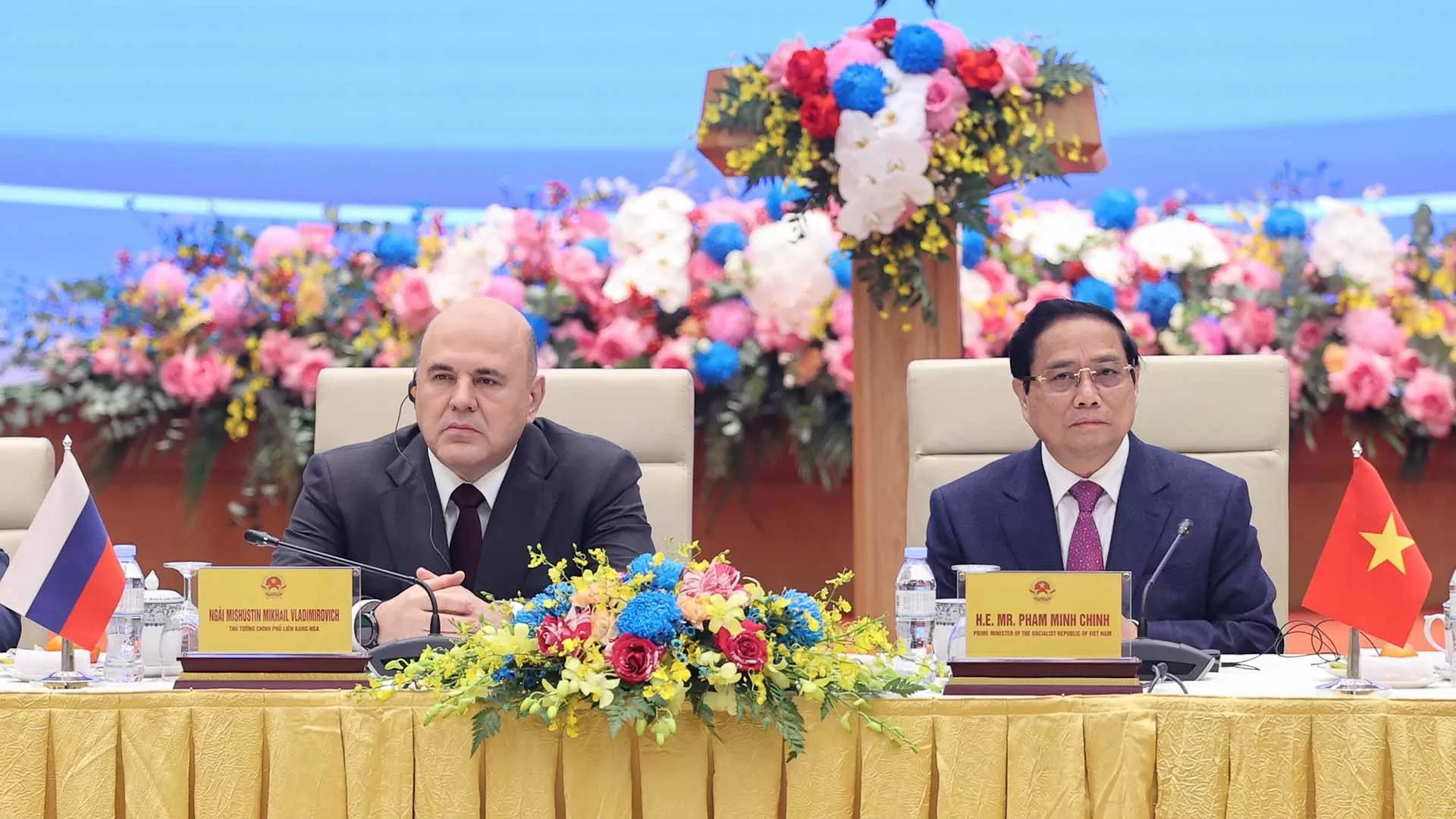 |
| Prime Minister Pham Minh Chinh and Russian Prime Minister Mikhail Mishustin co-chaired the Vietnam-Russia High-Level Business Dialogue on January 15, 2025. (Source: VGP) |
Ambassador, could you evaluate the significance and expectations of Prime Minister Pham Minh Chinh's visit to Russia in the context of both countries continuing to strengthen their comprehensive strategic partnership, serving national interests, and contributing positively to peace, stability, and sustainable development in the region and the world?
First of all, I want to emphasize that our two countries have established a regular and trustworthy political dialogue mechanism at all levels, including the highest level, contributing to the stable development of the Russia-Vietnam Comprehensive Strategic Partnership.
The upcoming visit is a logical continuation of a series of important bilateral engagements this year. Among them was the visit to Russia last February by Special Envoy of General Secretary To Lam, Politburo Member and Minister of Foreign Affairs of Vietnam Le Hoai Trung.
The main objective of the trip was to inform the Russian high-level leadership about the significant outcomes of the 14th National Party Congress – a crucial domestic political event in Vietnam aimed at guiding the country's future development.
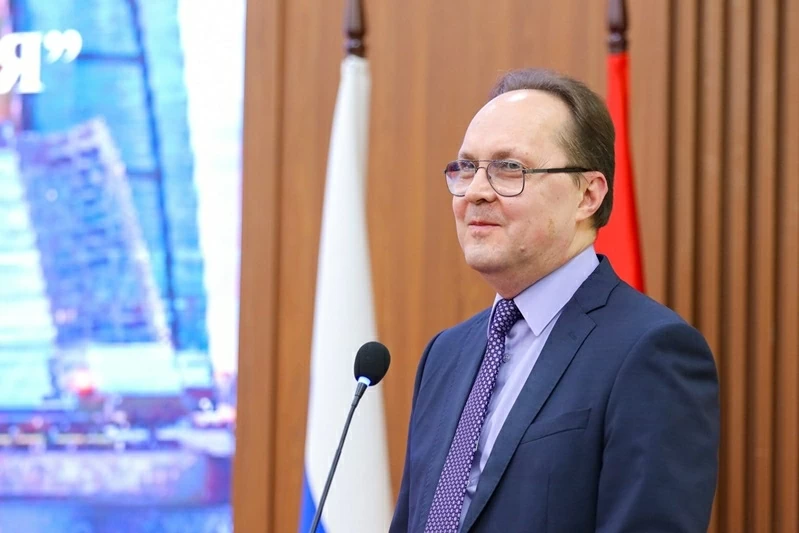 |
| Russian Ambassador to Vietnam Gennady Bezdetko. (Photo: VUFO) |
This March also saw the successful visit to Vietnam by A.V. Kurenkov, the Russian Minister for Civil Defense, Emergencies, and Disaster Relief.
During the visit, both sides detailed a roadmap to enhance cooperation in key areas such as ensuring safety, fire prevention monitoring at energy and strategic transport facilities, handling complex fires, and responding to emergencies, including radiological incidents and natural disasters.
We expect the upcoming meetings between the leaders of the two countries to create new momentum for economic activities between Russia and Vietnam. This cooperation is being implemented according to the comprehensive cooperation plan signed for 2025 to 2030, covering trade-investment, energy, transportation, finance-banking, agriculture, and other areas.
I believe new tasks will also be assigned to the key coordinating body, the Russia-Vietnam Intergovernmental Committee on Trade-Economic and Scientific-Technical Cooperation at the Deputy Prime Minister level.
Amid numerous security and economic challenges in the region and globally, coordinating foreign policy between the two countries becomes particularly important. For most current international issues, the two countries share close or similar views, based on respect for international law, the principles of the United Nations Charter, promoting equal cooperation, and opposing political imposition.
We particularly focus on multilateral cooperation in the Asia-Europe region within frameworks such as ASEAN, SCO, and BRICS – mechanisms with prestige and great potential. Overall, we expect the visit to be successful, contributing to elevating the bilateral relationship to new heights.
During the meeting with the Special Envoy of General Secretary To Lam, Politburo Member and Minister of Foreign Affairs Le Hoai Trung, President V.V. Putin emphasized the desire to enhance the quality and efficiency of cooperation in key areas such as energy and oil and gas. Could you share the efforts being made and the prospects for cooperation in these fields?
Cooperation in the fuel-energy sector has long been a crucial pillar of the Russia-Vietnam Comprehensive Strategic Partnership. This collaboration is carried out between leading corporations of the two countries such as Zarubezhneft, Gazprom, NOVATEK, and the Vietnam National Oil and Gas Group (Petrovietnam).
A notable project is the Vietsovpetro joint venture, which, after 45 years of operation, has proven effective and continues to contribute billions of USD to the state budgets of both countries. Recently, this enterprise reached the milestone of extracting 250 million tons of oil on the Vietnamese continental shelf. Vietnam's "reciprocal" project in Russia – the Rusvietpetro company – also operates effectively. The intergovernmental agreement package signed in May and effective from October 2025 has facilitated these enterprises to continue operations until 2050.
Another promising direction is establishing a supply of liquefied natural gas (LNG) from Russia, which can be used as an environmentally friendly fuel for electricity production, contributing to energy security for both countries. The urgency of this issue has become evident recently as the global fuel market faces shortages due to supply disruptions from the Persian Gulf.
Nuclear energy also holds a special position in bilateral relations. Developing the national nuclear power sector is an optimal solution to meet the growing energy demands of Vietnam's economy and society.
As we know, following General Secretary To Lam's visit to Russia in May 2025, the leaders of the two countries tasked with studying the construction of the Ninh Thuan-1 Nuclear Power Plant with support from the State Corporation Rosatom. Currently, ministries, sectors, and enterprises of the two countries are actively preparing to proceed with signing the related intergovernmental agreement and soon implement the project in practice.
Rosatom has many years of experience in constructing nuclear facilities and is currently implementing projects in nine countries. Russian experts possess high technological capabilities and ensure strict safety standards.
Clearly, the agenda of the visit is very rich, focusing on new large-scale projects. We believe that promoting these initiatives will not only serve the interests of both countries but also lay the foundation for long-term cooperation, fostering economic development and strengthening the bond between the two peoples.
The year 2026 has been declared the "Russia-Vietnam Year of Science and Education". Could you elaborate on the significance and main activities of this important event?
Indeed, 2026 has been designated as the "Russia-Vietnam Year of Science and Education". This decision was announced in May 2025 following a meeting between Russian President V.V. Putin and General Secretary To Lam. The program includes a series of thematic activities. We are coordinating with Vietnam to organize an exhibition in Hanoi on April 10, 2026, on the occasion of the 65th anniversary of the first human spaceflight.
Science and technology are among the traditional fields of cooperation. Tens of thousands of Vietnamese experts trained in Russia have succeeded in various fields, making significant contributions to national development and becoming a "bridge of friendship" between the two countries. Currently, exchange activities in this field continue to be maintained. Russia supports training Vietnamese experts under the Russian Government's scholarship quotas.
On this occasion, I invite Vietnamese youth to actively participate in joint educational programs, Olympiads, and international competitions organized by Russia, as well as consider studying at Russia's leading universities.
A prime example of successful cooperation is the Vietnam-Russia Tropical Center, which has been operating for over 40 years. Last April, Russia transferred the research vessel "Professor Gagarinsky" free of charge to this center. The center's team is conducting unique research in various fields such as basic science, materials, medicine, dangerous disease prevention, and the environment.
We also particularly focus on the project to build the Nuclear Science and Technology Center in Vietnam. This project will open up many applications of nuclear technology in medicine, new material production, agriculture, and more.
In May 2025, Rosatom and the Ministry of Science and Technology of Vietnam signed a roadmap for nuclear technology development until 2030. In November 2025, Russia supplied additional fuel for the Da Lat research reactor, sufficient for use until the early 2030s.
Additionally, we are exploring the initiative to establish a Russian Secondary School in Hanoi, in coordination with the relevant agencies of both countries.
Thank you very much, Ambassador!