



General Secretary, President To Lam calls for consolidation of central steering committees on legal, judicial reform
WVR - General Secretary, President To Lam emphasized the need for substantial transformation, resolving major legal bottlenecks, addressing intersectoral issues, and enhancing the quality of law-making and judicial activities.
Latest
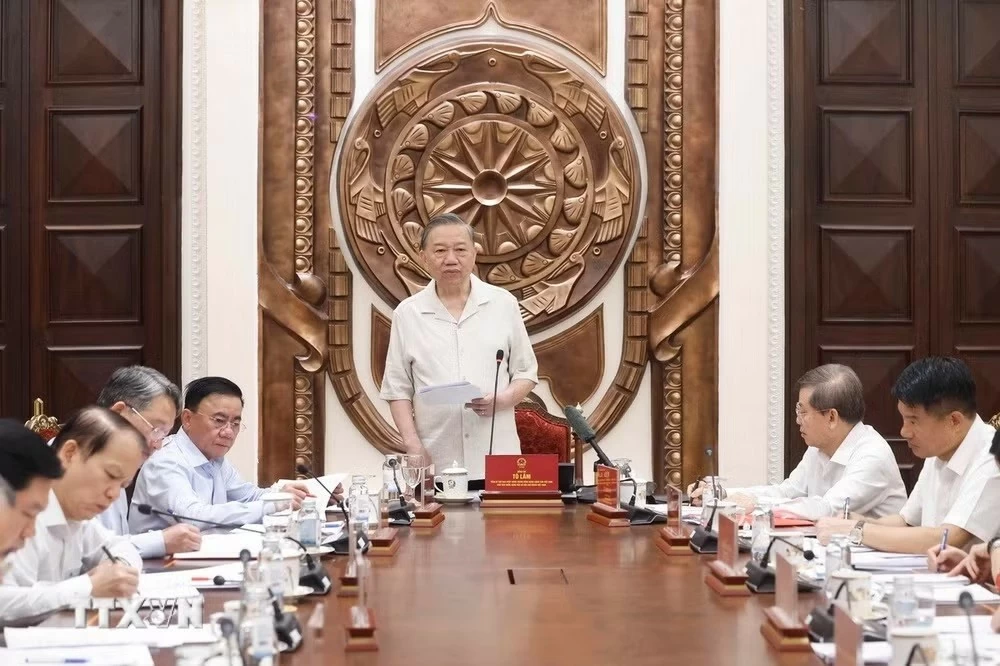 |
| General Secretary, President To Lam delivering directives. (Source: VNA) |
On the morning of May 13, in Hanoi, General Secretary, President To Lam chaired a working session with several ministries, departments, and agencies regarding the organization and operation of the Central Steering Committee on Institutional and Legal Perfection and the Central Steering Committee on Judicial Reform.
Also in attendance were comrades: Tran Cam Tu, Politburo Member, Standing Member of the Secretariat; Le Minh Tri, Politburo Member, Secretary of the Party Central Committee, Head of the Party Central Committee's Internal Affairs Commission; along with members of the Party Central Committee, leaders of several central ministries, departments, and agencies.
After listening to reports and opinions expressed at the session, General Secretary, President To Lam emphasized that the perfection of legal institutions and judicial reform are organically related and closely connected. There needs to be a central directive body to ensure that the processes of law-making, law enforcement, and judicial reform are unified, synchronized, interconnected, and effective.
The consolidation of the two Steering Committees is necessary, reducing the number of focal points without reducing tasks, clarifying responsibilities, products, and outcomes.
After consolidation, the name will be the Central Steering Committee on Institutional and Legal Perfection and Enforcement; with the General Secretary, President serving as the Head.
General Secretary, President To Lam clarified that the consolidation is not merely a mechanical arrangement but fundamentally a reorganization of the central leadership and directive mechanism concerning the task of building and perfecting the socialist rule of law state in Vietnam, with two very important axes being the perfection of legal institutions and law enforcement.
Perfecting legal institutions is not just about legislative techniques but also about organizing enforcement, controlling power, protecting justice, safeguarding human rights and citizens' rights, and creating a stable, transparent, and safe legal environment for development.
General Secretary, President To Lam stressed that the new Steering Committee must be a leadership, directive, coordination, urging, inspection, and strategic oversight institution; it should not replace the National Assembly in legislation, the Government in state management, or authorized state agencies; it should focus on policies, strategic orientations, major projects, and contents that need to be reported to the Central Committee, the Politburo, the Secretariat, coordinating to resolve bottlenecks, intersectoral issues, inspecting, supervising, urging, and handling political responsibilities according to authority.
The Steering Committee must have a standing agency with strategic advisory capacity, experience to coordinate intersectorally and monitor, urge, and inspect complex tasks related to legislation, executive, judiciary, internal affairs, anti-corruption, law enforcement, propaganda, legal introduction, and judicial reform; there needs to be a strong intersectoral task force, not only performing administrative tasks and summarizing meetings but also being a policy advisory unit with legal, internal affairs, judicial, state management, law enforcement, inspection, supervision, and digital transformation capabilities.
The new Steering Committee needs to review the entire program, plan, conclusions, files, data, and ongoing tasks of the two Steering Committees, classify tasks to report to the Politburo, the Secretariat for directive implementation, ensuring no disruption in activities; it must establish criteria for evaluating results through specific products.
The General Secretary, President proposed clearly defining the position and function of the Central Internal Affairs Commission and the Ministry of Justice; simultaneously, establishing a coordination regulation between the Party Committee of the Ministry of Justice and the Central Internal Affairs Commission, specifying clearly the responsibilities, tasks of each agency, and the coordination mechanism between the two; continuing to perfect the organizational structure of the Steering Committee.
The General Secretary, President demanded that the new Steering Committee must achieve substantial transformation, demonstrated through resolving major legal bottlenecks, addressing intersectoral issues, enhancing the quality of law-making, the effectiveness of law enforcement, improving the quality of judicial activities, preventing wrongful convictions, protecting justice, reducing compliance costs, improving the investment and business environment, and enhancing access to justice for citizens and businesses.
The General Secretary, President assigned the Party Committee of the Ministry of Justice to preside, coordinate with the Party Central Committee's Internal Affairs Commission to fully absorb the opinions from the meeting, and complete the submission to report to the Politburo.