




East Sea conference calls for stronger rules, cooperation to maintain regional stability
The 18th international conference on the East Sea/South China Sea: "Contestation, Connectivity and Cooperation: The South China Sea and the Regional Maritime Order" concluded in Ha Noi on October 8, with experts stressing the need to strengthen international law, crisis-management mechanisms and practical cooperation to maintain peace and stability in the strategically important waterway.
Latest
The conference focused on discussing issues shaping the security, maritime, and cooperation environment in the East Sea, notably managing disputes while maintaining regulations and crisis control mechanisms; protecting connectivity, freedom of navigation, and infrastructure resilience; substantive and specific cooperation to promptly meet common needs; building and strengthening an inclusive and stable maritime order in the region based on international law and the shared responsibility of countries in the area.
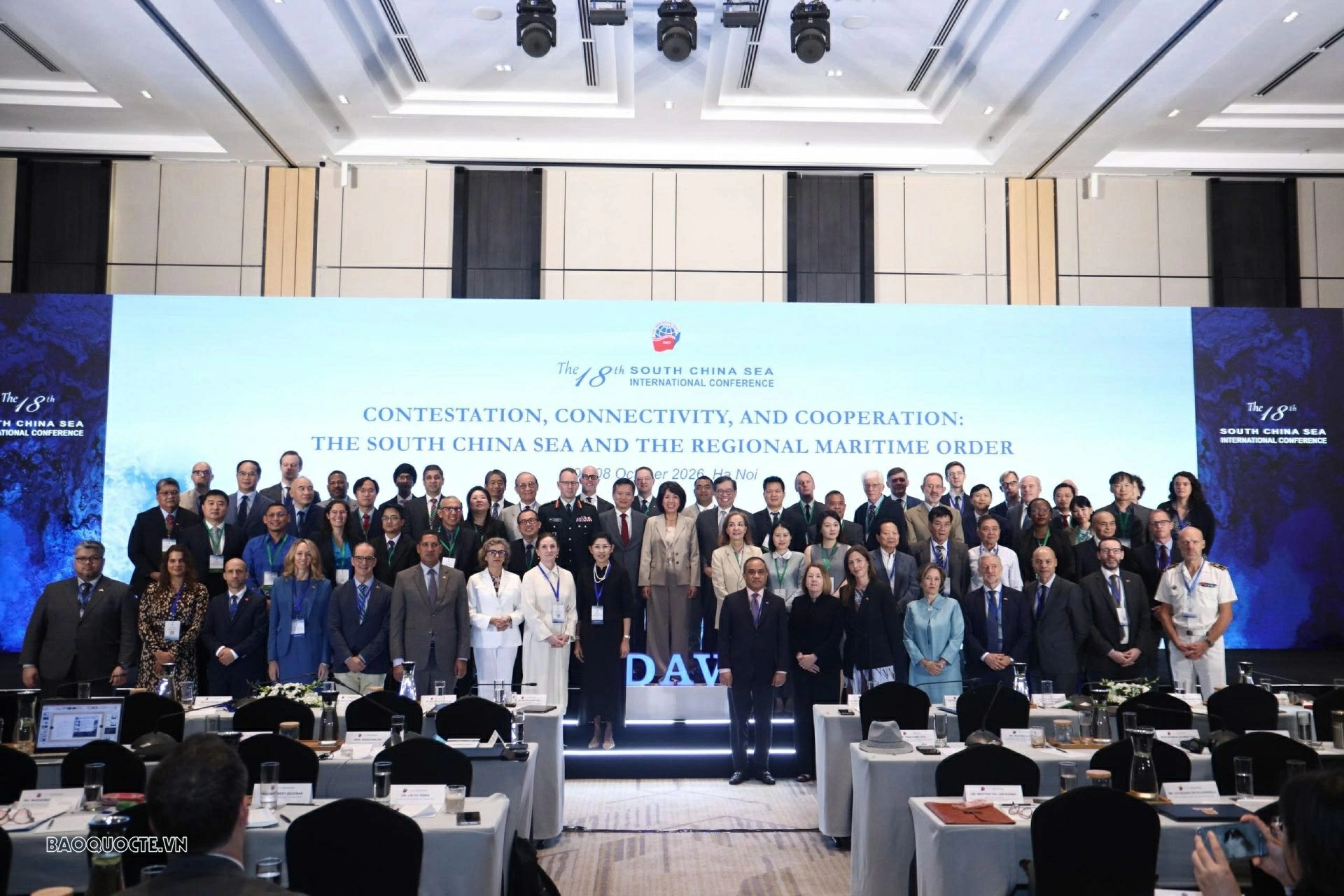 |
| The 18th East Sea Conference themed: Contestation, Connectivity and Cooperation: The South China Sea and the Regional Maritime Order. (Photo: Thanh Long) |
Speaking at the Closing Session, Dr. Nguyen Hung Son, Director of the Diplomatic Academy, distilled the overarching message from the discussions: The future of peace and stability in the East Sea does not lie in the immediate resolution of disputes but in the need for countries to build a system of regulations, ensuring predictability, resilience, and promoting substantive cooperation.
Managing disputes alongside maintaining regulations and crisis control
Most speakers at the conference assessed that although no major conflict has occurred, the East Sea is facing long-term strategic competition. Gray zone activities gradually alter the situation on the ground and erode trust among parties.
Therefore, controlling behaviors that could escalate tensions while seeking peaceful solutions to disputes becomes an urgent requirement.
Speakers suggested that managing competition requires reliance on international law, particularly the United Nations Convention on the Law of the Sea (UNCLOS), enhancing dialogue, and building appropriate management mechanisms. New proposals include establishing a Code for Unplanned Encounters at Sea (CUES) for coast guards, enhancing Maritime Domain Awareness (MDA), setting up hotlines, and sharing information. Experts hope ASEAN countries and China will achieve a substantive, effective, and efficient Code of Conduct (COC) in the East Sea, consistent with international law and UNCLOS, clearly defining obligations and dangerous behaviors.
However, experts believe that the entire burden of managing tensions should not be placed on a single mechanism like the COC.
Many discussions acknowledged that major power competition will continue, but parties still have a common interest in avoiding hot conflicts and maintaining strategic stability. Major countries need to take greater responsibility in self-restraint and avoiding changes to the status quo through coercion.
Protecting connectivity, freedom of navigation, and infrastructure resilience
Discussions at the conference indicated that stability in the East Sea should be viewed within an inclusive space, interconnected with many strategic maritime routes like the Hormuz and Malacca Straits, as disruptions at one point can affect the entire network. Protecting connectivity requires a cross-regional approach, maintaining safe and uninterrupted maritime routes, and preparing crisis response mechanisms and scenarios.
Enhancing resilience is a measure to ensure connectivity. On this topic, many scholars have made valuable proposals: Diversifying supply sources, developing alternative energy sources and transport routes; strengthening reserve capacity; enhancing infrastructure capability; and applying modern technology for operational monitoring. For essential infrastructure like submarine cables, it is necessary to diversify cable routes, clarify the roles of entities in ensuring the security and resilience of submarine cables.
Experience from many places shows that self-reliance and cooperation among countries, international and regional organizations, and between public and private sectors play a crucial role in enhancing the resilience of undersea cable routes.
Substantive cooperation, promptly addressing common needs
Many discussions suggested that for regional cooperation to be substantive, parties can promote priorities in areas that meet common needs and overlapping interests such as search and rescue, fishermen's safety, disaster response, submarine cable protection, marine scientific research, fisheries management, environmental protection, information sharing, infrastructure protection, human resource training, and enhancing maritime law enforcement capacity.
Science and technology play a role as a resource to promote future cooperation. However, the application of new technology needs to operate in accordance with international law, based on mechanisms ensuring transparency, data reliability, and national data sovereignty protection.
It is necessary to prioritize enhancing the effectiveness of existing mechanisms rather than focusing on building new ones. Cooperation can develop step by step, from individual initiatives to processes, standards, and common capabilities that can be maintained long-term.
Fisheries cooperation between Vietnam and China in the Gulf of Tonkin was highlighted by experts at the conference as a good practice in combining law, policy, and technology. Similarly, cooperation between Vietnam and the Philippines through signing memorandums of understanding and implementing specific coordinated activities, including supporting fishermen, is a noteworthy experience.
Notably, there is a proposal suggesting that ASEAN should gradually institutionalize feasible cooperation areas such as strategic infrastructure and submarine cables.
Building and strengthening an inclusive, stable maritime order in the East Sea
Discussions at the Conference recognized the East Sea as a common interconnected space. It is a region with many complex disputes but also an essential link in the regional trade, energy, data, and ecosystem network.
To ensure a stable, inclusive regional order, comprehensive measures are needed, adhering to international law, with UNCLOS as the foundational framework; ASEAN and ASEAN-led mechanisms like ARF, ADMM need to further promote their central role. ASEAN should be more proactive in building trust, protecting common interests, establishing norms, and connecting between parties and with multilateral, bilateral, and mini-lateral mechanisms.
Mechanisms should complement each other, enhance information sharing, and avoid fragmentation or exclusion. An inclusive order should ensure that medium and small countries can participate in shaping norms, protecting legitimate interests, and enhancing response capabilities. Changes in maritime safety, infrastructure resilience, and community benefits will be the measure of regional cooperation effectiveness.
On the sidelines of the Conference, there were also the Southeast Asia Dialogue, Southeast Asia-Pacific Dialogue, Young Leaders Program, and the Annual East Sea Report. These activities contribute to promoting dialogue, research, and policy exchange on maritime issues.
This year's conference continued to focus on the next generation. The Young Leaders session aimed to listen to proposals and initiatives from young speakers from various countries worldwide to strengthen regional maritime order and promote substantive cooperation even amidst disagreements and strategic competition.