



33rd Diplomatic Conference: Greater diplomatic flexibility requires a stronger political foundation
WVR - On the morning of August 7, in Hanoi, within the framework of the 33rd Diplomatic Conference, the Ministry of Foreign Affairs organized a session on Party work and political work in the diplomatic sector in the new situation.
Latest
Attending the session were Member of the Party Central Committee, Standing Deputy Secretary of the Party Committee, Deputy Minister of Foreign Affairs Nguyen Manh Cuong; Members of the Party Committee's Standing Committee of the Ministry; Members of the Executive Committee, Secretaries of various Party levels, Heads of units within the Ministry; Heads of Vietnamese Representative Missions abroad; along with representatives from the Party Central Committees, ministries, sectors, and advisory bodies of the Party Committee of the Government.
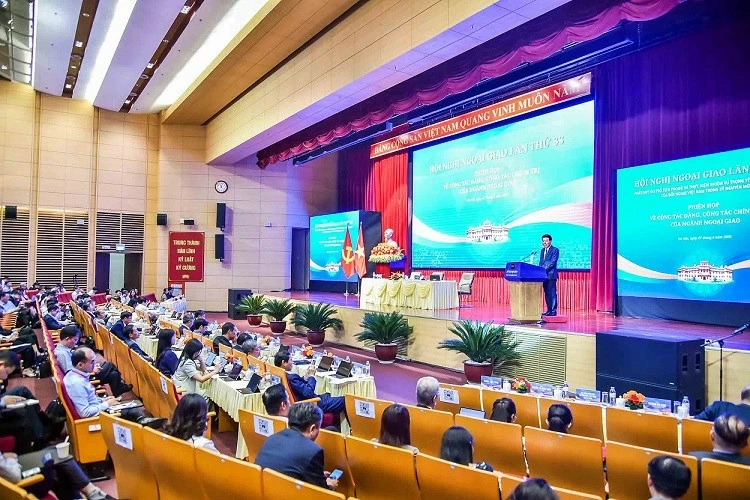 |
| Delegates attending the session at the Headquarters of the Ministry of Foreign Affairs. (Photo: Quang Hoa) |
Party work - The foundation for effective foreign affairs
In his opening remarks,Member of the Party Central Committee, Standing Deputy Secretary of the Party Committee, Deputy Minister of Foreign Affairs Nguyen Manh Cuong quoted General Secretary and President To Lam: “A good diplomat must first have a strong political will, always taking national interests as the guiding principle for action.”
From there, he emphasised: “If political will is the first condition for those in diplomacy, then Party work and political work—where that will is honed—do not stand apart from foreign affairs; they are the foundation for effective foreign affairs.”
The 14th National Party Congress identified foreign affairs and international integration as pioneering roles, alongside national defence and security, in carrying out the crucial and regular tasks of the country. “If the task is crucial and regular, then Party work and political work ensuring that task must also be crucial and regular, and thus cannot be done sporadically or occasionally,” the Standing Deputy Secretary of the Party Committee emphasised.
Analysing the specifics of the sector, he noted that diplomatic officers are trained to adapt and be flexible where rigidity would lead to failure. However, without a strong political foundation, this very ability becomes a risk: the line between flexibility in strategy and wavering in stance is often thin, and most of the time, each officer must recognise it themselves.
He also reiterated the words of General Secretary and President To Lam at the Opening Session of the Conference: each officer engaged in foreign affairs must always remember that behind them are the Party, the country, and the People.
“Flexibility is a professional requirement. Steadfastness is a political requirement. The more flexible diplomacy becomes, the stronger the political foundation must be,” he emphasised, while affirming that the heads of agencies and units in the sector must fulfill the “dual responsibility” of being both a Commander—specialized leader—and a Political Commissar—leader of Party work and political work.
| “The effectiveness of Party work is measured by the effectiveness of political tasks; for the diplomatic sector, it is the effectiveness of foreign affairs and the national position,” Member of the Party Central Committee, Standing Deputy Secretary of the Party Committee, Deputy Minister of Foreign Affairs Nguyen Manh Cuong. |
Assessing recent results, he noted that where Party work is implemented substantively, political tasks achieve higher effectiveness, and organizations are more united and stable; thus, he proposed shifting the focus of Party work from merely ensuring processes to creating substantive transformations.
To realize this orientation, he emphasised six key task groups, including: building the model of a Party member in the diplomatic sector in the new era; strengthening political and ideological work for foreign affairs officers; enhancing the effectiveness of grassroots Party organizations; tightening discipline and order; promoting the exemplary responsibility of leaders; and perfecting the institutions and regulations of Party work.
In this, he stated: “Protecting internal politics in the diplomatic sector starts with ensuring no Party member is left alone” and urged delegates to focus on discussing three major issues: innovating political and ideological work for foreign affairs officers; enhancing the leadership capacity of Party organizations linked to executing political tasks; and building ethical standards and qualities of Party members in the diplomatic sector in the new era.
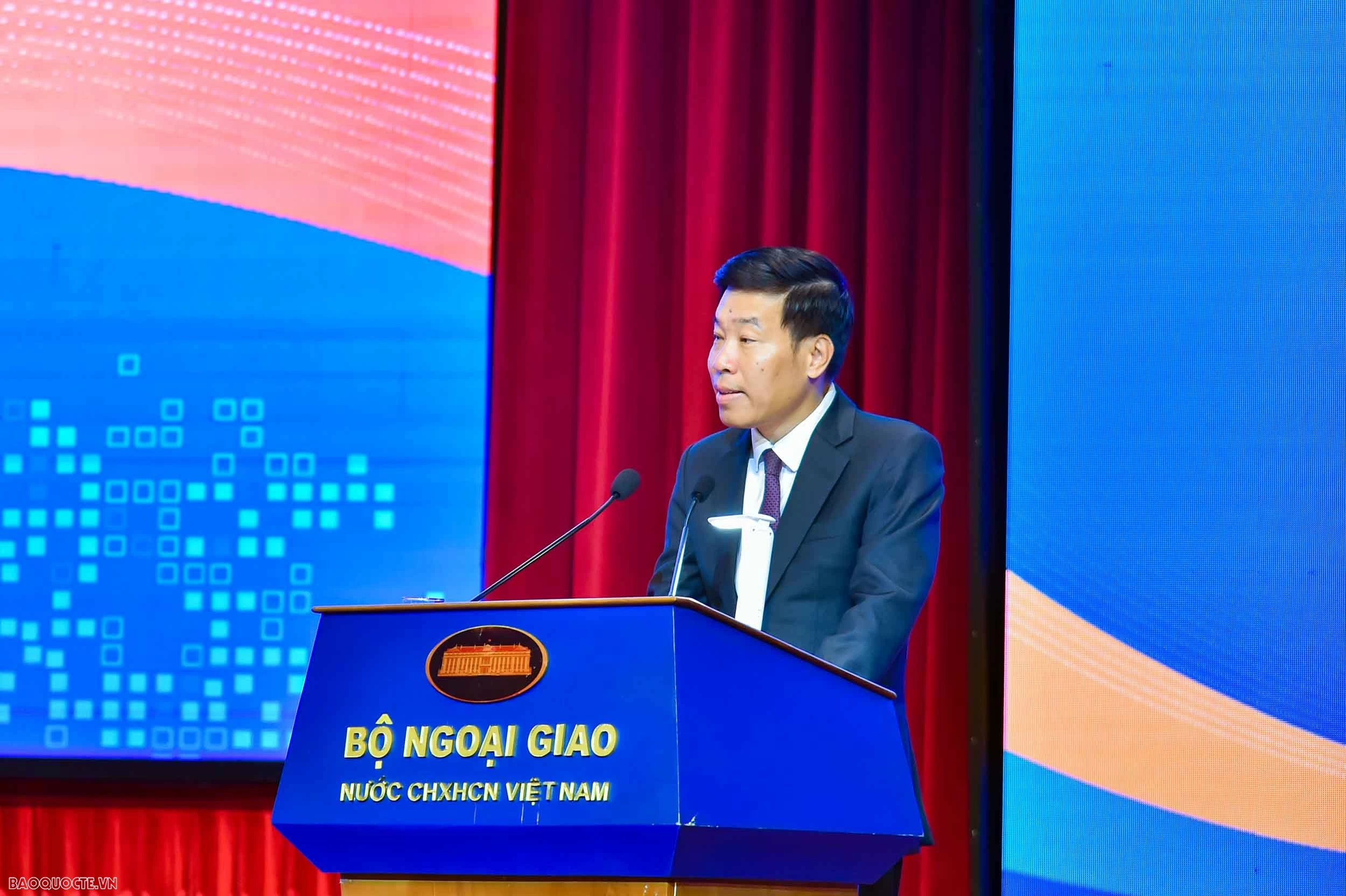 |
| Member of the Party Central Committee, Standing Deputy Secretary of the Party Committee, Deputy Minister of Foreign Affairs Nguyen Manh Cuong speaking at the session. (Photo: Quang Hoa) |
Building the Party is a condition for enhancing the quality, effectiveness, and will of foreign affairs
The session featured 14 presentations and candid, responsible opinions, directly addressing difficulties and obstacles and proposing many feasible solutions. The opinions focused on protecting internal politics; inspection and supervision; political and ideological work; building a strategic-level cadre team; and public service ethics, discipline, and order.
Representatives from the Party Central Committee's Organization Commission emphasised the need to strengthen the protection of internal politics for officials and Party members engaged in foreign affairs; learning content and dissemination must be tailored to the specifics of each unit, along with improving the quality of strategic research and forecasting. The Standing Deputy Chairman of the Government Party Committee's Inspection Committee suggested innovating inspection and supervision methods towards being proactive, regular, focusing on prevention, and early detection of violations, especially in the context of complex and unpredictable global developments.
Many Party Secretaries and unit heads noted from practical work that political and ideological work must lead, pave the way in forecasting, orienting awareness, and unifying actions; closely combining “building” and “fighting,” and promoting the application of science and technology.
Some opinions emphasised that each officer must always uphold the spirit of serving the community, starting with practical actions such as enhancing visual communication about Party resolutions and organizing community bonding activities. Delegates also shared many effective models and methods and proposed solutions to enhance the quality of Party work and political work across the sector.
Authorized by Politburo member, Secretary of the Party Committee, Minister of Foreign Affairs Le Hoai Trung, Standing Deputy Secretary of the Party Committee Nguyen Manh Cuong concluded the session. He expressed thanks for the presentations and opinions of the delegates, considering them important practical experiences from the grassroots for the Party Committee of the Ministry to absorb and perfect policies and solutions across the sector.
He summarized the discussion content into eight groups of issues, highlighting four major orientations.
Firstly, Party work and political work are foundational guarantees for the diplomatic sector to successfully complete political tasks, and must take the lead in unifying awareness and organizing the implementation of foreign policy.
Secondly, strongly innovate political and ideological work in line with the specifics of the sector.
Thirdly, enhance the capacity to implement political tasks of Party organizations and the cadre team, linking planning, training, and fostering with practical diplomatic work, focusing on strategic advisory capacity and forecasting.
Fourthly, innovate the evaluation of Party organizations, using the results of political tasks, the quality of the cadre team, and the reputation of Party organizations as the main criteria; build an index system towards quantification, closely following Central guidance, without creating additional procedures for the grassroots.
From there, he proposed three specific tasks that the advisory bodies of the Party Committee of the Ministry need to lead and implement immediately in the fourth quarter of this year: developing a specialized resolution of the Party Committee's Standing Committee on political and ideological work of the sector in the new situation; implementing solutions to enhance the leadership capacity of Party organizations and the quality of Party members; building an index system to evaluate Party work of subordinate Party committees, ensuring quantification and alignment with Central guidance.
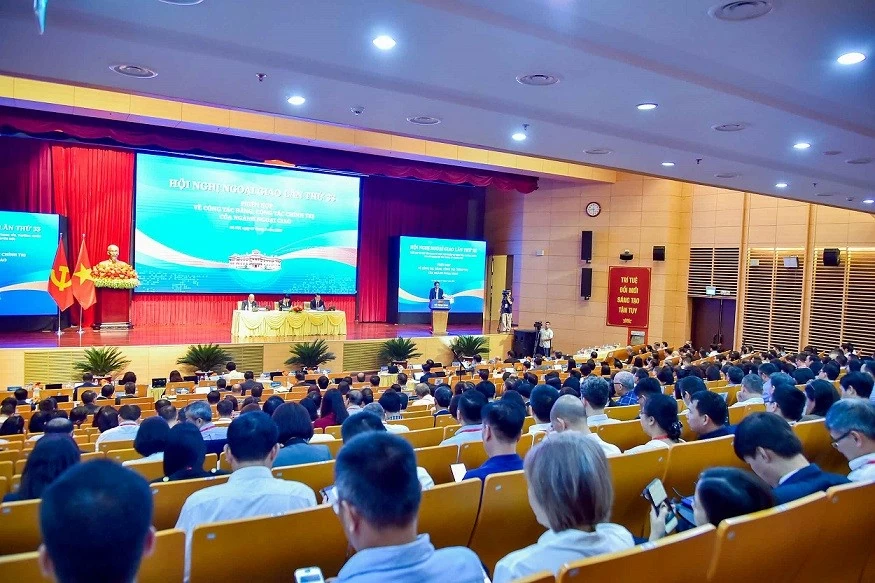 |
| Overview of the session. (Photo: Quang Hoa) |
Through the presentations and exchange of opinions, the session reached a consensus on an important understanding: building the Party is not only a requirement for foreign affairs work but is a condition for enhancing the quality, effectiveness, and will of foreign affairs. This consensus in understanding only truly holds significance when it is transformed into specific changes at each Party committee, each cell, and each cadre and Party member.
“I believe that with the tradition of eight decades of accompanying the nation, with the courage, intelligence, and pioneering spirit of the cadre and Party member team, the Party Committee of the Ministry of Foreign Affairs and the entire diplomatic sector will achieve this, continuing to maintain the pioneering role on the foreign affairs front in the new era of development,” emphasised Member of the Party Central Committee, Standing Deputy Secretary of the Party Committee, Deputy Minister of Foreign Affairs Nguyen Manh Cuong.


