


Draft Documents for the 14th National Party Congress: Report on new and important issues
WVR/VNA -On October 21, under the direction of General Secretary To Lam, Head of the Subcommittee on Documents, the Drafting Team for the Documents of the 14th National Party Congress released the "Report on new and important issues in the Draft Documents to be submitted to the 14th National Party Congress” as reference material for officials, Party members, and citizens during the process of discussing and contributing opinions to the Draft Documents.
Latest
On October 15, 2025, the 13th Party Central Committee released the full text of the Draft Documents to be submitted to the 14th National Congress of the Party, seeking feedback from National Assembly deputies, the Vietnam Fatherland Front, political–social organizations, mass organizations, officials, Party members, and the general public.
The period for collecting public feedback is from October 15, 2025, to November 15, 2025.
According to the Report on new and important issues, the Draft Documents for the 14th National Party Congress objectively assessing the situation, and based on that, proposing guiding viewpoints, development goals, key directions, tasks, and breakthrough solutions for rapid and sustainable national development, embodying the strong aspiration of the entire nation in the new era.
This Report is constructed to highlight new and important issues in the Draft Documents for the 14th National Party Congress, thereby assisting officials, party members, and the public in researching and correctly understanding the spirit of the Draft Documents, effectively contributing to the discussion and completion of the documents, while also spreading the spirit of innovation, development aspiration, and determination to build a prosperous, civilized, and happy country, steadily advancing towards socialism.
I. New Points on the Theme and Structure of the Draft Document
1. On the theme of the Congress
The theme of the 14th National Party Congress is: Under the glorious flag of the Party, unite and strive to successfully realise the national development goals by 2030; strategic autonomy, self-reliance, confidence, advancing strongly in the era of national rise, for peace, independence, democracy, prosperity, civilization, happiness, and steadily progressing towards socialism.
The theme is determined on the basis of following key foundation and requirements:
(1) The Congress theme must reflect the position and role of the 14th National Party Congress as a turning point, a particularly important milestone on the path of national development. The Congress takes place at a time when the entire Party, people, and military are striving to successfully implement the goals, policies, and tasks identified in the Resolution of the 13th National Party Congress; associated with summarizing 40 years of Doi Moi (renewal).
The Congress has the task of reviewing the implementation of the Resolution of the 13th National Party Congress, providing a comprehensive evaluation of the renewal process, deciding on the goals, directions, and tasks for the next 5 and 10 years, and the vision to 2045.
In the context of rapid, complex, and unpredictable global and regional developments; the country faces many opportunities and challenges, and many new issues need to be addressed. Officials, party members, and the public have high expectations for the 14th National Party Congress with the Party's correct and strong decisions to propel the country forward in the new era.
(2) The Congress theme must be a message that inspires, encourages, and directs the entire Party, people, and military to continue comprehensively, synchronously, and extensively promoting the renewal process, seizing every opportunity, determined to overcome all difficulties and challenges, maintaining strategic autonomy, self-reliance, confidence, advancing strongly in the new era - the era of national growth; successfully achieving the national development goals by 2030 when our Party celebrates its 100th anniversary (1930-2030); towards realizing the vision to 2045, commemorating the 100th anniversary of the founding of the Socialist Republic of Vietnam (1945-2045).
(3) The Congress theme must be concise, reflecting the overall goal, core ideological content, clear key components, including: The leadership of the Party; the role of the people and the strength of the entire nation; the continued renewal process and the national development goals in the new era; inheriting and developing the theme in previous Congresses, especially the 13th National Party Congress.
2. On the structure of the Political Report
New element in this Political Report is the integration of content from three documents, including: the Political Report, the Socio-Economic Report, and the Party Building Summary Report. This integration reflects the spirit of continuing innovation in document construction, stemming from the new realities of the country, the development of theoretical understanding, and the Party's organizational implementation, ensuring consistency in content; concise, succinct, easy to understand, remember, and implement.
The structure and presentation of the Political Report inherit and develop as follows:
- The Political Report of the 14th National Party Congress adopts the structure and presentation of document content by issue, similar to recent Congresses, with 15 issues. The structure and names of the issues are arranged, adjusted, and supplemented to suit the realities and development requirements, accurately reflecting the realities and clearly defining the goals, tasks of national development for the 14th Party Congress term and the vision to 2045, clearly conveying revolutionary, actionable, and highly feasible messages; comprehensive yet focused.
- The overall and consistent new content in the Political Report emphasizes viewpoints, goals, orientations, development methods, new resources, and development drivers, including: (1) Establishing a new growth model driven by science and technology, innovation, and digital transformation as the main drivers; identifying this as the central content of the national development model; developing the private economy as a crucial driver of the economy; developing high-quality human resources and effectively leveraging the advantages of deep international integration. (2) Affirming the key role of Party building and rectification; anti-corruption, waste, negativity, combating individualism, group interests, ideological, political, moral, and lifestyle degradation; strengthening power control; enhancing the Party's leadership, ruling capacity, and fighting strength; improving national development governance capacity and the operation of the political system's organizational apparatus, laying the foundation for maintaining unity and consensus within the Party, people, and military, as well as ensuring consensus, synchronization, and unity in formulating and implementing national development strategies.
- The most notable new feature lies in the design of the Draft Political Report for the 14th National Party Congress, which, for the first time, includes the Action Program for implementing the Congress Resolution of the 14th Party Central Committee as an integral part of the Draft Report.
The Action Program specifies specific programs, projects, and tasks to be implemented in the 5-year term, clearly assigning responsibilities to Party Committees from the Central to local levels, specifying progress, resources, and necessary conditions for implementation, serving as a basis for levels and sectors to implement according to their functions, tasks, and powers.
This policy aims to address the situation in which, after each National Congress, there is often a delay in concretizing the Congress Resolution—typically during the first half of the term. It emphasizes prompt action, concretization, and effective implementation of the 14th National Party Congress Resolution even before the Congress convenes; proactively reviewing, amending, and promptly removing bottlenecks; and overcoming limitations, shortcomings, and inconsistencies. The policy also stresses the need to closely follow the goals, guiding viewpoints, development orientations, key tasks, and strategic breakthroughs to ensure effective implementation immediately after the Congress.
II. New and important Issues in the Draft Political Report for the 14th National Party Congress
1. The Draft Political Report for the 14th National Party Congress marks a leap in development thinking by distilling and updating viewpoints, goals, tasks, and strategic breakthrough decisions in the Resolutions of the Politburo issued from late 2024 to the present, resolutions that serve as "levers" for immediate implementation before and after the Congress
Based on the Draft Documents for the 14th National Party Congress, the Politburo has directed the issuance of new Resolutions that are important strategic decisions serving as a basis, motivation, and breakthrough for rapid and sustainable national development in the era of national rise and are continuously distilled, updated, and developed in the Draft Political Report to:
(1) Institutionalize the Party’s guidelines and policies, improve the legal system, and build a solid legal and institutional framework to ensure transparency for all policy decisions. (2) Continue to take proactive and active steps to promote comprehensive international integration—not only to enhance Vietnam’s external standing but also to mobilize global resources, safeguard national interests, and expand markets for innovation. (3) Activate a breakthrough strategy for the development of science, technology, innovation, and national digital transformation as the main driving force; establish new value chains associated with innovation, digital transformation, green transition, energy transition, and the transformation of human resource structure and quality, with a focus on developing artificial intelligence.
4) Identify the private sector as a key driving force of the economy; promote entrepreneurship and the strong development of various types of private economic models; effectively leverage capital, land, and technology resources to generate multidimensional momentum for dynamic, flexible, and sustainable growth. (5) Continue implementing the national energy transition policy aimed at achieving a balance between traditional and renewable energy sources; develop smart grid systems and ensure energy security to serve national development in the new context. (6) Focus on restructuring and improving the quality of human resources, with emphasis on developing a modern, open, and globally integrated national education system. Introduce priority and special policies to comprehensively renew national education; strengthen the connection between research, training, and labor market development—both domestically and internationally—to train high-quality human resources capable of meeting the rapid demands of the Fourth Industrial Revolution. (7) Implement policies on universal healthcare and improving the well-being and happiness of the people, with particular focus on ensuring a strong grassroots healthcare network, proactive preventive medicine, and the application of digital technology in healthcare management so that every citizen has access to quality health services.
The logical connection from the institutional framework to economic, technological, modern governance, and human development has created a fast, sustainable development ecosystem, not only outlining the roadmap but also mobilizing the comprehensive strength of the entire society, realizing the aspiration for national development by 2045.
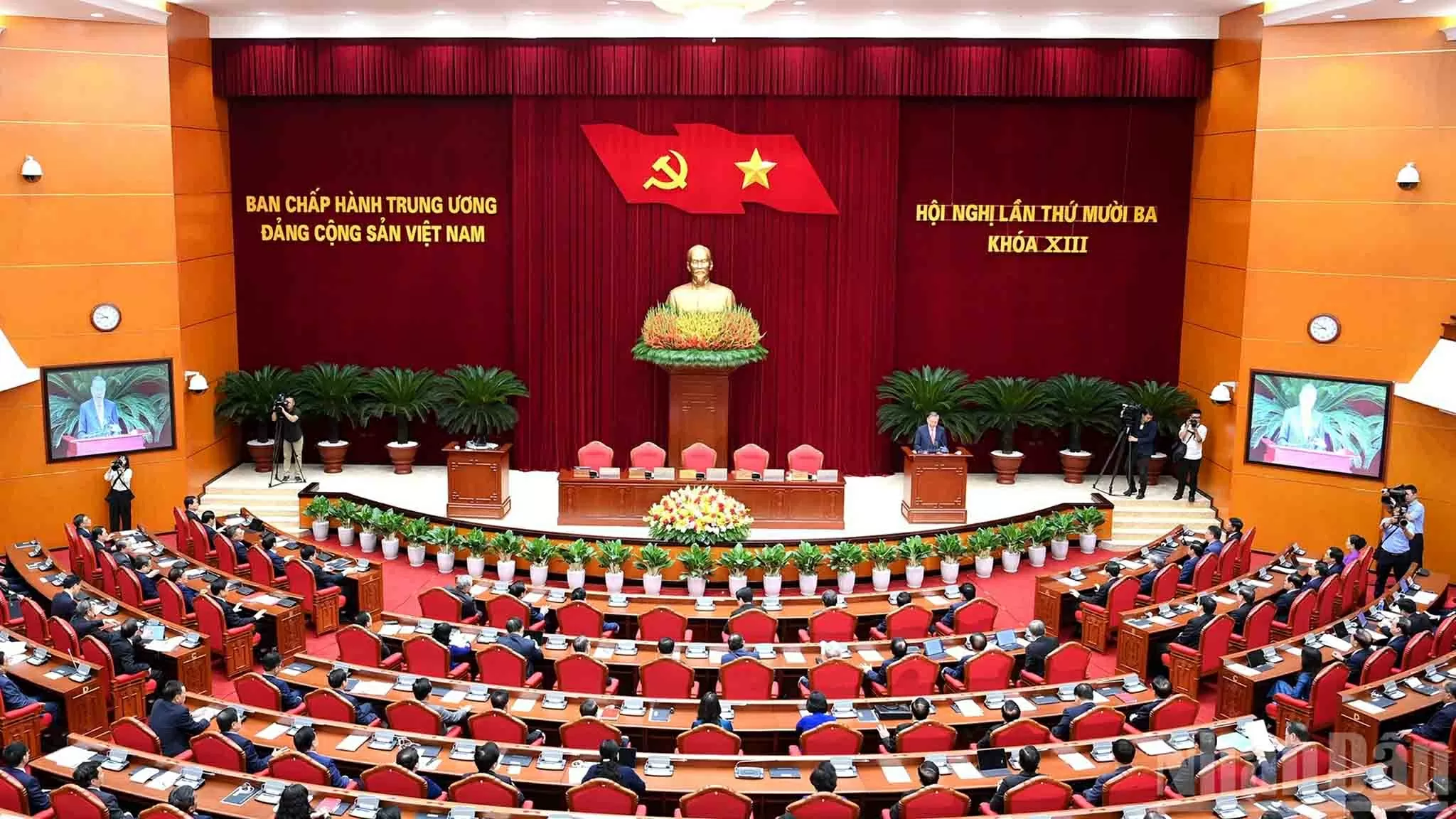 |
| The closing session of the 13th Plenum of the 13th Central Committee of the Communist Party of Vietnam. (Source: Nhan Dan Newspaper) |
2. Clearly evaluated the outcomes of implementation, lessons on organization, overcoming the inherent weakness of many terms that "implementation is still a weak link"
The summary of this term has clearly and comprehensively identified the important, outstanding results achieved, especially the strategic breakthroughs at the end of the term. The most prominent is the reorganization of the organizational apparatus and the construction of a two-level local government model - a historic, revolutionary decision that helps streamline the apparatus, clarify responsibilities, expand development space, and enhance governance and administration effectiveness from the province to the grassroots.
The implementation process has clearly shown the correct leadership and direction of the Party, the decisive involvement of the entire political system associated with regular urging, inspection, and supervision, which is crucial, especially the need to clearly assign people, tasks, responsibilities, progress, results, and have a regular supervision mechanism. As a result, the mentality of "formal achievements" has been pushed back, replaced by a spirit of focusing on real results, "running" while "lining up" on time and effectively.
An important lesson learned about organization is: The principle of "focus, openness, responsibility" must be thoroughly grasped right from the project construction stage; at the same time, flexibly and skillfully combining disciplinary measures with encouraging creativity. Continuous inspection and evaluation mechanisms have contributed to genuinely overcoming the inherent weakness that "implementation is still a weak link".
These experiences not only consolidate confidence in the strong renewal capability of the political system but also lay a solid foundation for new development steps in the upcoming term.
3. Supplementing "Theory on the Renewal path" as an integral component of the Party's ideological foundation
The first guiding viewpoint in the Draft Political Report states: "Steadfastly and creatively applying and developing Marxism-Leninism, Ho Chi Minh's thought, the theory on the renovation path". With this viewpoint, for the first time, our Party has identified "theory on the renovation path" as a component of the Party's ideological foundation.
Adding "theory on the renovation path" to the Party's ideological foundation is a historically significant development, reflecting maturity in theoretical thinking, practical summary capability, and the Party's self-renewal courage; showing that the Party is not dogmatic, not rigid, but always knows how to inherit, supplement, and creatively develop, linking theory with practice, enriching the treasure of revolutionary theory - thought of Vietnam.
The theory on the renovation path is the application and creative development, concretization of the principles, universal principles of Marxism-Leninism, and Ho Chi Minh's thought suitable to the reality of 40 years of renovation in Vietnam, reflecting the unity between theory and practice, between the goal of national independence and socialism, the Party's fundamental theoretical breakthrough on developing a socialist-oriented market economy and promoting deep international integration.
The theory on the renovation path is a comprehensive set of viewpoints, visions, development orientations for the country, and firmly protecting the socialist Republic of Vietnam; the people are the center, the subject; steadfast in the goal of national independence and socialism; establishing the model of Vietnamese socialism with three foundational pillars: A socialist-oriented market economy; the socialist rule-of-law state of the people, by the people, and for the people under the leadership of the Communist Party of Vietnam; socialist democracy; successfully building a peaceful, independent, democratic, prosperous, civilized, and happy socialist Vietnam.
Accordingly, the theory on the renovation path becomes a component of the ideological foundation, continuing to guide the country's development in the new era of the nation.
Adding "theory on the renovation path" to the Party's ideological foundation is also evidence of the vitality of Marxism-Leninism, Ho Chi Minh's thought in new conditions, while affirming the comprehensive, wise leadership role of the Party steadfast on the socialist path, while opening up dynamic, creative development possibilities, suitable to the country's reality and the trend of the times; it is the torch guiding us to successfully realize aspirations, visions, and strategic orientations, creating new development miracles in the era of national resurgence.
4. Adding "environmental protection" along with economic and social development as a "central" task
The second guiding viewpoint in the Draft Political Report states: "Economic, social development, and environmental protection are central...", thus the Party Central Committee unanimously adds "environmental protection" along with economic and social development as a "central" task.
Adding "environmental protection" along with economic and social development as a central task in the Draft Documents for the 14th National Party Congress marks a profound and solid development in understanding sustainable development based on three pillars: Economy, society, and environment. This is no longer a formal assertion but a strategic commitment, placing ecological environment as a measure in every development policy.
In the 1991 Platform and Resolutions from the 7th, 8th, to 13th National Party Congresses, environmental protection, and sustainable development were mentioned only in principle, while resource prioritization still focused on promoting economic development. The environment was often seen as a consequence to be addressed after promoting the economy, not identified as a central task in each step, in every development policy.
The fundamental new point here is that environmental protection has been identified as a pillar to establish a new growth model. This means not trading short-term benefits to ensure long-term benefits for the nation and future generations.
On the international level, Vietnam has committed to green economic development and carbon neutrality by 2050, creating both pressure and new opportunities for rapid, sustainable national development. The Draft Documents for the 14th National Party Congress demonstrate that Vietnam not only implements agreements but also attracts green capital, carbon credits, and clean technology; through energy transition, circular economy development, and promoting science and technology, innovation, and digital transformation.
The application of environmental cost pricing mechanisms, "ecological taxes", carbon credits, and a strict legal framework will create a strong lever for green investment by enterprises, while ensuring fair competition among economic sectors; affirming our pioneering role and responsibility to the global community.
In terms of institutions, the State has been and is perfecting environmental laws, strengthening inspection and strict handling of violations. Strong decentralization mechanisms help local governments proactively exploit sustainable resources, combined with mobilizing green finance through bonds, environmental protection funds, and public-private partnerships. Green enterprises are supported with tax incentives, preferential credit, and technology transfer to reduce costs. The intelligent monitoring system, big data, and artificial intelligence will support risk prediction and optimize resource use.
The circular economy promotes recycling, reducing emissions, and increasing production value... The biggest challenge to overcome is eliminating short-term development thinking, breaking psychological barriers, laying the groundwork for long-term action.
Emphasizing the role of digital transformation and the circular economy in environmental protection, training green human resources, promoting cooperation between research institutes and enterprises, along with a strong policy communication strategy to raise community awareness.
Social consensus and decisive political commitment will be the key to opening up breakthrough development directions for Vietnam in rapid and sustainable national development.
5. Adding "external relations, international integration" along with national defense and security as "crucial, regular" tasks
The second guiding viewpoint in the Draft Political Report states "... strengthening national defense, security, and promoting external relations, international integration are crucial, regular tasks". For the first time, the Central Committee has identified "foreign relations, international integration" on par with national defense and security as crucial, regular tasks, opening up a more comprehensive strategic framework for national protection, marking a renewal in the Party's strategic vision in the context of deep integration and increasingly fierce global geopolitical and economic competition.
From the 1991 Platform to the 13th National Party Congress, external relations have always been mentioned as one of the important tasks, but not identified as a crucial, regular task.
This draft clearly shows that external relations are the task of the entire political system, not just the foreign affairs sector, with diplomacy as the core. More importantly, this is about combining national strength with the strength of the times; internal resources are decisive with external resources being important; it is about partners, subjects... On the other hand, in the past term, foreign relations have been a very successful field for us in the context of rapidly changing, complex, unpredictable world.
General Secretary To Lam emphasized: Although peace, cooperation, and development remain major trends, the world situation is changing rapidly, complexly, impacting multidimensionally on our security and development environment. In this context, external relations tasks are no longer temporary but must be continuous, monitoring and coordinating policies according to each new development.
Establishing external relations, international integration as crucial, regular tasks allows enhancing the role of the Ministry of Foreign Affairs, foreign affairs agencies, and the provincial external relations system. The "three pillars" mechanism of Defense - Security - External Relations will promote inter-sectoral cooperation, strengthen specialized staff, build a team of experts on economic, cultural, technological, technical diplomacy... to proactively exploit opportunities, respond timely and effectively to challenges.
This guiding viewpoint is the basis for establishing diplomatic methods, such as: "economic diplomacy", "cultural diplomacy", "defense, security diplomacy", "technology diplomacy"... to attract capital, technology, international resources, and increase national soft power.
The diplomatic network will be digitized, leveraging big data to analyze, forecast, expand relations with multilateral organizations, economic blocs, while promoting the role of localities in boosting exports, attracting foreign investment, and promoting the national image.
In summary, adding external relations, international integration to the group of crucial, regular tasks not only changes thinking but is a strategic lever, making foreign relations, international integration a core tool of national security and sustainable development. This renewal affirms Vietnam's determination to be proactive, flexible, and comprehensive in leveraging soft power, enhancing its position on the international stage.
6. On continuing to build and improve a comprehensive, synchronous institutional framework for rapid, sustainable national development
The policy of continuing to build and improve a comprehensive, synchronous institutional framework for rapid, sustainable national development, in which "political institutions are key, economic institutions are central, other institutions are very important", is an inheritance and development of the institutional innovation thinking mentioned in recent Congress terms.
However, the important difference lies in three aspects: Overall, prioritized stratification, and transparency, rule of law, effective governance to create a foundation for building a rapid, sustainable national development institutional ecosystem.
Development institutions are a set of regulations, rules, processes, agencies, legal documents, implementation mechanisms, and governance culture interacting to create a favorable, smooth, safe, and effective operating environment. Unlike the fragmented view of each dimension, document, or individual law, the concept of development institutions emphasizes the interconnectedness, interdependence, and spillover effects between different institutional pillars.
First, the overall aspect is reflected in the view that perfecting institutions is not just about amending discrete laws but building a comprehensive set of pillars: Political, economic, legal, administrative, social, science - technology, and institutions ensuring human rights.
When viewing political institutions as key, it particularly emphasizes enhancing the role, leadership capacity, and innovating organizational methods, decision-making mechanisms, power control, and ensuring political stability of the Party, to create conditions for renewing other institutions. This is not just a technical solution but a renewal of the Party's leadership thinking towards modernity, transparency, adaptability, substantive and high efficiency.
Second, viewing economic institutions as central reflects a deep understanding that growth quality, efficiency, value-added, and competitiveness of the economy directly depend on the operation of market mechanisms, resource mobilization and allocation mechanisms, business environment, and sustainable macroeconomic policies.
Being central does not mean other institutions are neglected; on the contrary, it requires close integration between economic institutions and legal mechanisms, resource management, social security for rapid, sustainable development.
Third, emphasizing "other institutions are very important" shows that institutional innovation in education, healthcare, science - technology, environmental protection... and governance in other fields all contribute decisively to the strength, growth quality, and long-term competitive capacity.
This approach is a breakthrough compared to isolated development thinking, as it requires addressing institutional bottlenecks, knots from an interdisciplinary perspective, instead of isolated interventions that easily lead to unintended consequences.
Fourth, the policy of institutional renewal is always linked with decisive action requirements: Standardizing processes, making information transparent, clearly assigning responsibilities, and having supervision and evaluation mechanisms. This breakthrough also lies in promoting science and technology, innovation, digital transformation in governance, creating momentum for development in both the public and private sectors.
Fifth, this policy is a continuation, elevation of the renovation line with a breakthrough in implementation methods, largely depending on the capacity to institutionalize into legal documents, organize implementation, control mechanisms, and social consensus to successfully realize the goal of rapid, sustainable national development.
7.Establishing a new growth model, restructuring the economy, promoting industrialization, modernization; taking science and technology, innovation, and digital transformation as the main drivers to achieve the goal of an average GDP growth rate of 10%/year or more for the 2026-2030 period
The Draft Political Report for the 14th National Party Congress has set the goal of "striving to achieve an average GDP growth rate of 10%/year or more for the 2026-2030 period". It also clearly states: "Establishing a new growth model, restructuring the economy, promoting industrialization, modernization, taking science and technology, innovation, and digital transformation as the main drivers".
Establishing a new growth model for the 2026-2030 period with the goal of an average GDP of 10%/year is not only an aspiration but also a challenge to transform into a development opportunity. To realize the double-digit growth target, growth engines: Land, resources, labor, exports, domestic market, investment... and total factor productivity (TFP) must be mobilized synchronously under the framework of innovation, industrialization, modernization, and digital transformation.
The new point compared to previous periods is that on the current development foundation, especially at the end of the 13th National Party Congress term, the country has enough room to achieve a double-digit growth rate in the next term.
To achieve this, the following requirements must be met:
First, the investment-to-GDP ratio needs to exceed 40%. Previously, Vietnam maintained an investment level of about 30 - 35% of GDP, mainly focusing on traditional drivers. The new model requires increasing the scale of effective investment, expanding green financial channels, technology bonds, and venture capital innovation funds. However, the capital utilization coefficient (ICOR) must be maintained at about 4.5 - meaning 4.5 units of investment capital are needed to create 1 unit of additional GDP. To improve investment efficiency, project selection needs to be tightened, automation, digitalization of production processes, and strict project management applied...
Second, labor growth is expected to contribute 0.7% per year due to the slow decrease in the labor force. To achieve double-digit GDP growth, labor productivity must increase by 8.5%/year. This is a leap compared to the current 5-6%. To realize this, digital engineers, R&D experts, and high-tech project managers need to be trained; at the same time, a mechanism for linking training between institutes, schools, and enterprises needs to be established to bridge the skills gap.
Third, total factor productivity (TFP) must contribute over 5.6 percentage points in the growth structure. TFP reflects the efficiency of capital and labor use along with the impact of innovation. To increase TFP, Vietnam must build an innovative startup ecosystem, encourage enterprises to invest in R&D, strengthen global value chain links, and protect intellectual property rights. Digital transformation, artificial intelligence, big data, and the Internet of Things must become daily tools in enterprise management and development planning.
Fourth, restructuring the economy focuses on foundational industries, core industries, strategic industries, green industries, high-tech agriculture, quality services, and the digital economy. Each sector, each project must meet low emission standards and smart management from the design stage. The policy framework includes R&D tax incentives, preferential credit, venture capital funds, and administrative reform to shorten licensing time, serving as a "catalyst" for the new growth model.
In summary, the double-digit growth target for the 2026-2030 period will be feasible if investment is strong enough, labor is productive enough, and TFP is high enough, effectively exploiting both domestic and international markets. Success depends on policy synchronization, institutional capacity, and renewal determination. When the new growth model operates smoothly, Vietnam will not only achieve double-digit growth but also create a sustainable foundation for the next development phase.
8. Properly addressing the relationship between the State - market - society, affirming the decisive role of the market in mobilizing and allocating development resources
The Draft Political Report for the 14th National Party Congress emphasizes shaping the organic relationship between the State - market - society, while affirming the decisive role of the market in mobilizing and allocating resources for development.
This is not only a theoretical requirement but also an urgent practical demand in the process of perfecting the socialist-oriented market economy under the leadership of the Party. Effective coordination between the three subjects of the State, market, and society will enhance transparency, objectivity, and risk control, contributing to optimizing the overall resource allocation results of the economy.
The market functions to determine prices, mobilize, and allocate resources according to natural supply-demand signals. Thanks to the competitive mechanism, information becomes more transparent, entrepreneurial motivation is strongly stimulated; thereby social resources are concentrated in sectors and fields with high efficiency and effectiveness.
Affirming the decisive role of the market means ensuring the autonomy and responsibility of economic entities, while minimizing direct administrative intervention in the natural operation mechanism of prices, market, interests, and risks.
The State plays a role in creating and regulating the institutional, mechanism, policy, strategy, planning, and development plans in line with market principles and realities. Ensuring the construction of laws, issuing regulations for fair competition, controlling monopolies, protecting consumer rights, and balancing interests among social groups must be carried out regularly and synchronously.
The State's initiative is not only reflected in issuing the right policies but also in monitoring, evaluating, and timely amending so that the legal framework always closely follows market developments and social development demands.
Society plays a role in supervision, critique, and offering suggestions through political-social organizations, industry associations, intellectual teams, and media. Through honestly reflecting the aspirations of the people, businesses, and social strata, the State has a basis to adjust policies, establish development priorities, and enhance transparency.
The supervisory role of society not only ensures the fair and effective implementation of policies and plans but also promotes responsibility, creativity, and connectivity among economic and social entities.
Over 40 years of renovation, comprehensive achievements in economic, cultural, and social fields have affirmed the correctness of the renovation line. The socialist-oriented market economy with State management has been formed, operated, and perfected through each development phase.
Adding the viewpoint on "properly addressing the relationship between the State - market - society" in the Draft Documents for the 14th Congress marks a new shift, opening up an era of economic governance based on a transparent, efficient market foundation, closely linked with social responsibility and sustainable development orientation.
9. The private economy is a crucial driver of the economy
The Draft Political Report for the 14th National Party Congress affirms: Fully promoting the functions and roles of economic sectors. Developing an effective state economy, truly maintaining a leading role in ensuring major balances, strategic orientation, leading, and strategic orientation; developing the private economy as a crucial driver of the economy; cooperative economy, collective economy, foreign-invested economy, and other economic forms play important roles.
Thus, the Draft Documents for the 14th National Party Congress affirming the development of the private economy as a crucial driver of the economy is a very important new point. At the same time, the Draft emphasizes the importance of fully promoting the functions and roles of each economic sector, aiming to create a comprehensive, sustainable development picture for the socialist-oriented market economy in Vietnam.
The division, coordination, and supplementation between the state economy, private economy, cooperative economy, collective economy, foreign-invested economy, and other economic forms must be organized tightly, scientifically, and flexibly to maximize the potential and unique strengths of each economic component.
In our country, the policy line on the position and role of the private economy has undergone significant changes. (1) The 6th Congress "considered a multi-component economic structure as a characteristic of the transitional period". (2) The 12th Congress, our Party evaluated the private economy as one of the important drivers of the economy. (3) The 5th Central Conference of the 12th term issued Resolution No. 10-NQ/TW, dated June 3, 2017, affirming the private economy as an important driver of the socialist-oriented market economy. (4) On May 4, 2025, the Politburo's Resolution No. 68 on private economic development affirmed: "... the private economy is the most important driver of the national economy...".
Positioning the private economy as the most important driver of the economy is a strategic approach in the context of deep integration and increasingly fierce global competition. The rapid development of private enterprises has demonstrated the ability to quickly adapt, strong creativity, and flexibility in market fluctuations, becoming the main attraction for social labor, a diverse supplier of goods, services, and technological solutions.
Although there are still some limitations and existences, the private economy has the ability to mobilize diverse resources from domestic and international, especially when the State perfects credit mechanisms, tax policies, land, creating equal conditions for all enterprises.
The autonomy in capital allocation, human resources, and technology helps private enterprises accelerate investment, expand scale, and improve efficiency. From there, this sector makes a significant contribution to GDP growth, while creating a healthy competitive environment, encouraging innovation. The private economy has the ability to effectively use resources, significantly contributing to growth and job creation, promoting creativity, and enhancing social welfare.
This is consistent with the theory of Marxism-Leninism, which considers the market economy as a product of human civilization and the private economy in socialism as a component of the economy.
At the same time, for the private economy to become the most important driver of the economy, the state needs to continue perfecting the legal framework, minimizing administrative barriers, and protecting property rights, ownership rights, freedom of business and market competition, intellectual property rights, while developing a diverse and flexible market system.
The strong development of the private economic sector not only brings economic benefits but also serves as a pillar to build a socialist-oriented market economy, enhancing Vietnam's proactive role in the global political landscape, international economy, and global civilization.
10. Culture and people are the foundation, resource, internal strength, and a great motivation, the regulatory system for sustainable social development
This is a very basic thesis in the Draft Documents for the 14th National Party Congress, vividly reflecting the Party's new understanding of the role of culture and people in building, developing the country, and protecting the socialist Republic of Vietnam.
The basis for identifying culture and people as the foundation, resource, internal strength, great motivation, and regulatory system for sustainable social development includes:
First, the position and role of culture in shaping thinking, behavior, and core values of human development. Culture crystallizes the strength of the nation, is a system of values, social norms, a repository of knowledge, experience, and traditional values through generations.
These values shape how people think, act, interact, and solve problems. Culture is the internal resource of development, a motivation that drives development from within. Cultural characteristics such as the spirit of learning, diligence, overcoming difficulties, creativity, and innovation will directly contribute to economic and social development.
Second, contemporary historical practice has clearly demonstrated the foundational role of culture in the development of nations. Culture becomes a strong spiritual resource, helping communities overcome all difficulties and challenges, building community and social solidarity.
Culture is a direct motivation and resource for economic growth, a soft power that plays a role in opening up opportunities for exchange, connection, promoting economic development, and international integration. Culture is the regulatory system of social relationships. Culture guides sustainable development. Culture is the national soft power.
Third, practice over 40 years of renovation has prominently demonstrated the promotion of cultural and human resources in economic, social, environmental, national defense, security, and foreign affairs development... especially in the 13th Congress term.
Fourth, from the summary of practice and theory over 40 years of renovation, it shows that culture ignites patriotism, self-reliance, and the aspiration to rise of the Vietnamese people. Preserving and promoting national cultural identity is extremely important to affirm identity, resist cultural invasion, while creating differences and competitive advantages for the country.
11. Building a modern national education system on par with the region and the world
The Draft Political Report for the 14th Congress proposes the policy of building a modern national education system on par with the region and the world as a new, urgent requirement for national development, enhancing competitiveness, developing high-quality human resources, promoting innovation, ensuring rapid, sustainable national development. The basis for building a modern national education system on par with the region and the world includes:
First, the development requirements of the country in the new era (establishing a new growth model, improving growth quality, promoting industrialization, modernization, international integration, rapid and sustainable national development requirements) demand a new human resource - high-quality human resources.
An open, modern, integrated education system will be a launching pad to train generations of citizens with knowledge, skills, and qualities to meet the new development requirements of the country and protect the nation.
Second, from the current state of Vietnam's education system, there is an urgent need to immediately address the weaknesses, backwardness, and inadequacies of our education system, an education system not based on output standards, lacking openness, and struggling to keep up with global trends.
Third, stemming from the requirements of promoting international integration and globalization; the rapid development of science - technology and the Fourth Industrial Revolution; the global trends of education reform, development, and international competition in education.
A modern education system will create a competitive advantage for Vietnam. Advanced learning programs, innovative teaching methods will help Vietnamese students be capable of working in an international environment, attracting investment and external resources, promoting cooperation in science and technology.
Fourth, inheriting revolutionary, scientific theories of Marxism-Leninism and Ho Chi Minh's thought on education; modern theories on sustainable development; theories on knowledge economy and learning society; theories on innovation and capacity development; sharing international experiences on education development and accordingly, a modern education system on par with the region and the world will provide high-quality human resources, promote the development of high-tech industries, enhance labour productivity, create added value and competitiveness for the economy.
Fifth, absorbing the essence of countries with modern education systems often focuses on factors such as: Equity, creativity, and comprehensive development. For example, Finland is famous for its education system without exam pressure, emphasizing equality and personal development. Japan emphasizes ethics, independence, and discipline, helping students form character. Countries like the United States, the UK, Germany, and Canada have advanced education systems with strong investment in research, technology, and modern teaching methods. These countries often have flexible learning programs, encouraging critical thinking and creativity.
12. Breakthrough development in science, technology, innovation, and national digital transformation
Breakthrough development in science, technology, innovation, and national digital transformation is a new, important policy in the Draft Political Report for the 14th National Party Congress, aiming to fully exploit development drivers without limits.
Identifying this priority stems from a strategic vision to meet the requirements of the Fourth Industrial Revolution, where digital technology and innovation become decisive factors for the speed and quality of economic and social development of nations. The Party affirms that only a strong breakthrough in these fields will help Vietnam break free from traditional growth limits.
Modern development theories such as growth theory based on innovation, information society theory, and knowledge economy theory all point out the core role of science, technology, and digital transformation in activating new value chains. Growth based on innovation, knowledge, and technology will create endless production resources as they quickly spread in the economy.
Meanwhile, the concept of an information society and knowledge economy emphasizes data, information, and digital analysis capabilities to enhance productivity and resource use efficiency. The digital economy model combines digital infrastructure, data platforms, and startup ecosystems to create strong development for the innovation process.
Vietnam is a latecomer but is seizing the opportunity to join the ranks of developed digital economies. The 12th Politburo issued Resolution No. 52-NQ/TW titled "Some Policies and Measures to Actively Participate in the Fourth Industrial Revolution". Clearly defining tasks to build digital infrastructure, develop high-quality human resources, and complete the legal framework for Industry 4.0. Emphasizing the role of data, artificial intelligence, the Internet of Things, smart manufacturing, and global value chain connectivity.
Requiring close linkage between enterprises, research institutes, universities, and management agencies to promote the application of new technologies, enhance product productivity and quality. Proposing preferential mechanisms for R&D investment, intellectual property protection, and ensuring cybersecurity.
The 13th Politburo issued Resolution No. 57-NQ/TW on "Breakthrough Development in Science, Technology, Innovation, and National Digital Transformation". Emphasizing science, technology, and innovation as limitless drivers for growth. The government is reviewing, increasing public investment in R&D, prioritizing core technologies such as AI, Big Data, IoT, molecular biology.
Building a strong connection ecosystem between innovative startups, high-tech enterprise development, venture capital funds, and innovation centers. Completing the institution for intellectual property protection, data sharing mechanisms, and product evaluation and acceptance mechanisms for science and technology.
Proposing a roadmap for the comprehensive digital transformation of state agencies, enterprises, and society from 2025-2030, aiming towards a digital government, digital economy, and digital society.
The government, levels, and sectors from the central to grassroots levels have been and are vigorously implementing the National Digital Transformation Project, promoting innovation and investing in technology infrastructure, aiming to make Vietnam a digital nation by 2030.
Focusing on innovating investment mechanisms for research and development, prioritizing resources for advanced technology fields such as: Artificial intelligence, big data, the Internet of Things, and biotechnology. Promoting the formation of innovation centers, enhancing connectivity between enterprises, research institutes, and training institutions, while completing the legal framework for intellectual property protection. Encouraging public-private partnerships, international linkages, and diversifying investment sources to create a dynamic environment for research and technology transfer activities.
Ensuring cybersecurity is considered a foundational factor for successful digital transformation and protecting national interests in cyberspace.
The results of breakthroughs in science, technology, innovation, and digital transformation are reflected in increased labor productivity, reduced production costs, and shortened time to market. Vietnam can increase its GDP index by 1-1.5 percentage points annually thanks to the effective application of science, technology, and digital transformation.
At the same time, the competitiveness of Vietnamese enterprises on the international stage is strengthened through improved product quality, services, and self-reliance in supply chains. New products and services shaped by high technology and digital solutions not only meet domestic demand but also create attraction in the global market.
Deep participation in international production chains helps Vietnamese enterprises learn technology, improve management standards, and expand partner networks. From there, Vietnam's position is elevated, becoming an important link in the global production and value network.
13. Accelerate breakthroughs in the development of an autonomous, self-reliant, resilient, dual-use, and modern defense and security industry to firmly safeguard the Fatherland in all circumstances, especially against high-tech warfare.
For the first time, the Draft Political Report for the 14th National Party Congress affirms the need to "breakthrough development" instead of just "development" or "construction" as in previous Party resolutions on defense and security industry development. This shows a very high political determination to create a leap in the development of the defense and security industry.
Along with continuing to affirm the "dual-use, modern" nature, the Draft Political Report for the 14th Congress adds the elements of "self-reliant, resilient" in defense and security industry development.
Although the policy of "self-reliance, resilience" in defense and security industry development has appeared in Party documents and resolutions during the renovation period, the 13th National Party Congress Document only stopped at developing the defense and security industry towards "dual-use, modern"; subsequently, the Defense, Security Industry and Industrial Mobilization Law (June 2024) defined "Self-reliance, resilience, dual-use, modern, proactive international integration, with internal resources being the decisive factor".
Therefore, the inclusion of all five elements—autonomy, self-reliance, resilience, dual-use, and modernity*—aims to: (1) Promote internal strength and self-reliance, moving toward strategic autonomy throughout the entire process from research to production and development. (2) Maximize the dual-use potential of products to reduce costs and enhance their practical value. (3) Continuously innovate and apply advanced and emerging technologies to ensure ever-higher product quality, meeting the requirements of firmly safeguarding the Fatherland in all circumstances, especially in the context of high-tech warfare.
14. Developing foreign affairs in the new era, commensurate with the country's historical stature, cultural identity, and international standing
The Draft Political Report for the 14th National Party Congress sets the requirement to "develop foreign affairs in the new era, commensurate with the country's historical stature, cultural identity, and international standing" not only as a continuation of previous viewpoints and policies but also as a new development in external relations thinking, goals, and approach.
The new thinking identifies foreign affairs not only as "proactive, positive" as emphasized in previous Congresses but also underscores the need to develop them in a maner "commensurate with the country's historical stature, cultural identiy, and international standing": (1) Foreign affairs are not just a tool for safeguarding the regime or seeking economic cooperation, but also a method to expressing Vietnam's courage, identity, and stature on the international stage. (2) Emphasis is placed on cultural and historical factors associated with the promotion of Vietnam’s "soft power" and civilizational values, thereby fostering respect, trust, and influence within the international community.; (3) This vision represents a broader and deeper approach than the previous one, which primarily focused on “peace, cooperation, and development
Setting higher objectives because Vietnam's current standing has changed. Foreign affairs in the new era must: (1) Create a favourable landscape and environment for the country to enter the era of national advancement. (2) Play a role in creating, motivating, opening up new opportunities for national development. (3) Enhance the country's position and prestige in world politics, the global economy, and human civilization. With its new strength and standing, Vietnam actively participates and contributes to maintaining peace and stability in the region and the world.
Foreign affairs are closely linked with national development. For the first time, it is explicitly stated that foreign affairs must be commensurate with the nation’s level of development; that is, diplomacy should not only support the economy but also take the lead in technology, knowledge, and culture. The country proactively builds a comprehensive and modern diplomatic system with three pillars—Party diplomacy, state diplomacy, and people-to-people diplomacy—functioning as an integrated and unified “foreign affairs ecosystem.” This approach tightly connects political, economic, cultural, defense, security, science and technology, and digital diplomacy
Compared with the Documents of previous National Party Congresses during the renewal period, the Draft Political Report for the 14th National Party Congress sets higher requirements for foreign affairs: It calls not only for "enhancing Vietnam's position" but also for "developing commensurately with the nation's stature"; not only for "deepening international integration" but also for "promoting the strength of Vietnam's culture, history and values" to enhance international influence; and not only for pursuing foreign affairs "for Vietnam" but also for "contributing to peace and common development of humanity".
15. On streamlining the organizational apparatus of the political system; Promoting decentralization, ensuring centralized management of the Central Government, promoting the proactive role of localities
Carrying out the revolution of streamlining the organizational apparatus of the political system, while promoting decentralization, but still ensuring the centralized management of the Central Government and promoting the proactive role of localities is a new thinking, vision, and strategic breakthrough to build a streamlined, strong, efficient, effective political system; creating motivation for rapid, sustainable socio-economic development.
This is not only an urgent requirement of the ongoing renovation process but also evidence of development vision and wise leadership, the ability to organize and implement the Party and State's lines, policies in the new phase:
First, streamlining the organizational apparatus of the political system is a solution to reorganize the system of agencies and organizations in the political system from the Central to the grassroots. Thoroughly implementing the reorganization of focal points, reducing intermediate levels, streamlining the number of departments, and merging units with similar functions to eliminate overlap, duplication, save resources, and improve the quality of civil servants and public employees. A streamlined apparatus model, shortening processes, minimizing administrative procedures, creating a more dynamic, disciplined, and responsible working environment.
Second, promoting decentralization is a key factor to exploit the potential and advantages of each region. Granting more decision-making power to local governments in planning, infrastructure investment, resource management, and social security helps speed up work resolution, suitable for new practical conditions.
At the same time, grassroots governments will be more proactive in organizing implementation, creatively finding ways, promptly adjusting to local characteristics, thereby igniting aspirations and self-reliance, self-strengthening of grassroots, and community residents.
Third, implementing decentralization but always ensuring the centralized management of the Central Government. This requires building a system of clear, transparent, and synchronous regulations, standards, and evaluation criteria. The Central Government plays a role in strategic orientation, enacting laws, and control mechanisms; localities are responsible for organizing implementation and reporting results.
The supervision and evaluation mechanism is designed methodically, with the participation of many stakeholders, including the Fatherland Front and social organizations, to enhance openness and accountability.
Fourth, the revolution of streamlining the organizational apparatus, along with decentralization, has been and is creating a strong impetus to restructure institutions, perfect the socialist-oriented market economy institution, build a clean, constructive, and serving rule-of-law state. Local governments are not only "executors" but also "creative subjects" in policy construction and implementation.
Fifth, effectively implementing the three pillars: Streamlining the apparatus; decentralization and centralized management will help the State comprehensively renew, enhance governance capacity, and consolidate people's trust. Recent performance reports have affirmed the initial effectiveness of the revolution of streamlining the organizational apparatus, decentralization in the two-level local government model.
Strengthening governance capacity at the grassroots level along with a streamlined organizational model has liberated resources, expanded development space, increased work processing speed, and improved service quality for people and businesses. This revolution urges each party committee, government, and all officials and civil servants to continue self-reflection, self-correction, and self-improvement to meet the requirements in the new development era.
16. Focusing on building cadres at all levels, with a focus on strategic and grassroots levels, particularly those holding leadership positions
President Ho Chi Minh affirmed: "Cadres are the root of all work", "success or failure in all matters depends on good or bad cadres". Therefore, cadre work is "the key of the key", placed at the center of Party building. The new point in this document is the synchronization in building cadres at both strategic and grassroots levels, instead of focusing on each level separately as before.
At the strategic level, planning, training, fostering, and using strategic-level cadres are elevated to a central task. This is the elite group with strategic vision, participating in policy formulation, strategic advice for the Party and State, so it requires having vision, courage, understanding of domestic and international realities, and the ability to recognize global trends and make accurate forecasts.
Focusing resources on strategic-level cadres helps ensure stability and continuity in strategic cadre work, in general, and the country's development vision and strategy in particular.
The policy of placing grassroots-level cadres at the center of cadre work is a breakthrough in cadre thinking. Because grassroots cadres are the closest link to the people, directly organizing policy implementation, promptly reflecting the people's thoughts and aspirations.
Strengthening the quality of cadres right from the grassroots helps improve the quality of political system activities at the grassroots level, where all Party policies and State laws are implemented; at the same time, it helps identify and spread good experiences, while limiting negatives and inadequacies from the beginning, from the grassroots.
Especially, the new policy pays the highest attention to the heads at all levels. The role of the director and operator is emphasized not only in professional competence but also in revolutionary ethical standards, leadership style, and personal responsibility. The exemplary behavior of the head will motivate the entire collective, thereby enhancing social awareness, discipline, discipline, promoting administrative reform, and effective service to the people.
The supervision and evaluation mechanism is required to be more tightly regulated. The appointment and evaluation process is fair and transparent, closely linking achievements with rewards, violations with sanctions. At the same time, focusing on horizontal rotation, upward rotation, and rotation to the grassroots according to the principle of "in and out", "up and down" to give cadres practical experience, cultivate courage, and hone professional competence.
Thus, this policy is a strategic vision to build a cadre team with revolutionary qualities, high professional competence, responsibility, and dedication to serving the people. The harmonious combination of training, planning, evaluation, and supervision; especially focusing on the heads, will create a breakthrough in leadership and management quality in the political system, meeting the requirements of rapid, sustainable development in the new era.
17. Policy on building a civilized Party
The Draft Political Report for the 14th National Party Congress states: "Strengthening Party building, rectification, and self-renewal so that our Party truly embodies ethics and civilization". This is a new content, the first time the policy of building a civilized Party is identified as a strategic task, systematic and concretized in the Party Congress Document.
First, President Ho Chi Minh affirmed: "Our Party embodies ethics and civilization". According to Him, the Party must represent the nation's intellect, conscience, and honor to be worthy of leadership. Building a civilized Party is a step to deeply realize Ho Chi Minh's thought on Party building, making our Party truly "embody ethics and civilization".
Second, building a civilized Party is the inheritance and promotion of the nation's good cultural values, creating a strong bond between the Party, the people, and the nation.
Third, building a civilized Party contributes to enhancing the Party's prestige and leadership capacity, helping to consolidate people's trust in the Party. In the context of international integration and the Fourth Industrial Revolution, the Party must renew its thinking and leadership methods to adapt to the rapid changes of the times. A civilized Party will lead the country to develop and keep pace with the world.
Fourth, from the theory of Party building, the two factors of "ethics" and "civilization" of the Party are not separate but organically linked, complementing each other.
Fifth, practical experience shows that a communist party can only lead a successful revolution when it is a civilized, clean, strong, transparent, democratic, pioneering party; with scientific, modern thinking; with democratic, effective leadership methods; with the ability to self-renew, adapt to the changes of the times, loved and supported by the people.
Sixth, overcoming current inadequacies in Party building work, alongside achievements, there are still limitations and weaknesses in the Party, not suitable for a civilized political party.
18. Strengthening and effectively promoting the strength of the people and the great national unity bloc
Based on the summary of 40 years of renewal, the Draft Political Report for the 14th National Party Congress has drawn the lesson "Strengthening and effectively promoting the strength of the people and the great national unity bloc". This is a valuable theoretical lesson with practical orientation value for the revolutionary cause of the country in the new development era.
The basis for strengthening and effectively promoting the strength of the people and the great national unity bloc includes:
First, revolution is the cause of the masses. The strength of the people and the great national unity bloc is the decisive factor for the success or failure of the revolutionary cause. Strengthening and promoting this strength is the key for Vietnam to firmly advance on the path of building, developing the country, and protecting the nation.
Second, patriotism, the tradition of unity, valuing the people of our nation is the inheritance of the thought "the people are the root". The people are the creators of history.
Ho Chi Minh's thought on the people as the subject of the revolution, a great strength with infinite creativity: "In the sky, nothing is more precious than the people. In the world, nothing is stronger than the united force of the people"; "with the people's force, no matter how big or difficult the task, it can be done. Without it, nothing can be done. The people can solve many problems simply, quickly, and fully, which talented people and large organizations cannot think of".
Third, inheriting and promoting the lessons learned in the history of nation-building and defense; in the Party's revolutionary leadership and the experiences of revolutions worldwide. Our Party has gathered, united, and promoted the great strength of the people in terms of force and material and spiritual resources, to achieve the victory of the August Revolution in 1945, the Dien Bien Phu Victory in 1954, and the Great Spring Victory in 1975, completely liberating the South and unifying the country.
Fourth, the great achievements of the country during the renovation period. Our Party has promoted the strength of the people, taking the goal of "rich people, strong country, democratic, fair, civilized" as the action goal; ensuring fairness and social equality, caring for the legitimate, legal interests of classes and social strata; harmonizing individual, collective, and societal interests... with the consistent motto: "The people know, the people discuss, the people do, the people inspect, the people supervise, the people enjoy".
Fifth, stemming from the development requirements in the new era. The great national unity bloc is a solid foundation for building a people's national defense and security posture linked with building a solid people's heart posture.
Promoting the strength of the people helps mobilize great resources, both material and spiritual, from the people. The creativity, self-reliance, and self-strengthening spirit of each citizen is a key factor in promoting the construction, development of the country, and firmly safeguarding the Socialist Republic of Vietnam.
(Source: WVR/VNA)