





Ambassador Pham Thanh Binh discusses specialized topics at Renmin University of China
WVR - On March 12, Vietnamese Ambassador to China Pham Thanh Binh participated in and discussed specialized topics at the academic seminar titled “Ambassador's Story”, co-organized by the Chongyang Institute for Financial Studies and the School of Global Leadership at Renmin University of China in Beijing.
Latest
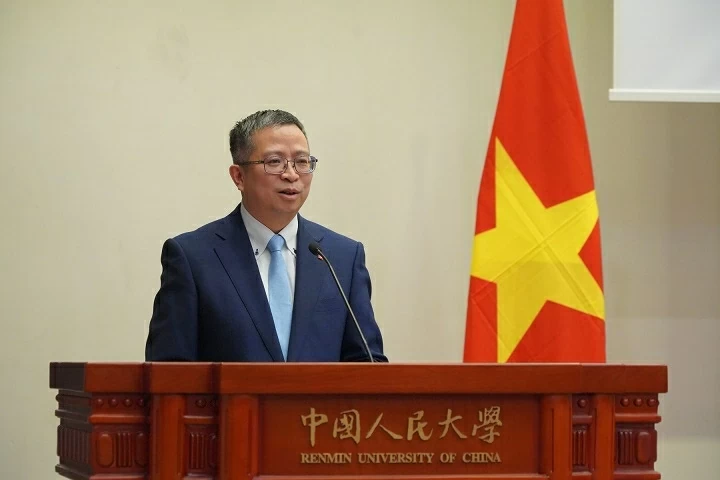 |
| Ambassador Pham Thanh Binh speaking at the event. |
Attending the event from Renmin University of China were Zhang Dai Miao, Head of International Cooperation; Wang Wen, Director of the Chongyang Institute for Financial Studies and Dean of the School of Global Leadership, along with over 400 students conducting research and studying at the university.
Among the guests were Professor Phan Kim Nga from the Chinese Academy of Social Sciences and Professor Cheng Han Bing, Acting Director of the Institute of National and Regional Studies at Zhejiang University of Technology.
The program also attracted a large number of experts, scholars, representatives from business associations, and media agencies, attending both in person and online with three connection points at universities in Zhejiang.
Speaking at the event on the theme “Strengthening Vietnam-China Friendship”, Ambassador Pham Thanh Binh reviewed the development of bilateral relations, highlighting significant achievements in recent cooperation, especially since the state visit to Vietnam by Chinese President Xi Jinping. The cooperation spans six major areas, including strengthening political trust, enhancing security and defense cooperation, promoting practical cooperation across fields, consolidating social foundations, closely coordinating in multilateral mechanisms, and effectively managing and resolving differences.
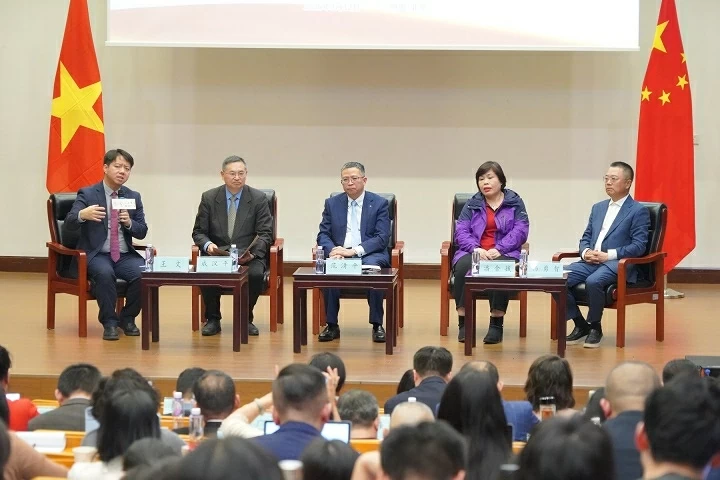 |
| Scene from the academic seminar titled “Ambassador's Story”. |
On this occasion, Ambassador Pham Thanh Binh informed Chinese scholars and students about the outstanding results of the 14th National Congress of the Communist Party of Vietnam. He emphasized Vietnam's development directions and goals in the new era, including ensuring national defense and security, pursuing an independent, self-reliant, peaceful, friendly, cooperative, and developmental foreign policy, diversifying and multilateralizing foreign relations, promoting rapid and sustainable socio-economic development, advancing science and technology, fostering innovation, and promoting Vietnamese cultural and human values.
The Ambassador also shared insights into Vietnam's socio-economic development in recent years, highlighting positive outcomes in growth, international integration, and improved investment environment, thereby showcasing the vast potential for cooperation between the two countries in the coming period.
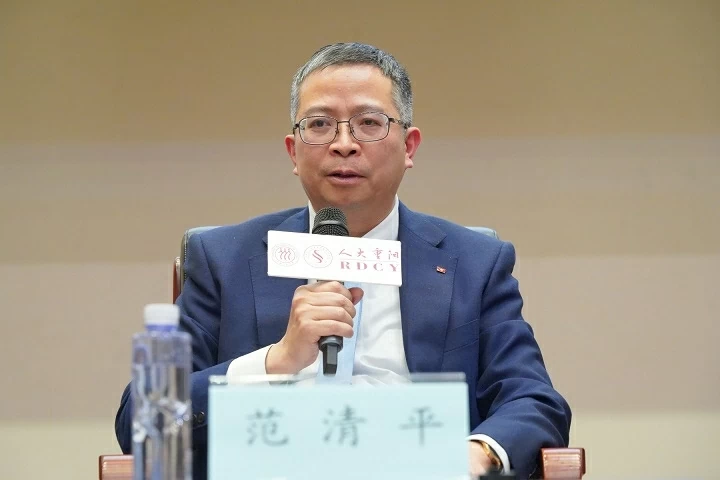 |
| Ambassador Pham Thanh Binh discussing at the event. |
During the discussion session, Ambassador Pham Thanh Binh, along with Chinese experts, scholars, and students, engaged in lively exchanges, offering numerous opinions and positive assessments on the prospects of Vietnam-China cooperation across various fields. They expressed hope that the two countries would continue to strengthen coordination and expand practical cooperation in line with each country's interests, meeting the aspirations of their peoples and contributing positively to regional peace and stability.
Chinese experts and scholars highly appreciated the prospects of Vietnam-China relations, noting that the two countries have significant potential and space to expand cooperation amidst regional and global fluctuations. Vietnam and China share many positive similarities, such as stable societies, progressive thinking, and safe environments, with unique complementary aspects in socio-economic development. These are important factors contributing to the continued stable and positive development of bilateral relations in the future.
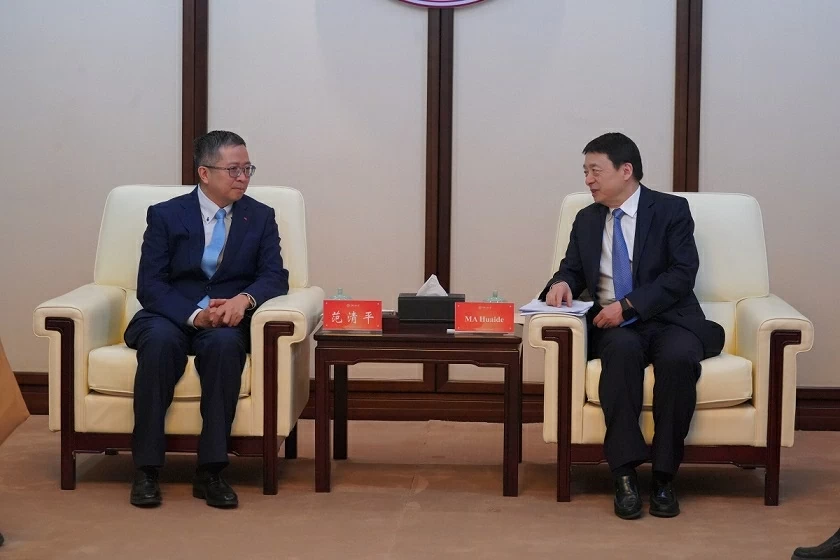 |
| Ambassador Pham Thanh Binh meeting with Renmin University of China President Ma Huai De. |
Earlier, Ambassador Pham Thanh Binh met with Renmin University of China President Ma Huai De. Both sides highly valued the role of higher education and research institutions in enhancing mutual understanding and friendship between the peoples of the two countries. They agreed to promote expanded cooperation in research, training, and academic exchanges between scholars and students of Renmin University and Vietnamese educational institutions in the next phase.
(Source: Embassy of Vietnam in China)


