







AI reshapes the job market: Global network of Vietnamese parents and experts launches FINO 2026
Initiated by a global network of Vietnamese parents and experts, Future Innovators (FINO) 2026 has concluded a two-day Bootcamp at the National Innovation Center (NIC) in Hanoi.
Latest
Fifty students of Vietnamese heritage aged 14 - 18 were selected for the project-based learning journey, designed to build practical capabilities through real-world challenges in education, health, the environment and everyday life.
Artificial intelligence is emerging as one of the major forces reshaping job structures and skills requirements. The Future of Jobs Report 2025 by the World Economic Forum (WEF) found that 86% of surveyed employers expect AI and information-processing technologies to transform their business by 2030.
The report also projects that around 39% of workers’ current skill sets will be transformed or become outdated, while structural changes in the labor market between 2025 and 2030 could affect about 22% of today’s jobs.
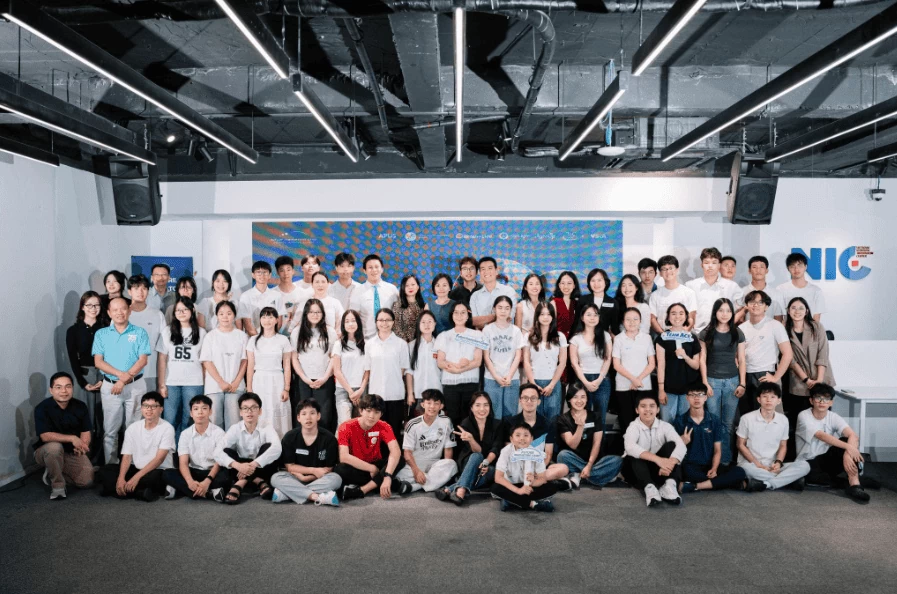 |
| FINO 2026 students and mentors at the two-day Bootcamp at the National Innovation Center (NIC), Hanoi. (Photo: FINO) |
When academic credentials alone are no longer enough
The Employment and Social Trends 2026 report by the International Labour Organization (ILO) puts the global youth unemployment rate at 12.4%. Around 260 million young people - roughly 20% of the global youth population are neither in employment, education nor training. The ILO also notes that AI and automation may intensify the challenges facing highly educated young people seeking their first jobs in high-skilled occupations.
That increasingly difficult reality prompted Phuong Doan, an education professional based in Philadelphia, United States, and her colleagues to look for ways to better prepare students aged 14–18. As a mother raising children who were born and grew up in the United States, and as the founder of the “Dong hanh cung con tai My” (“Supporting Our Children in the U.S.”) community - a network bringing together Vietnamese parents, intellectuals and experts in the United States - Doan observed that traditional learning models centered heavily on grades are no longer sufficient to help the next generation keep pace with a rapidly changing world of work.
This observation is echoed by signals from higher education. A June 2026 survey of 759 U.S. college instructors published by Cengage Group found that 79% recommended strengthening critical thinking, problem-solving and writing skills to better prepare learners for an AI-shaped workplace; 61% said institutions should expand hands-on and experiential learning opportunities.
From that shared concern, Future Innovators was launched as a community education initiative with a nonprofit mission. The initiative aims to help young people of Vietnamese heritage around the world build the capacity to adapt to the future through real-world exposure while staying connected to their Vietnamese identity and culture.
A global Vietnamese mentor network tackles real-world problems alongside students
Rather than centering on test preparation or conference-style simulations, FINO places students in practical project settings modeled on real-world problem-solving. In 2026, 50 selected students formed teams across three focus areas: Education Technology (EduTech), Financial Technology (FinTech) and Health Technology (HealthTech).
FINO 2026 combined five interactive online sessions with a two-day in-person Bootcamp in Hanoi. Students selected one of the three tracks, then worked with their teams to define a problem, understand user needs, build a prototype and prepare a concise presentation of their proposed solution.
On the first day of the Bootcamp, August 8, The Trade Show required teams to present their prototypes, explain how their solutions worked and receive direct feedback from mentors and peer teams. Immediately afterward, The War Room sent students back to their worktables to examine what was not working, revisit assumptions and refine either the product or the way it was presented. Mentors served as questioners and critical reviewers, while the ideas, process and outputs remained student-led.
On August 9, six teams entered the Showcase with six different solution directions: biodegradable material made from food waste; a learning platform designed to encourage deeper thinking; an improved motorcycle helmet; a technology solution to support concentration in digitally distracting environments; an ergonomically designed backpack; and an application that helps users access nutrition information more conveniently.
What mattered was not only the final product. Throughout development, students had to answer questions similar to those faced by real project teams: Does this problem genuinely exist? Who needs the solution? Were our initial assumptions correct? What needs to change after feedback from users and experts?
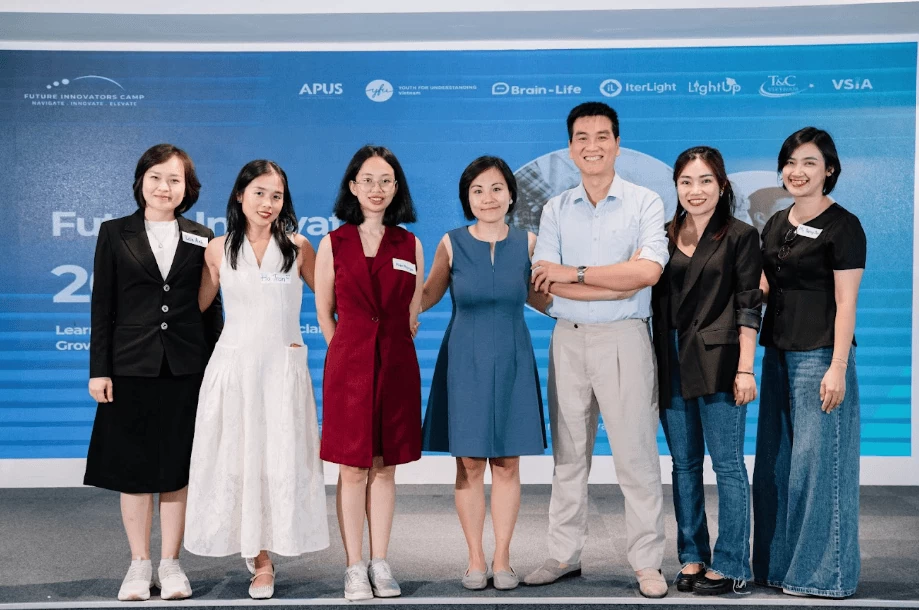 |
| FINO 2026 students pitch their projects before the judging panel. (Photo: FINO) |
Supporting the students was a global network of Vietnamese mentors and advisers, including experts and engineers working in the United States, Japan, Singapore and Vietnam. They guided and challenged each team from problem definition through final solution development. Exposure to professionals across different markets gave students access to varied career perspectives and problem-framing approaches, while preserving student ownership of each project.
Toward a sustainable nonprofit model
FINO says its 2025 pilot produced encouraging shifts. With less emphasis on grades, students showed stronger systems thinking, a greater ability to connect ideas and improved confidence in persuading users. Parents also reported that some participants began thinking more actively about their futures and identifying fields of study that interested them through the practical needs they encountered in their projects.
The program does not end with the final pitch. After the Bootcamp, students continue with a Reflection Circle and write a 50–100-word College Ready Story reflecting on what they attempted, what did not work and how they changed through the project.
Selected projects may receive partial funding for further development, along with opportunities for one-on-one mentoring and a progress presentation approximately three months later. Students who complete the program will also receive a certificate from Youth For Understanding (YFU).
Established in 1951, YFU is an international education and intercultural exchange network with 45 member organizations across six continents and more than 310,000 students who have participated in its programs.
First piloted in 2025, FINO is now working toward a long-term learning community for students of Vietnamese heritage. Its founding team is currently completing the legal procedures required to register a nonprofit entity in the United States.
If the early cohorts focused on creating opportunities for students to “do the work for real,” the next phase will depend on FINO’s ability to sustain its mentor network, connect successive generations of students and continue supporting promising projects beyond the program.


