

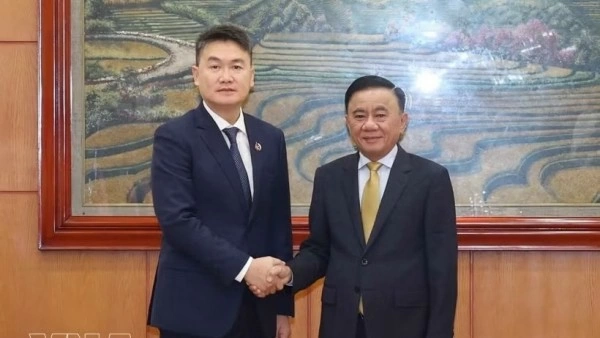


Speaker Kover Laszlo's visit to Vietnam holds profound symbolic and practical significance: Hungarian Ambassador
WVR - On the occasion of the official visit to Vietnam by Speaker of the National Assembly of Hungary Kover Laszlo (October 18–22), Hungarian Ambassador to Vietnam Tibor Baloghdi shared with The World & Vietnam Report on the significance and key focuses of the visit.
Latest
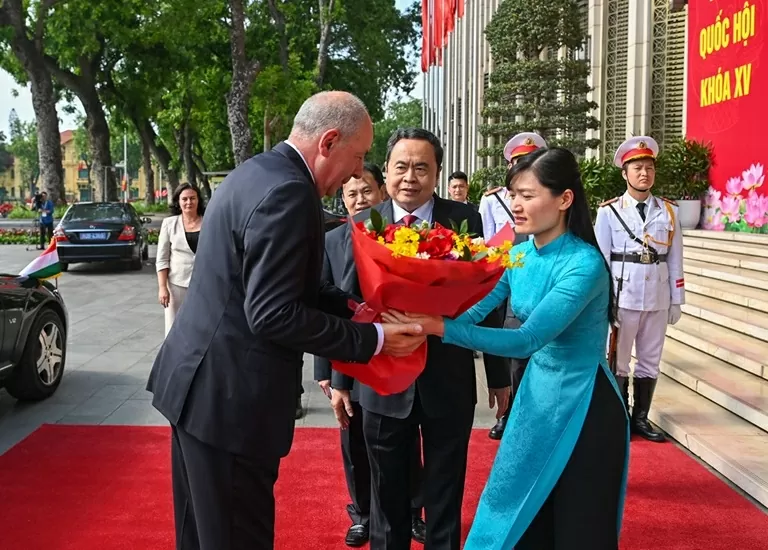 |
| National Assembly Chairman Tran Thanh Man met with Hungarian President Sulyok Tamas during his official visit to Vietnam in May 2025. (Photo: Nhan Dan Online) |
Could you please share the significances and main focuses of Hungarian National Assembly Speaker Kover Laszlo’s visit to Vietnam?
This visit by Speaker Kover Laszlo to Vietnam holds profound symbolic and practical significance. It represents not only the continuation of our long-standing political dialogue but also the deepening of the traditional friendship and comprehensive partnership that Hungary and Vietnam have nurtured for 75 years. The visit underscores the mutual commitment of our two countries to further elevate bilateral relations through parliamentary diplomacy and closer intergovernmental coordination.
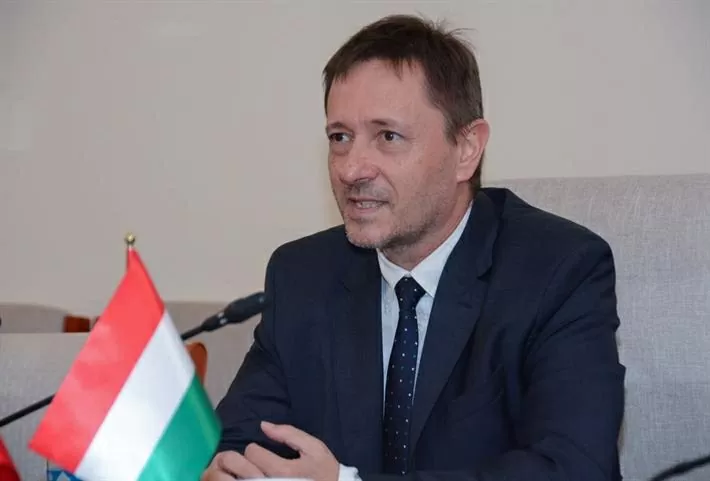 |
| Hungarian Ambassador to Vietnam Baloghdi Tibor. (Photo: CT) |
The Hungarian National Assembly attaches great importance to fostering ties with the National Assembly of Vietnam, which has always been a strong pillar of our political relations. The visit provides an invaluable opportunity for our legislative leaders to exchange views on the most recent developments in each country, to discuss ways to strengthen cooperation in law-making, oversight, and representation, and to share experiences in adapting legislative work to the rapidly changing global context.
Beyond the bilateral agenda, this visit also reaffirms Hungary’s enduring interest in Southeast Asia and the key role Vietnam plays in the region. It is also an expression of our shared commitment to upholding dialogue, multilateralism, and respect for international law in international relations. In short, the visit will serve as both a reaffirmation of trust and a forward-looking framework for practical cooperation between our two legislatures and governments.
What are your assessments of the cooperation between the National Assemblies of our two countries in recent years, and what are your views on the prospects for future collaboration?
Parliamentary cooperation between Hungary and Vietnam has developed greatly in recent years, in line with the excellent political relations between our two countries. The mutual visits by parliamentary delegations and the active participation of both sides in multilateral parliamentary forums all demonstrate the vitality of our legislative ties.
A particularly important initiative has been the Hungary-Vietnam Legislative Expert Seminar series, jointly organized by our two National Assemblies. These seminars provide an effective platform for professional dialogue between Hungarian and Vietnamese legislative experts, enabling the exchange of best practices in areas such as legal reform, parliamentary administration, and the modernization of legislative procedures. The outcomes of these seminars have contributed tangibly to mutual understanding and capacity-building within our respective parliamentary institutions.
Looking ahead, we see significant potential to further deepen these exchanges, not only at the leadership level but also through the strengthening of working-level and committee-to-committee cooperation. Thematic workshops, staff training, and digital governance discussions can all serve as vehicles for broadening the practical scope of our partnership. Both sides also share the view that parliamentary friendship groups should play an even more active role in facilitating mutual visits and people-to-people ties.
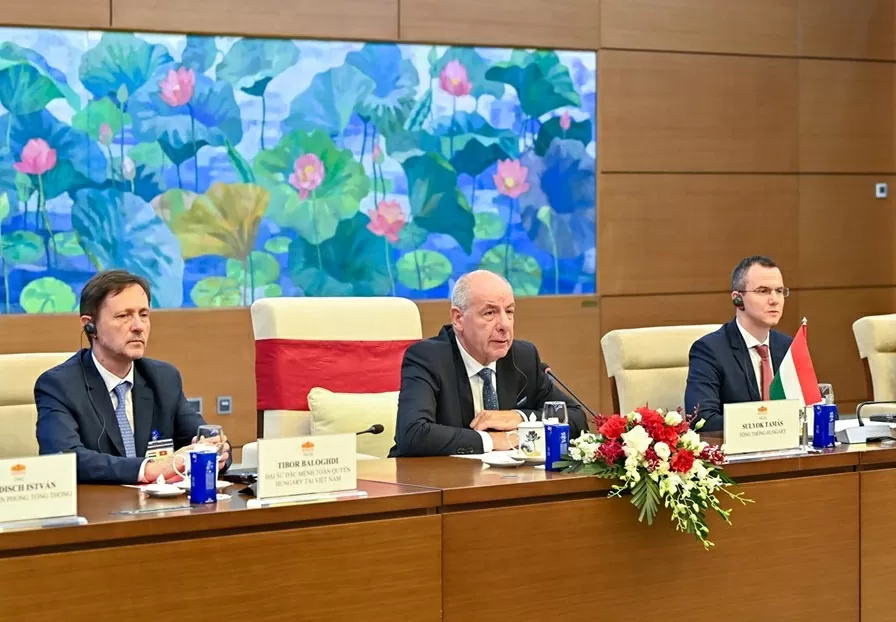 |
| Hungarian Ambassador to Vietnam Baloghdi Tibor (first from left) accompanied President Sulyok Tamas during his visit to Vietnam. (Photo: Nhan Dan Online) |
How do you comment the role of parliamentary cooperation in establishing mechanisms and frameworks to further strengthen bilateral relations?
Parliamentary diplomacy plays an increasingly important role in the architecture of modern international relations. It provides both the political legitimacy and the legislative foundation necessary for governments to pursue meaningful and sustainable cooperation. In the case of Hungary and Vietnam, our National Assemblies have not only supported but have actively shaped the frameworks that underpin our bilateral partnership.
The parliamentary dimension complements the work of our executive branches by ensuring that cooperation agreements are anchored in law, transparency, and public accountability. For example, the Hungarian National Assembly’s ratification of bilateral agreements has provided the legal certainty and continuity required for long-term projects to flourish. Similarly, the Vietnamese National Assembly’s role in supporting and implementing these frameworks has been instrumental in transforming political goodwill into practical results.
Parliamentary engagement also contributes to building trust and understanding between our peoples. When legislators from both sides engage directly, they not only exchange views on policy matters but also cultivate mutual respect for each other’s traditions, values, and development models. In this sense, parliamentary diplomacy functions as a bridge, connecting not just institutions but societies.
Recently, President of Hungary Sulyok Tamas affirmed that for Hungary, Vietnam is regarded as a key partner in Southeast Asia and will continue to play a strategic role in the future. How do you evaluate the strengths of bilateral cooperation, and what plans are in place to realize this potentials?
Hungary and Vietnam are bound by a deep and sincere friendship that dates back to the early years of Vietnam’s independence. Over the past 75 years, our cooperation has evolved from traditional solidarity into a comprehensive and multi-dimensional partnership encompassing politics, economics, education, culture, and development. President Sulyok’s statement reflects the Hungarian Government’s clear strategic vision: Vietnam is not only an important political partner but also a key bridge to the wider Southeast Asian region.
One of the strongest pillars of our bilateral cooperation lies in education and human capacity development. The Stipendium Hungaricum Scholarship Programme continues to be one of the most visible symbols of our friendship. Each year, hundreds of talented Vietnamese students pursue higher education in Hungary, gaining knowledge and experiences that contribute to Viet Nam’s further development and enhance mutual understanding between our nations.
In the economic field, Hungary’s role as Vietnam’s development partner has been marked by a focus on sustainable growth, healthcare modernization, and water management, sectors where Hungarian expertise is internationally recognized.
Cultural diplomacy and people-to-people exchanges remain another area of strength. Hungarian culture enjoys a special place in the hearts of many Vietnamese, while the Vietnamese community in Hungary continues to play a valuable role in linking our two societies. In this spirit, we also aim to further strengthen cooperation between our universities, research institutions, and cultural organizations.
Thank you, Ambassador!