







National Assembly adopted amended Press Law with new rrovisions on media economics
WVR - The National Assembly has passed the amended Press Law with numerous new provisions to adapt to the digital era and address the limitations of the previous law.
Latest
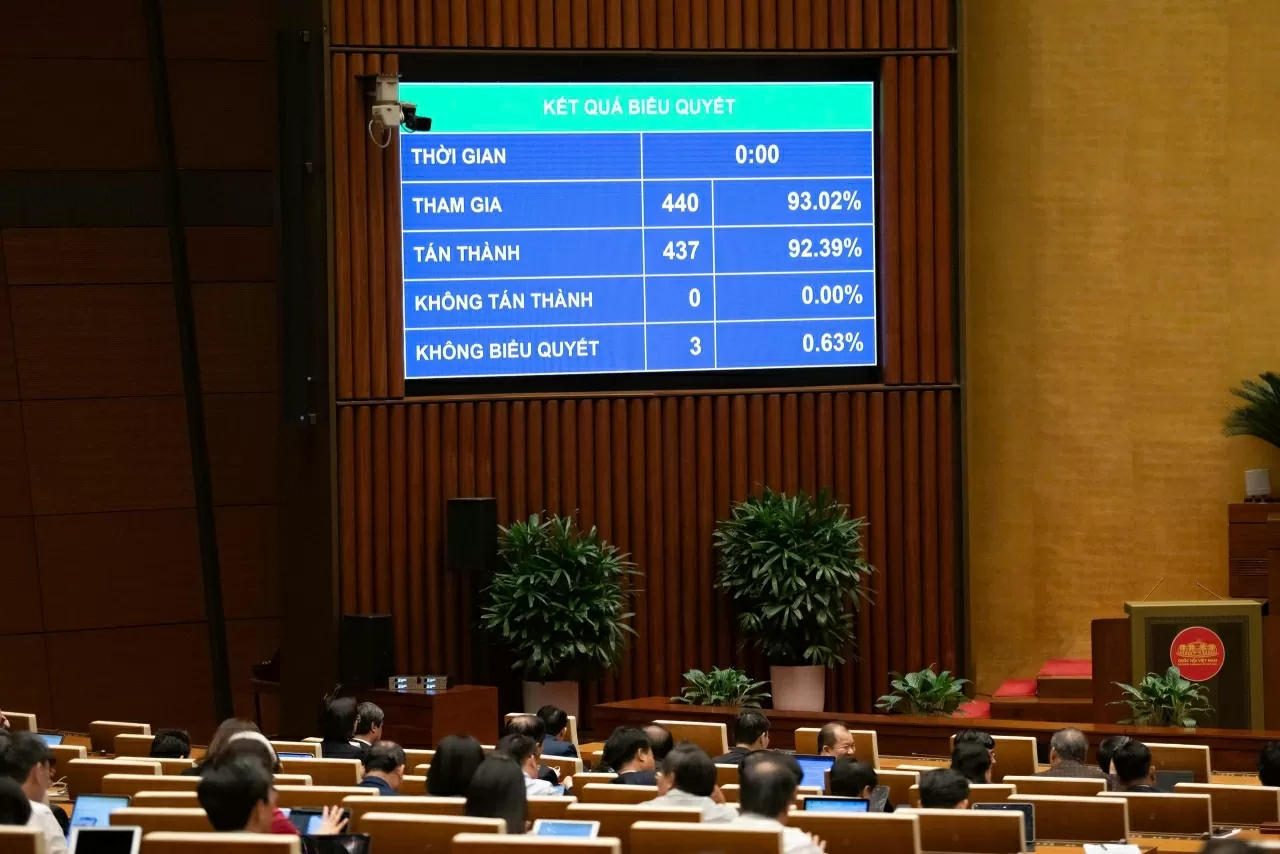 |
| Electronic voting results for the passage of the amended Press Law. (Source: National Assembly) |
On the morning of December 10, with 437 out of 440 deputies participating in the vote, accounting for 92.39%, the National Assembly passed the amended Press Law. The amendments aim to institutionalize the Party's viewpoints, meet the practical demands of the digital era, and address the shortcomings of the current Press Law.
The draft amended Press Law presented to the National Assembly consists of 4 Chapters and 51 Articles. Compared to previous discussions, the draft has removed the article on the applicable subjects (due to lack of new content) and added Article 35, which stipulates the removal of violating information and the recall of printed press products.
The amended Press Law includes significant revisions to adapt to technological advancements and the current state of journalism; it is expected to create a solid legal framework for building a professional, humane, and modern revolutionary Vietnamese press. Accordingly, the Law clearly distinguishes between "Newspaper" and "Magazine" to prevent the "newspaperization" of magazines.
The Law defines "Magazine" as a press product that publishes specialized, sector-specific news and articles; it only updates news and events related to the activities and fields of the managing agency. This regulation aims to resolve overlaps, ensure transparency, and prevent the "newspaperization" of magazines and scientific journals.
Additionally, the Law distinguishes "Scientific Journal" (publishing research results) from other types of journalism, and personnel in this field are not eligible for press card issuance.
The Law also includes strict regulations on managing journalistic activities in cyberspace and artificial intelligence (AI). It introduces several provisions to adapt to digital transformation, such as managing content channels on social media and officially recognizing "Content Channels of Press Agencies in Cyberspace" as a type of press product. The head of the press agency is responsible for the content posted on these channels.
For the first time, the use of AI in journalism is legalized. Article 39 stipulates that press agencies and authors using AI to support journalistic activities must comply with regulations on intellectual property, artificial intelligence, and professional ethics. The state invests in developing a national digital press platform and digital tools to monitor journalistic activities in cyberspace.
Regarding press cards, the Law requires that individuals applying for a press card for the first time must complete a journalism and professional ethics training course (this provision takes effect from January 1, 2027). The validity of a press card is set at 5 years. Additionally, the Law expands eligibility for press card issuance to include cameramen and directors of radio and television programs (excluding films).
The Law clarifies the revenue sources of press agencies, including revenue from individuals seeking to publish scientific research articles (for scientific journals) to fund peer review and article completion.
The amended Press Law stipulates 8 revenue sources for press agencies, including: funding from the managing press agency; revenue from selling printed press, rights to read, listen to, view journalistic works, press products, advertising, exchanging, buying and selling content rights, allowing exploitation and use of journalistic works; revenue from business activities, services, and collaborations of the press agency and its affiliated units; revenue from financial activities and capital contributions to enterprises (if any).
Notably, the Law provides for a "Multimedia Key Press Agency". A multimedia key press agency encompasses various types of journalism and affiliated press agencies; it has a special financial mechanism and is established in line with the Strategy for Developing and Managing the Press System approved by the Prime Minister.
The Law adds Article 35, which clearly stipulates that, depending on the nature and severity of the violation, the state management agency for the press has the right to require the press agency to immediately remove violating information from electronic press products, content channels of press agencies in cyberspace, the national digital press platform, or issue a decision to recall printed press products.
The amended Press Law will take effect from July 1, 2026. The specific provision regarding the conditions for first-time press card issuance related to the training course will apply from 2027 to allow for preparation time.
| Nguyen Dac Vinh, Chairman of the Committee for Culture and Society, stated that the draft Law, after being revised and finalized, consists of 4 Chapters and 51 Articles, closely aligning with the major goals, viewpoints, and policies approved by the National Assembly, promptly institutionalizing the Party's directives and policies, meeting the practical demands of press management and development in the current period, and meeting the conditions for submission to the National Assembly for consideration and approval at this session. Compared to the current Law, the draft Law has the following key new points: First, clearly identifying types of journalism in the new context Second, adding policies for press development and ensuring resources for implementation, from financial mechanisms to infrastructure investment and tax incentives in a more feasible manner Third, clarifying conditions for journalistic activities, licensing mechanisms, and organizational structure; identifying multimedia key press agencies, representative offices, and resident reporters Fourth, specifically regulating press cards, legal responsibilities for content information; the right to request corrections, removal of violating information on platforms Fifth, completing regulations on managing journalistic activities in cyberspace and applying new technologies, including adjusting behaviors related to artificial intelligence application. |