





From free classes to the journey of bridging the educational gap
With over 300 open classes and 500 volunteers participating in teaching, Khan Academy Vietnam is building a learning community where every student, regardless of location, has the opportunity to access knowledge and receive the support they need to thrive.
Latest
One evening, in an online class, dozens of students from various provinces were working together to solve a math problem in English. Some lived in cities, while others came from rural areas where access to high-quality education remains limited.
The classroom had no blackboard or podium, but it featured something truly special: all the instructors were volunteers, ranging from local students and teachers to Vietnamese expats living abroad.
This is part of the Khan Academy Vietnam (KAV) Open Class model, a place where knowledge is shared directly by the community.
To date, the open classes have attracted over 500 volunteers and launched more than 300 classes covering various subjects such as math, English, programming, financial literacy, Internet safety, and SAT preparation.
Beyond these numbers are very real changes, starting with each student.
From a single classroom to real changes
For many participating teachers, the most memorable aspect is not the academic results but the students’ personal growth over time.
Mr. Duong Minh Hoang, a teacher of the Math in English class, shared that many students were quite shy when they first joined, hesitant to ask questions, and even intimidated by the idea of learning Math in English. Yet, after just a short period, they gradually open up: “Initially, they were quite shy and afraid of Math, but over time, they began to proactively ask questions, send messages, become more confident, and dare to tackle difficult problems.”
According to him, this change does not stem from studying more. It is important that students are placed in a safe learning environment where they can try, make mistakes, and always have someone to guide them. “Such changes truly make me feel that my work is meaningful. Sometimes education does not start with grand things, but rather with a student saying: ‘I can do this.’”
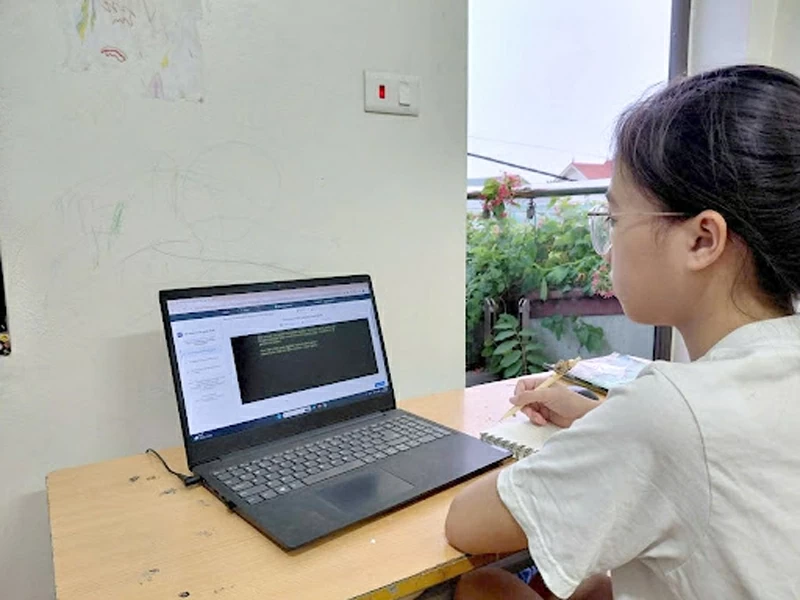 |
| Student Nguyen Khanh Linh believes that taking free online classes helps save money. |
During his teaching, Mr. Hoang also realized a common reality: many students do not lack ability, but rather lack proper guidance and opportunities for access. “Some students do not know where to start or easily give up when facing difficult problems. Furthermore, the language barrier when accessing international materials is a fairly significant issue.”
Therefore, learning through open classes not only helps students understand lessons better but also gradually familiarizes them with studying in English, which is an increasingly vital skill in the context of an integration-oriented educational system.
These changes are also clearly reflected by the students themselves.
Nguyen Khanh Linh, a 6th grader in Hung Yen, shared that participating in the open classes has helped her access many subjects she previously had little opportunity to explore deeply, especially those integrating English: “I feel very happy and grateful to participate in this online learning program. I can study multiple subjects, such as Math, English, Physics, and Chemistry, which allows me to broaden my knowledge. Thanks to the teachers’ help, I feel more confident and perform better in my studies.”
Being able to study online for free also helps her overcome common barriers: “Because the classes are free, my parents do not have to worry about finances. I also save time since I do not need to commute.”
From her experience, Linh hopes that many other students, especially in disadvantaged areas, will also be able to access such classes.
When the community steps up to teach and bridge the gap
A unique feature of the model is the involvement of Vietnamese teachers living abroad, who bring international experience and teaching methods into the classroom.
Ms. Nguyen Pham, a teacher living in California (USA) with over 30 years of teaching experience, has been teaching English to Vietnamese students since 2024. For her, teaching is a way to contribute to education in her homeland: “I deeply cherish the program’s educational aspirations and goals, so I want to do my best to help students excel in English and become more confident to integrate globally.”
After a period of teaching, she noticed that Vietnamese students possess great potential: “Vietnamese students are very smart, quick to grasp concepts, and always eager to learn more. What they need is the opportunity and support to grow.”
Similar to Ms. Nguyen, Tong Nguyen Nguyen Chuong, currently a student at the University of Melbourne (Australia), is also teaching various open classes, such as Math in English and English Skills... “Having the opportunity to experience one of the world’s leading education systems, I am all the more eager to bring these fascinating and useful things to the youth in Vietnam,” Chuong said.
From a systemic perspective, the Open Class model demonstrates a new approach to education.
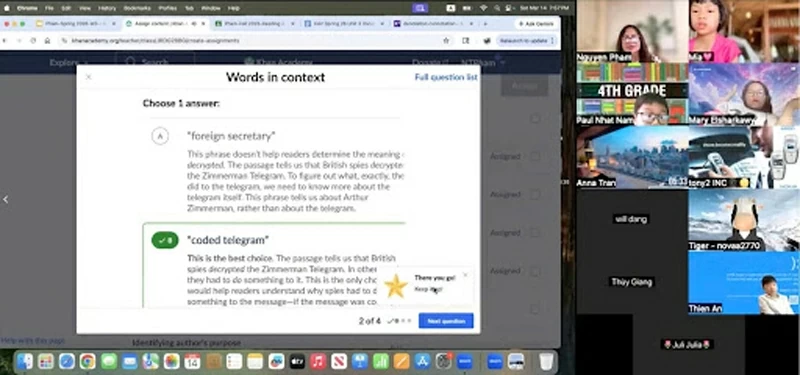 |
| An English open class taught by Ms. Nguyen Pham. |
According to Mr. Do Ngoc Minh, co-founder of the KAV program, right from the beginning, the goal was not just to launch individual classes but to build an open learning ecosystem: “We want to create a place where knowledge is easily shared, and learners can genuinely and effectively educate themselves.”
After more than 6 years of development, the model has proven its viability in terms of both scale and quality. From the initial SAT classes with a few hundred students, the program has expanded to thousands of students nationwide, with many achieving exceptionally high, or even perfect, scores.
Notably, many students who achieved great results have returned to become teachers for the next generation. “It is a very natural cycle of knowledge, learning, growing, and then returning to share,” Mr. Minh said.
From small classes to the journey of integration
From a single class to many, a learning community is gradually taking shape, where everyone contributes a small part to create greater opportunities for others.
Beyond helping students reinforce their knowledge, these classes also open up opportunities to access foreign languages, modern learning methods, and a global mindset.
Mr. Do Ngoc Minh believes that by combining an open learning platform, mastery learning methods, and the power of the community, this model possesses a highly distinctive characteristic: “The cost to expand educational opportunities can be reduced significantly, yet the impact multiplies exponentially.”
In the journey ahead, to spread these impacts more widely, the companionship of organizations and individuals will play a vital role: “With the support of organizations, especially philanthropists, we aim not only to expand the number of classes but also to bring this model to more localities and organize more diverse activities, particularly in areas where students have limited access to high-quality learning resources”.
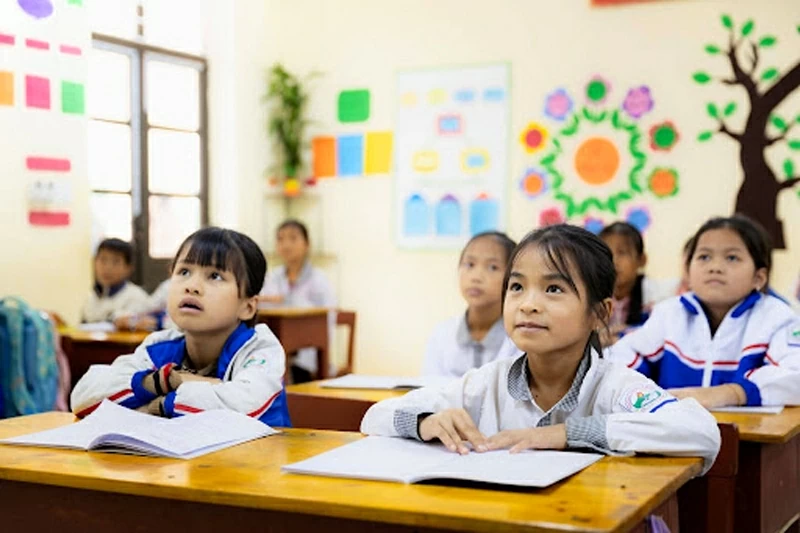 |
| The open class contributes to narrowing the educational gap between regions. |
“Education should not be limited by geography or economic conditions. Sometimes, just a single class created out of a volunteer spirit or a small community learning together can completely change how a student views education and, consequently, alter their future path.”
When a rural student can learn Math in English, when a teacher in the US or a university student in Australia can teach students in Vietnam, or when a successful student returns to become a teacher, the gaps in education are no longer insurmountable.
And perhaps, that journey of bridging the gap does not begin with grand things, but starts with a single classroom, where a student thinks for the first time that “I can learn, I can understand, and I can step out into the world”.
| National competition for 6Cs Innovative Integration into Elementary Physical Education Classes The Vietnam Institute of Educational Sciences (VNIES), in partnership with Danson Solutions, organized the Final round and Award Ceremony of the National competition for 6Cs ... |
| Promoting Vietnamese language community classes in southeastern RoK WVR - On April 14, a seminar titled “The Importance of Teaching and Preserving Vietnamese Language and Culture in the Vietnamese Community in Southeast Korea” ... |


