


Ethiopians admire Vietnam's resilience, tremendous development achievements: Ambassador
WVR - According to Ambassador of Ethiopia to Republic of Korea, who is concurrently accreditted to Vietnam Dessie Dalkie Dukamo, in the last 50 years, the most significant achievement has been the transformation of Vietnam-Ethiopia ties from a historical friendship rooted in shared anti-colonial and liberation struggles into a modern, multidimensional partnership.
Latest
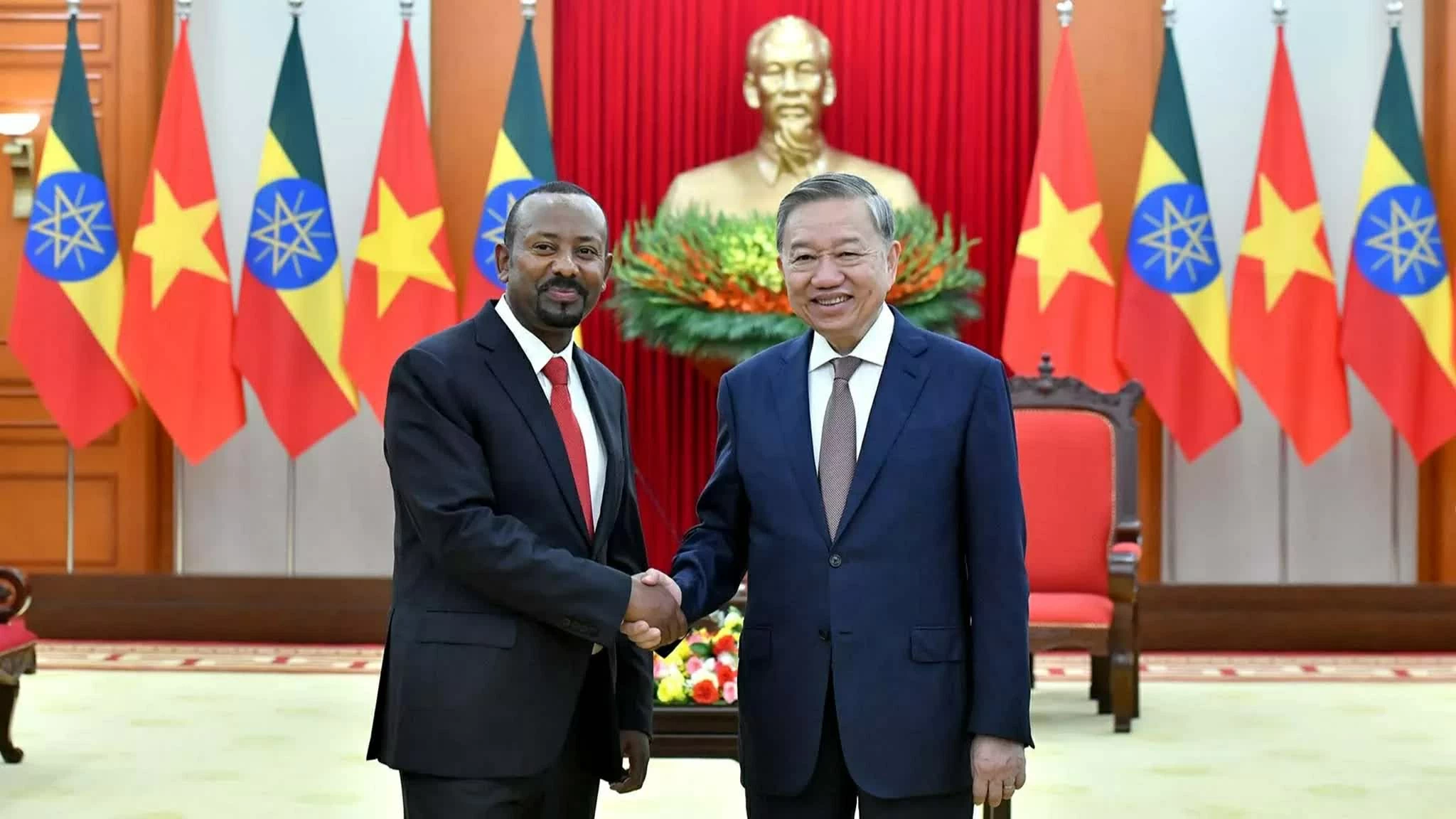 |
| General Secretary To Lam received Ethiopian Prime Minister Abiy Ahmed Ali, on April 15, 2025. (Source: Nhandan Newspaper) |
2026 marks the 50th anniversary of the establishment of diplomatic relations between Vietnam and Ethiopia. Looking back at this half-century journey, what do you consider to be the most significant achievements our two nations have reached in strengthening our traditional friendship?
It is a great honour to celebrate this Golden Jubilee of diplomatic ties between Vietnam and Ethiopia. In the last 50 years, the most significant achievement has been the transformation of our ties from a historical friendship rooted in shared anti-colonial and liberation struggles into a modern, multidimensional partnership.
We have built a foundation of deep political trust, enabling us to support one another in international and multilateral forums. Growing economic, cultural, and people-to-people exchanges have complemented this trust.
The opening of direct air links and the mutual recognition of each other’s market status are tangible symbols of this progress, demonstrating how two nations, though geographically distant, have become closer than ever before in their shared objectives and cooperation.
In recent times, the exchange of high-level delegations has been significantly bolstered, most notably the official visit of the Ethiopian Prime Minister to Vietnam in conjunction with the P4G Summit in Hanoi in April 2025. In your opinion, how has this visit created new momentum for our bilateral relations?
The official visit of Prime Minister Abiy Ahmed to Hanoi in April 2025 marked a turning point in relations between Ethiopia and Vietnam. The first visit by an Ethiopian head of government in decades made it clear that both parties are ready to advance their strategic collaboration.
This visit changed our conversation from primarily exploratory to actual action. We are now very close to reaching important agreements in several areas. Ethiopian Airlines has started direct flights to Hanoi after the Prime Minister's visit, which is significant.
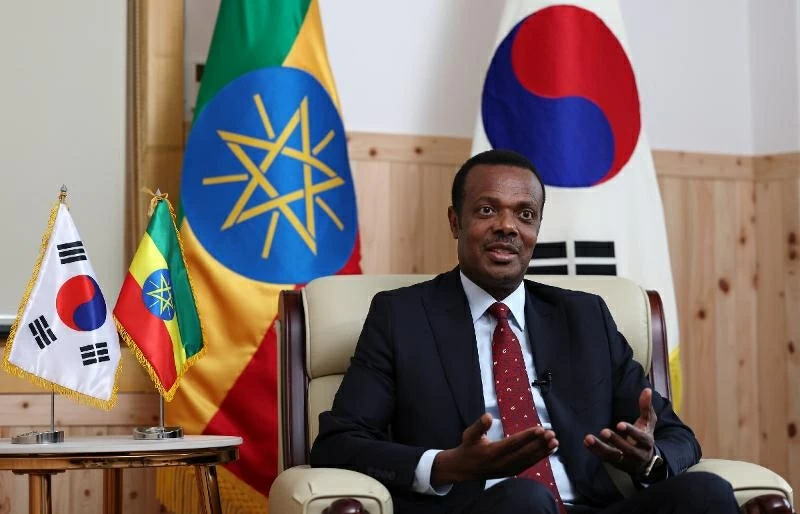 |
| Ambassador of Ethiopia to South Korea with concurrent accreditation to Vietnam Dessie Dalkie Dukamo. (Source: Korea.net) |
This is the most important result of our reinvigorated participation. The new route not only makes it easier for people to travel between Ethiopia and Vietnam, but it also connects Vietnam more closely to the rest of Africa through Ethiopian Airlines' extensive network. It will facilitate trade, tourism, business travel, and interpersonal interactions, putting the political promises made during the visit into practice.
Bilateral trade turnover reached approximately USD 161 million in 2025, and Ethiopia maintained an impressive economic growth rate of 7.2%. Which specific sectors do you believe will be the key to elevating these figures in the near future?
Bilateral trade of about USD 161 million in 2025 is a good sign, but it's only a small part of what we could do. Ethiopia offers much more than just its famous Arabica coffee. We think the following areas have a lot of potential:
Textiles and garments: Vietnam's excellent manufacturing capabilities, combined with Ethiopia's low labour costs, renewable energy potential, and access to large markets, can create strong value chains in textiles and clothing.
Mining and gemstones: Ethiopia has substantial mineral and gemstone resources that remain underexplored. Vietnamese enterprises adept at processing, creating value, and leveraging technology can transform this industry.
Pharmaceuticals and medical supplies: Vietnam has made significant progress in the pharmaceutical sector. Vietnamese pharmaceutical and medical equipment manufacturers can sell many of their products in Ethiopia, which has a large and growing population. Ethiopia is also a gateway to Africa.
Leather and leather products: Ethiopia is among the African countries with the largest livestock populations. Vietnamese companies may make high-quality goods in Africa by investing in Ethiopia's leather sector. They can also have duty-free and preferential access to major global markets.
We also want to see more variety in electronics, building materials, agro-processing, and processed agricultural items. This will help make trade between our two economies more stable and balanced.
| More from WVR |
 4th P4G Summit: Prime Minister’s closing speech praises vision for global green transition 4th P4G Summit: Prime Minister’s closing speech praises vision for global green transition |
With Ethiopia’s position as the “Heart of Africa” and the host of the African Union (AU) headquarters, how can Ethiopia support Vietnamese businesses in accessing this vast regional market?
Ethiopia offers Vietnamese enterprises not only a favourable geographic position but also an institutional and diplomatic platform to expand into the broader African market.
First, our Government has established a network of specialized Industrial Parks that provide ready-to-use facilities for foreign companies. These parks provide reliable infrastructure, simplified regulations, and proximity to vital logistics routes, thereby enabling Vietnamese enterprises to establish industrial bases in Ethiopia.
Second, Ethiopia, as the African Union's seat and an active member of the African Continental Free Trade Area (AfCFTA), is well-positioned to assist Vietnamese businesses in navigating regulatory environments, understanding continental trade frameworks, and connecting with African partners.
Producing in or exporting through Ethiopia enables Vietnamese companies to benefit from AfCFTA-driven market integration and preferential access throughout the continent.
Furthermore, Ethiopian Airlines' direct flights to Hanoi, which began following the Ethiopian Prime Minister's visit, provide a vital air bridge between our two countries. With Ethiopian Airlines' extensive African network and growing connectivity to Asia, this route offers Vietnamese investors, traders, and tourists access to Ethiopia and other African destinations via Addis Ababa.
We also regard tourism as an essential part of this collaboration. Ethiopia may be a leading destination in Africa for Vietnamese travelers, offering unique experiences such as the Simien Mountains, the rock-hewn churches of Lalibela, the ancient city of Aksum, the Blue Nile's source region, and newly expanded tourist destinations. Tourism fosters mutual understanding and facilitates economic transactions.
Beyond trade and logistics, our people are at the heart of our 50-year partnership. Cultural interaction serves as a bridge between people and close friends. Ethiopia and Vietnam are both home to ancient civilizations with rich cultural heritages.
We believe there is significant potential in organizing Ethiopia-Vietnam Cultural Weeks in Addis Ababa and Hanoi, featuring traditional music, dance, food, Ethiopia's coffee ceremony, and Vietnam's distinctive tea culture.
Education is another essential component. We are trying to increase scholarship programs, academic alliances, and university collaborations. Ethiopian students can benefit from Vietnam's expertise with industrialization, agriculture, and digital transformation, while Vietnamese students can discover Ethiopia as the "Cradle of Mankind" and a dynamic African hub. These young people will be the next wave of advocates for our friendship.
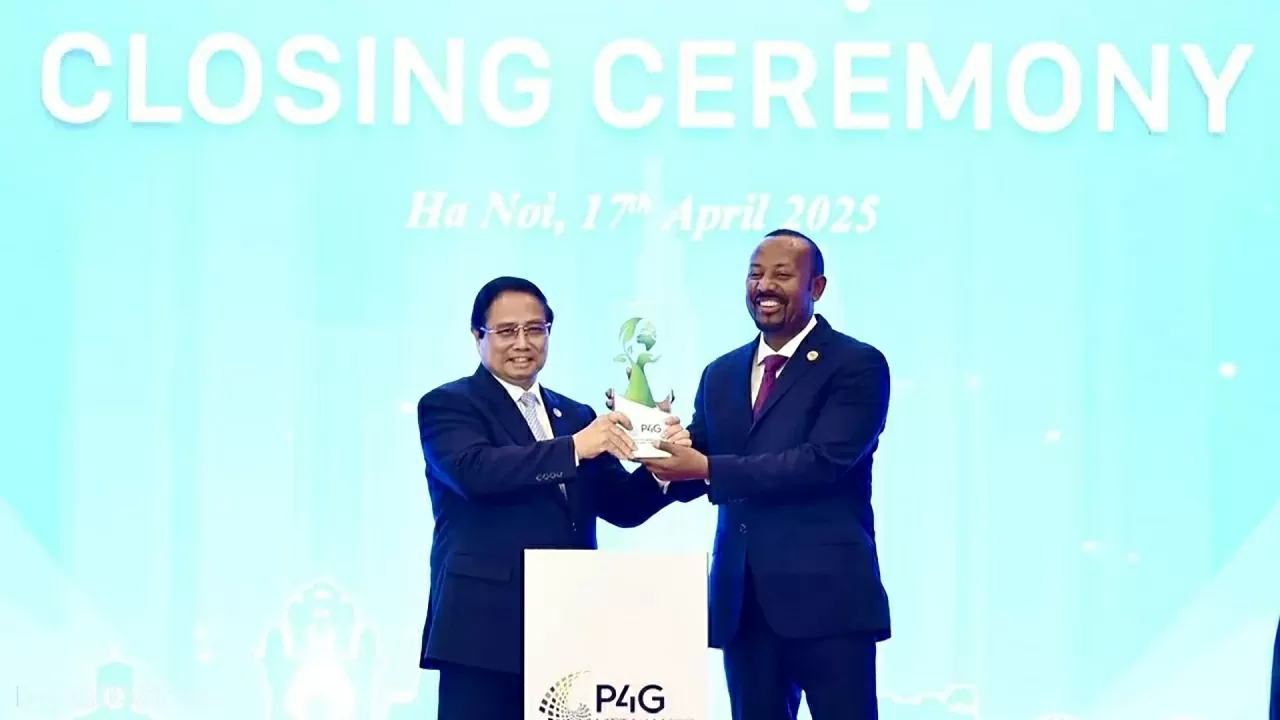 |
| Prime Minister Pham Minh Chinh transferred the role of host of the P4G Summit to Ethiopian Prime Minister Abiy Ahmed Ali. (Photo: Thanh Long) |
Vietnam and Ethiopia have consistently coordinated well in multilateral forums. Amidst the current global volatility, what is the significance of this cooperation in protecting the interests of both countries as well as those of the developing world?
In today's unpredictable global context, close cooperation between Ethiopia and Vietnam through institutions such as the United Nations and the P4G platform is critical.
Our two countries are committed to a fair, inclusive, and multipolar international order. We firmly believe in "solutions for the Global South, by the Global South." As members of the Non-Aligned Movement (NAM), both countries collaborate to advance their shared interests. By unifying our positions and supporting one another, we can ensure that the transition to a green and digital economy is inclusive and that the voices of developing countries are not drowned out.
Our collaborative efforts serve several important purposes, including defending the policy space of developing countries to pursue industrialization and structural reform, while promoting environmental sustainability. They oppose rising protectionism and call for a more equal global trade and financial system.
They highlight the Global South's concerns and goals in climate finance, technology transfer, capacity building, and equitable market access. Our collaboration shows that when developing countries work together, they can drive the global agenda rather than merely react to it.
On the occasion of the 50th anniversary, what message would you like to convey to the people and the business community of Vietnam, further to promote mutual understanding and exchange between our two nations?
My message to Vietnam's people and business community is clear: Ethiopia is open and ready.
I want to express to the people of Vietnam that Ethiopians admire their resilience, tremendous development achievements, and cultural richness. We share common values such as hard labour, dignity, and perseverance. I cordially encourage you to discover Ethiopia—not only as a place of ancient history and natural beauty, but also as a vibrant African nation forging its future.
I invite the Vietnamese business community to view Ethiopia through new eyes. Instead of focusing solely on geographic distance, consider a land of origins and future opportunities—a dynamic market, a gateway to Africa, and a reliable partner.
As we celebrate 50 years of diplomatic relations, let us commit to going beyond the exchange of products. Let's broaden the exchange of thoughts, innovations, technology, and cultural heritage. If we invest in our people, businesses, and shared values, Ethiopia-Vietnam ties will be even more fruitful in the coming 50 years.
Our journey together has just begun.
Thank you very much!
| President Luong Cuong welcomed Ethiopian Prime Minister Abiy Ahmed Ali WVR/VNA - On April 16, President Luong Cuong welcomed Ethiopian Prime Minister Abiy Ahmed Ali who is paying an official visit to Vietnam and attending ... |
| Spouses of Vietnamese, Ethiopian Prime Ministers visit Nguyen Dinh Chieu secondary school Madam Le Thi Bich Tran, Spouse of Prime Minister Pham Minh Chinh, and Madam Zinash Tayachew, Spouse of Ethiopian Prime Minister Abiy Ahmed Ali, visited ... |
| Vietnam, Ethiopia Prime Ministers enjoy breakfast, visit Tran Quoc Pagoda WVR/VNA - Prime Minister Pham Minh Chinh, his Ethiopian counterpart Abiy Ahmed Ali, and their Spouses enjoyed breakfast and visited Tran Quoc Pagoda in Hanoi ... |

| Ethiopian Prime Minister Abiy Ahmed Ali wraps up official visit to Vietnam WVR/VNA - On April 17 afternoon, Ethiopian Prime Minister Abiy Ahmed Ali and his Spouse Zinash Tayachew left Hanoi , wrapping their official visit to ... |
| Prime Minister Pham Minh Chinh holds meetings with leaders of countries, int'l organisations on G20 Summit occasion WVR - On November 22, on the occasion of attending the G20 Summit in South Africa, Prime Minister Pham Minh Chinh continued to meet with ... |