
Assoc. Prof. Dr. Tran Dinh Thien: Hanoi needs to establish a distinctive development vision
Assoc. Prof. Dr. Tran Dinh Thien, former Director of the Vietnam Institute of Economics, believes that Hanoi possesses a system of advantages that few other localities have.
Latest
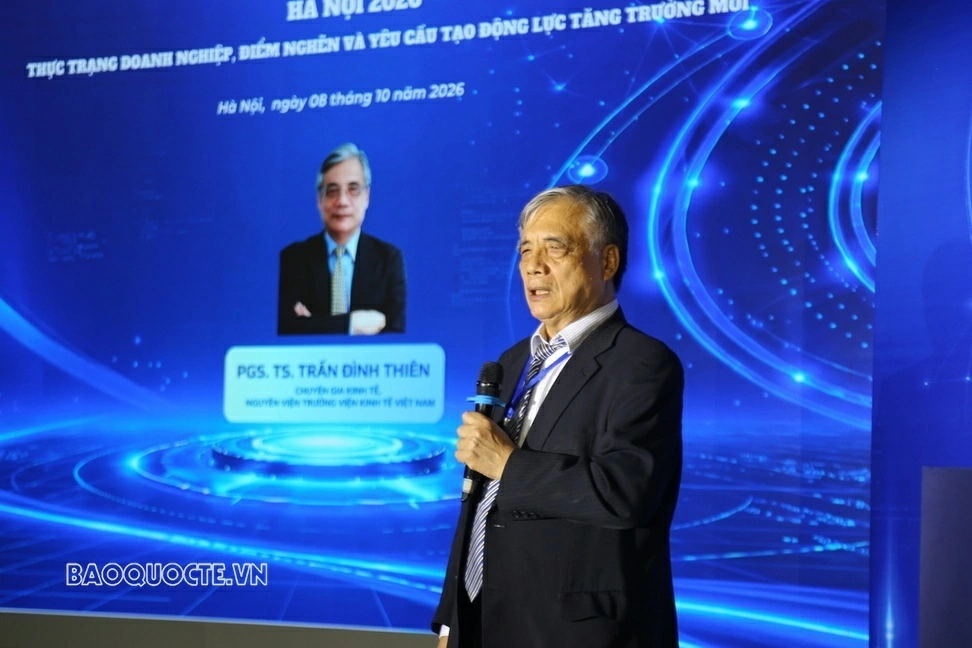 |
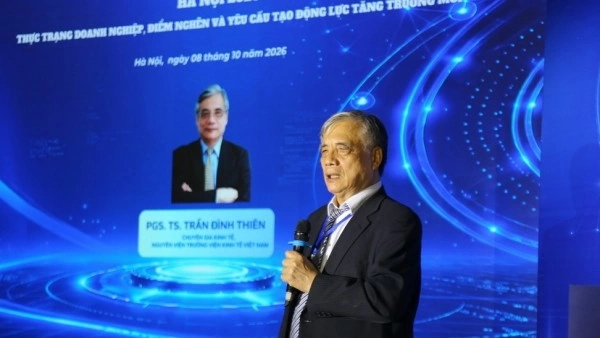
| Assoc. Prof. Dr Tran Dinh Thien presents his paper at the 3rd Capital Economic Forum 2026. (Photo: Trung Anh) |
Presenting his paper at the 3rd Capital Economic Forum 2026 (CEF III) on the afternoon of October 8, Assoc. Prof. Dr Tran Dinh Thien stated that, as the capital and regional centre, Hanoi has the ability to concentrate resources for policy decisions, markets, knowledge, and talent; along with a foundation of civilisation, history, and culture that creates its unique identity. Hanoi also boasts a large economy, leading in many fields, and is one of the country's important international integration centres.
However, these advantages only truly create value when they are transformed into capabilities. For Hanoi's businesses, Assoc. Prof. Dr Tran Dinh Thien observed that value does not simply lie in possessing resources, but in the ability to connect and utilise them to create new products, markets, and value.
Creating space for human resources to transform into economic value
Assessing the economic potential of the capital, Assoc. Prof. Dr Tran Dinh Thien noted that, in recent years, the picture continues to show that Hanoi's growth potential remains vast. From 2020 to 2024, Hanoi's GRDP growth rate was 5.79% per year, lower than that of Hai Phong, Hung Yen, and Quang Ninh in the same period.
This raises a significant question: Why has a locality with superior position, resources, and workforce concentration not yet achieved a growth rate commensurate with its potential?
According to Assoc. Prof. Dr Tran Dinh Thien, the answer lies in the ability to organise and leverage resources. Hanoi has a clear labour advantage, with the trained labour force rate in 2024 reaching 53.9%, significantly higher than the national average of 28.4%, and higher than those in Ho Chi Minh City (37.5%), Hai Phong (38%), and Quang Ninh (42.4%). But degrees are just a foundation; new tasks and opportunities determine the ability to harness human potential.
This is also one of the paradoxes that Hanoi needs to resolve: Having quality human resources but not creating enough space for these resources to transform into economic value.
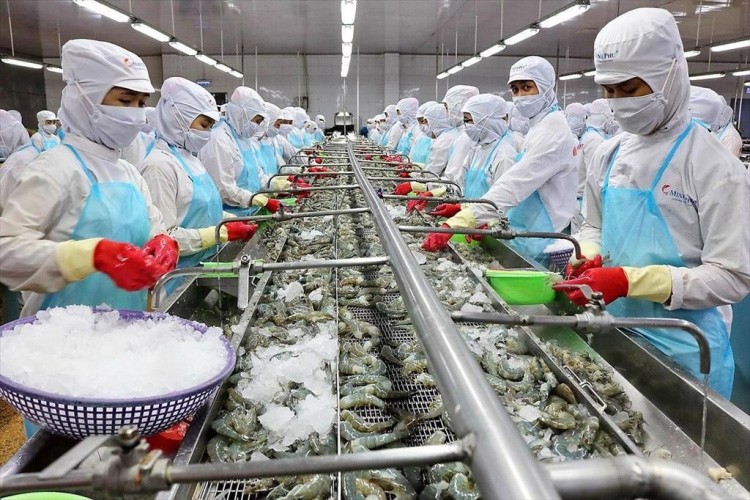
"The structure of Hanoi's enterprises still bears many similarities with the national average. In 2024, enterprises with fewer than 10 employees accounted for 77.8%, those with 10-49 employees for 18.3%, and those with 50 or more employees for only 3.8%.
Meanwhile, the number of enterprises increased significantly faster than the rate of job creation. From 2015-2024, the number of enterprises increased by 56.7%, while employment increased by only 19.9%. This indicates the need to 'pave the way' for enterprises to scale up and enhance their capabilities," Assoc. Prof. Dr Tran Dinh Thien emphasised.
From a business development perspective, the Assoc. Prof. Dr. also suggested that Hanoi's issue is not just about establishing more enterprises but creating conditions for enterprises to grow, participate more deeply in the value chain, and become market leaders.
“To achieve this, infrastructure must also be viewed as a business development policy. Congestion increases logistics time and costs; flooding disrupts operations and incurs contingency costs; pollution affects health, quality of life, and the ability to retain workforce. These urban costs ultimately become business costs,” Assoc. Prof. Dr Tran Dinh Thien emphasised.
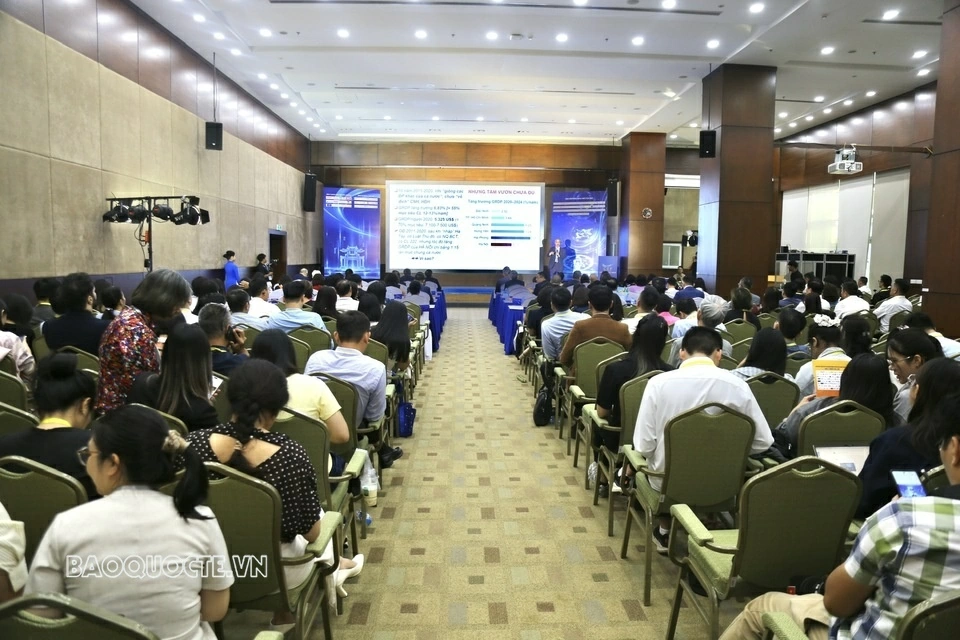 |
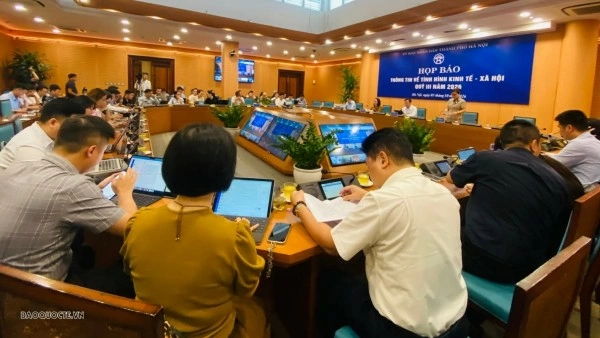
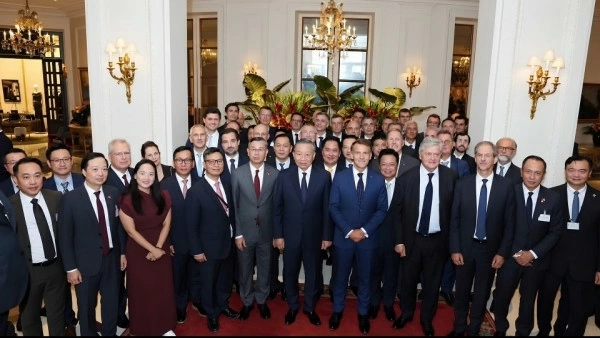
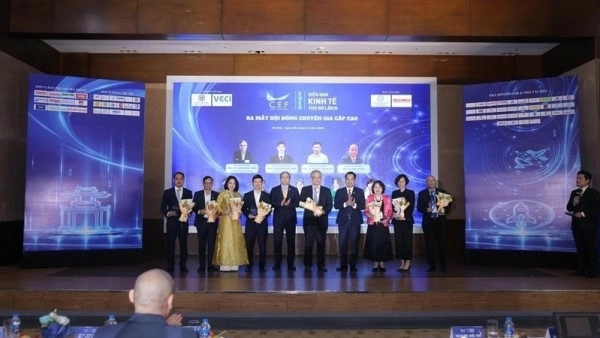
| Overview of CEF III. (Photo: Trung Anh) |
According to Assoc. Prof. Dr Tran Dinh Thien in Hanoi needs to change its approach to talent. Instead of only looking at degrees or titles, it is necessary to create sufficiently large tasks to attract, utilise, and verify capabilities.
From there, he proposed an approach to valuing talent through specific task groups. Selected individuals are based on capability, provided with conditions to execute, and evaluated by results. The report proposes about 10 task groups over 12-24 months, accompanied by users of results, data, equipment, authority, and compensation methods.
Assoc. Prof. Dr Tran Dinh Thien stated: “Hanoi needs to establish a distinctive development vision: Leading - Advancing - Model. 'Leading' is preparing conditions for new activities; 'Advancing' is selecting large tasks with high competitive standards; and 'Model' must be proven by verifiable and replicable results.”
Building resource organisation capability, creating sufficiently large tasks
From the requirement to elevate the capital's position, Assoc. Prof. Dr Tran Dinh Thien identified two development lines that need special prioritisation: the digital economy and innovation, and the cultural industry.
According to the 2030 target outlined in Program 04, the digital economy aims to account for 40% of GRDP, while the cultural industry targets 8% of GRDP. This is a target for 2030, not an achieved result.
For the digital economy and innovation, the issue is not only about technology but also about building a robust ecosystem in which businesses, universities, research institutes, and investors can jointly address the city's major challenges.
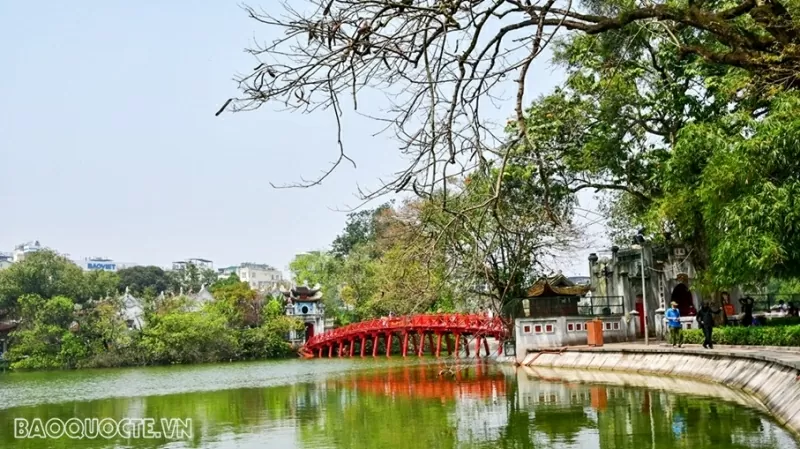 |
| Culture only truly creates economic value when organised into a chain, from cultural resources, design, and copyright to content production, distribution, experience, and creative reinvestment. (Photo: Huy Hiet) |
In the direction of the cultural industry, Assoc. Prof. Dr Tran Dinh Thien stated that culture only truly creates economic value when organised into a chain, from cultural resources, design, and copyright to content production, distribution, experience, and creative reinvestment.
He said: “This is also the approach that helps Hanoi transform its advantages in civilisation, history, and identity into products with customers, revenue, and markets beyond the capital.”
Assoc. Prof. Dr Tran Dinh Thien emphasised three initial decisions to transform the capital's development model. First, open space for action, data, infrastructure, and premises.
Second, assign large tasks to talents, businesses, universities, and research institutes to solve together.
Third, link responsibility to the products and value created, rather than just evaluating by process or resources.
“The capital must build the capability to organize resources, create sufficiently large tasks, grant authority alongside responsibility, and form ecosystems where businesses, talents, universities, institutes, and the State can jointly create value,” Assoc. Prof. Dr Tran Dinh Thien said.

| Hanoi Jazztival 2026: Building an International Music Festival with a distinctive Hanoi identity WVR - On the evening of September 17, the opening night of the Hanoi International Jazz Festival 2026 – Hanoi Jazztival 2026 took place at ... |

| Hanoi Book Fair 2026: Integrating reading culture with the capital's cultural development Through the Book Fair, Hanoi continues to promote a reading culture, aiming to build a learning society and cultivate elegant, civilised Hanoians. |
Tags: