






50 Years of ASEAN-U.S.Relations: Secretary of State Marco Rubio outlines new cooperation agenda with Southeast Asia
WVR - U.S. Secretary of State Marco Rubio affirmed that Southeast Asia is playing an increasingly important role in Washington's strategy, emphasizing that the U.S. will continue to promote cooperation in security, economy, technology, and investment to build an equal and mutually beneficial partnership with ASEAN in the new phase of development.
Latest
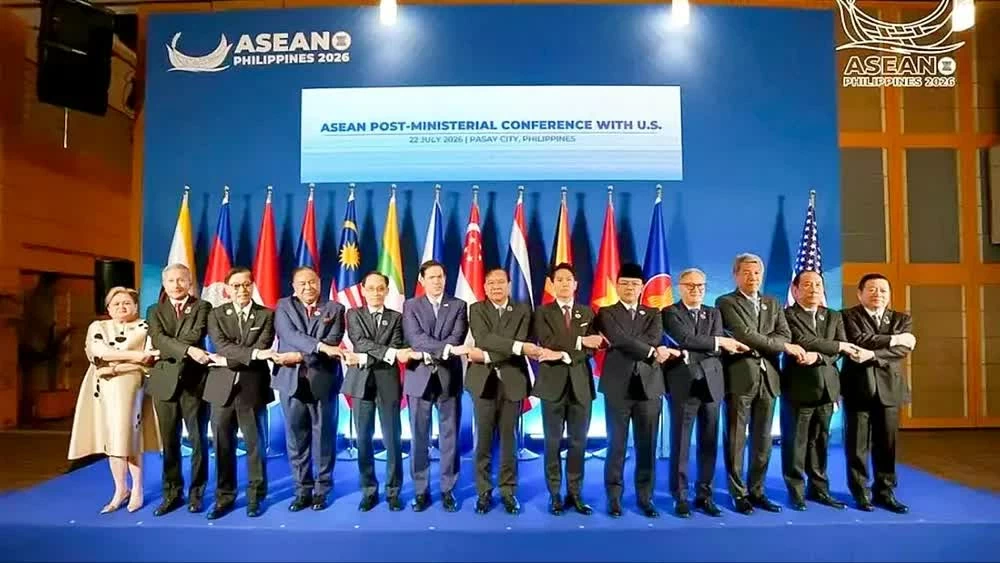 |
| U.S. Secretary of State Marco Rubio with ASEAN Foreign Ministers at the ASEAN-U.S. Foreign Ministers' Meeting in Manila, Philippines. (Photo: ASEAN) |
In his speech at the 59th ASEAN Foreign Ministers' Meeting (AMM-59), U.S. Secretary of State Marco Rubio noted that the shared interests between the U.S. and ASEAN are now deeper than at any previous stage.
The U.S. Secretary of State affirmed that U.S. investment, businesses, and technology have contributed to the region's growth for decades, making the U.S. one of Southeast Asia's leading investment and trade partners, while creating approximately 625,000 jobs in the U.S.
Regional security remains the foundation of U.S.-ASEAN Relations
According to Secretary Marco Rubio, Washington always views a stable, prosperous Southeast Asia that respects national sovereignty as a long-term strategic interest of the U.S.
Assessing ASEAN's role, the U.S. Secretary of State stated that the peaceful environment maintained over the decades has laid the foundation for economic growth, expanded trade, and promoted regional connectivity, making Southeast Asia one of the world's most dynamic development centers.
Referring to the maritime routes in the region, the head of U.S. diplomacy emphasized that these are the lifelines of global trade, ensuring the flow of energy, food, raw materials, and industrial goods. Therefore, the U.S. will continue to support maintaining a safe, stable maritime environment, free navigation, and compliance with international law.
According to the U.S. Secretary of State's assessment, if these strategic transport routes are dominated by geopolitical calculations, both the U.S. and ASEAN countries will face significant risks regarding security, sovereignty, and economic development prospects.
On the occasion of the 10th years of the 2016 South China Sea Arbitration ruling, Secretary Marco Rubio stated that countries in the region need to continue coordinating to ensure a peaceful, stable environment and resolve differences through peaceful means. In this context, the U.S. affirms it will continue to strengthen cooperation with allies and partners to enhance regional security capabilities.
Towards equal and mutually beneficial economic relations
Besides security cooperation, Secretary Marco Rubio believes that ASEAN's rapid growth is opening up significant economic cooperation opportunities with the U.S. Currently, the region's digital economy serves over 400 million Internet users and is projected to reach a scale of about 2 trillion USD by 2030, making ASEAN the fourth-largest economy in the world.
According to the U.S. Secretary of State, ASEAN's completion of negotiations on the Digital Economy Framework Agreement, expected to become the first legally binding digital trade agreement across the region, will help complete the legal environment for e-commerce and the digital economy.
This also creates conditions for U.S. businesses to expand investment and business in Southeast Asia. Furthermore, the U.S. AI Export Program under President Donald Trump will prioritize Southeast Asia as a key area, thereby promoting digital transformation by providing comprehensive AI solution packages to partner countries.
The head of U.S. diplomacy also emphasized the potential for cooperation in the energy and supply chain sectors as ASEAN is accelerating the diversification of supply sources and developing the ASEAN Power Grid to enhance the connectivity of electricity systems among member countries.
In this context, the U.S. is ready to supply liquefied natural gas (LNG), new-generation nuclear power technology, and technical solutions to support the energy transition process, considering these as stable, competitive options suitable for the region's long-term development needs.
Alongside commitments on technology and energy, Washington is also expanding infrastructure investment. According to the U.S. Secretary of State, the U.S. International Development Finance Corporation (DFC) is allocating about 1.5 billion USD to build an energy infrastructure investment platform across the Indo-Pacific region.
Simultaneously, the U.S. Department of State is coordinating with its Congress to implement an investment of over 100 million USD to develop infrastructure in the Luzon Economic Corridor of the Philippines, thereby promoting trade, supply chain connectivity, and expanding investment opportunities. The total value of U.S. programs currently implemented in the region exceeds 2.5 billion USD.
Concluding his speech, Secretary Marco Rubio affirmed that Washington wishes to build a partnership with ASEAN based on the principles of respecting sovereignty, sharing prosperity, and mutual development. Accordingly, the U.S. will continue to promote an open trade environment, support economic growth, and expand opportunities for businesses and workers on both sides in the coming decades.


