




16th National Assembly’s First Extraordinary Session: Institutional breakthroughs, unleashing resources for a new development model
WVR - Renewing the development model must first create breakthroughs in institutions, innovate the methods of organization, governance, and national operations, thereby forming new development capabilities.
Latest
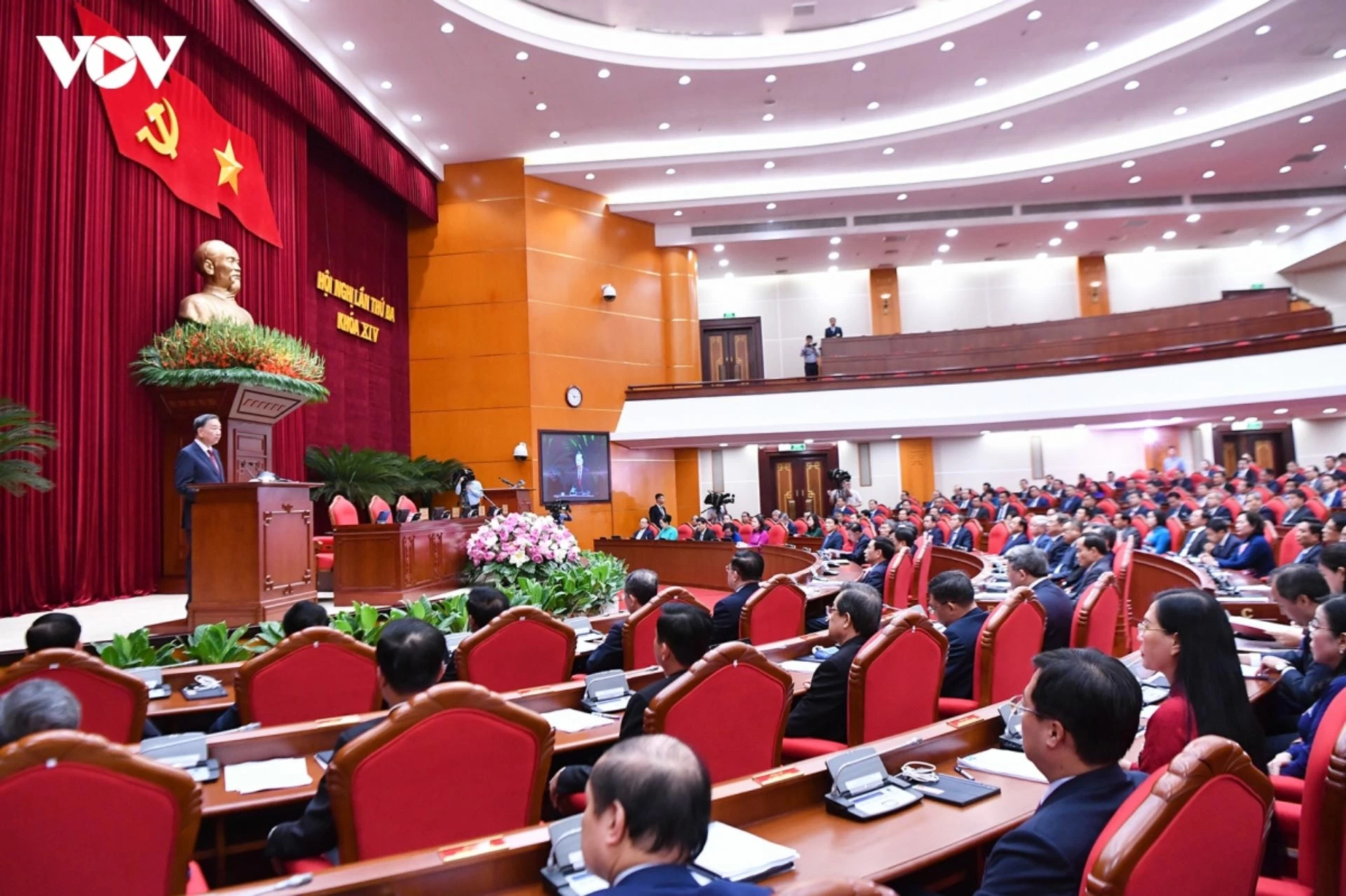 |
| The third plenum of the 14th Party Central Committee. (Source: VOV) |
This perspective is outlined in Resolution No. 19-NQ/TW of the 3rd plenum of the 14th Party Central Committee on renewing Vietnam's development model, continuing the spirit of breakthroughs in law-making and enforcement as identified in Resolution No. 66-NQ/TW of the Politburo.
From this orientation, the requirement is to innovate the mindset in law-making and enforcement, shifting strongly from management to development facilitation, creating space for resources to be liberated, and allowing citizens and businesses to unleash their creativity.
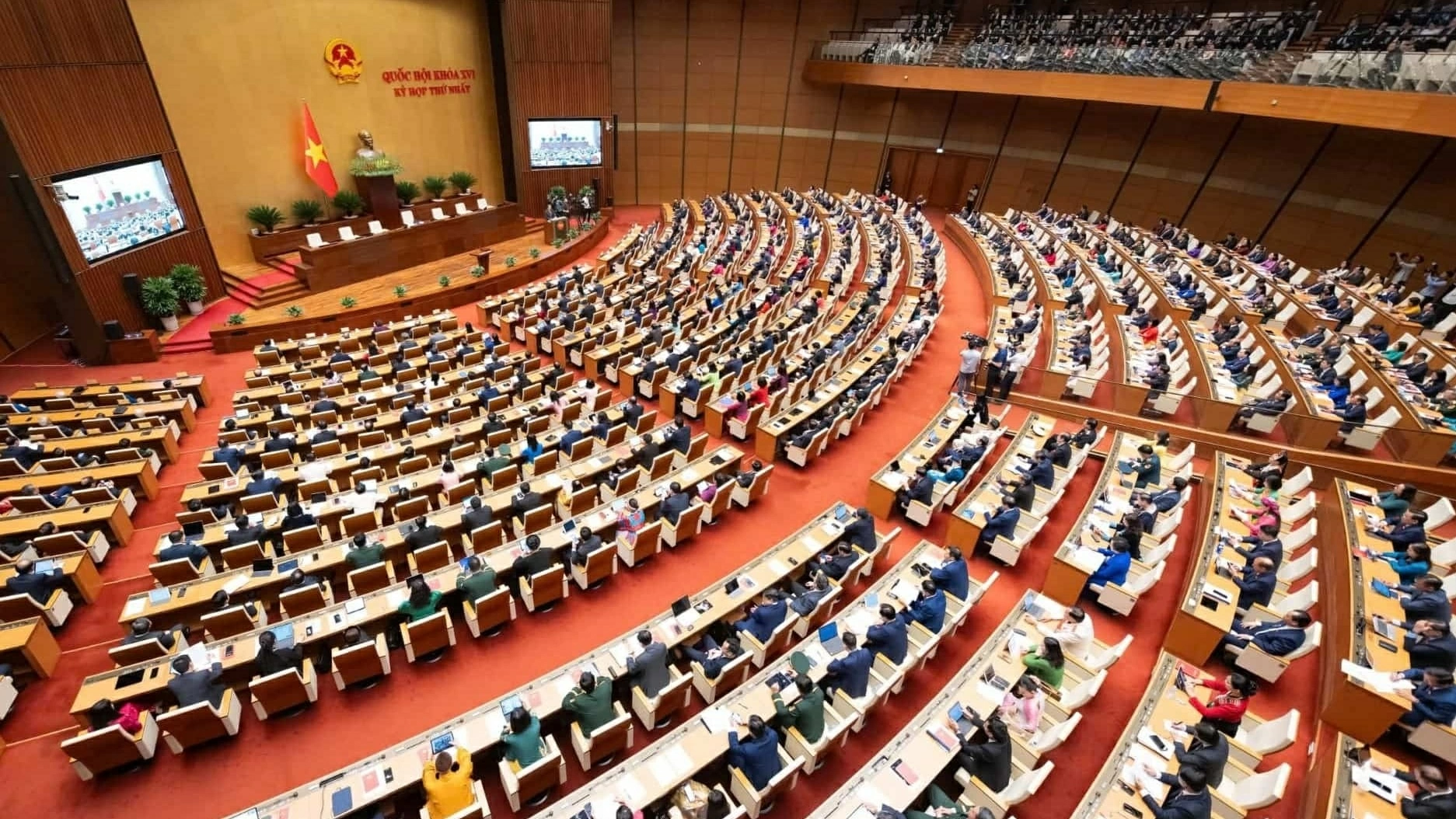
The current extraordinary session of the 16th National Assembly clearly demonstrates this spirit as many laws are being amended to reduce procedures, decentralize, delegate authority, increase local autonomy, and design new mechanisms to remove bottlenecks and expand development space.
Institutions must become a development resource
According to Assoc. Prof. Dr. Nguyen Thi Thu Ha, Head of the Interdisciplinary - Foreign Language - Informatics Department, Academy of Administration and Public Management, the perspective on renewing the development model introduces a new mindset: development breakthroughs must begin with institutional breakthroughs.
Institutions should not only be management tools but must become development resources, motivating the liberation of productive forces, unblocking social resources, and enhancing national competitiveness. Laws need to be stable, transparent, predictable, reduce overlaps, and lower compliance costs for citizens and businesses while improving the quality of law enforcement.
The current spirit of legal perfection strongly focuses on addressing practical issues, removing bottlenecks, and creating development momentum. At the extraordinary session of the National Assembly, many laws are discussed in this direction. Many deputies suggest evaluating the quality of law amendments through specific results: the number of procedures reduced, compliance costs lowered, and increased transparency and accountability of management agencies.
Deputy Nguyen Thanh Trung (Hai Phong) emphasized the need for substantial reform when commenting on the draft Law amending and supplementing several articles of the Law on Radio Frequency, Telecommunications Law, Electronic Transactions Law, and Technology Transfer Law. He stressed that digital transformation must reduce compliance costs and avoid digitizing old procedures. The state must still manage strictly, but management tools should shift from licensing to standards, regulations, data, and supervision; businesses should not have to provide information multiple times that the state already possesses.
Deputy Tao Duc Thang (Ho Chi Minh City) highly appreciated the draft Law for reducing and simplifying administrative procedures and investment and business conditions; promoting decentralization and delegation; and resolving practical regulatory issues, including mechanisms for shared use of telecommunications infrastructure for national defense and security. The deputy suggested that in developing policies and planning telecommunications infrastructure in the future, the Ministry of Science and Technology should plan passive infrastructure when advancing to 6G, 7G. Once passive infrastructure planning is completed, businesses can proactively build, laying the foundation for increasing shared use in the future.
Deputy suggested continuing to simplify investment and business conditions, shorten procedures, and enhance post-inspection; while improving data sharing and exploitation mechanisms, clearly defining data to be shared, the agency authorized to exploit it, and responsibilities when data is incorrect, delayed, or misused.
Exploiting existing data within the state system as management input will reduce the need for citizens and businesses to provide the same information in multiple forms. In this way, digital transformation becomes a data-driven governance method rather than merely digitizing paperwork.
 |
| Financial buildings in the central area of Ho Chi Minh City by the Saigon River, opposite Thu Thiem Peninsula, An Khanh Ward. (Source: VNA) |
Empowering localities to create development space
A consistent theme in the laws discussed by the National Assembly is promoting decentralization and delegation, linking authority with responsibility, resources, and power control.
The spirit of “local decision-making, local implementation, local accountability” is clearly reflected in the Urban Development Law project. The draft aims to increase the autonomy of urban governments, especially in organizing apparatus, managing personnel, and building and implementing policies; while opening up mechanisms for developing free trade zones, international financial centers, public service socialization, and new urban development models.
Deputy Trinh Thi Tu Anh (Lam Dong) highly valued the draft's promotion of delegation to urban governments, where localities are given autonomy in areas such as planning, land, human resources, organizational apparatus, scientific research, and innovation.
According to the deputy, specific delegation helps localities proactively exploit new development spaces such as underground, high, and low spaces. Along with streamlined approval processes, localities have more flexibility in attracting investment into new models like free trade zones and logistics areas.
Deputy Trinh Xuan An (Dong Nai) noted that the draft Law has assigned over 150 authorities to the People's Council. According to the delegate, delegation needs to be linked with promoting the role of the People's Council in policy decision-making and supervising the activities of local administrative agencies. Authority and responsibility of leaders should go hand in hand with power control, transparency, and openness.
Delegate Nguyen Dai Thang (Hung Yen) stated that strong delegation creates conditions for localities to be more proactive and flexible in implementation. The deputy suggested clarifying the responsibility of leaders, the supervision mechanism of the National Assembly, the Government, and the People's Council; and specifying criteria and conditions for cities to apply the law's mechanisms, avoiding the emergence of a “request-give” mechanism.
Regarding the controlled experimental mechanism, the deputy suggested clarifying its relationship with specialized laws, specifying the scope, conditions, supervision time, and evaluation of experimental results.
Reducing procedures, removing bottlenecks
The spirit of institutional breakthroughs is also reflected in the draft Law amending and supplementing several articles of 10 laws related to administrative procedures and business conditions in agriculture and environment.
The draft amends 10 laws, cuts 40 administrative procedures, simplifies 12 procedures, and reduces 40 business conditions. The draft law also delegates 24 administrative procedures of the Ministry of Agriculture and Environment to the Chairmen of provincial People's Committees. These figures indicate that the reform direction is focusing on the direct requirements of production and business activities: reducing procedures, reducing conditions, increasing local autonomy, and shifting management focus to post-inspection.
Deputy Nguyen Thi Viet Nga (Hai Phong) evaluated that the focus of the session is to review and perfect institutions, removing bottlenecks to unblock resources for development. According to the deputy, a good policy must remove bottlenecks, create additional momentum, expand development space, and bring practical benefits to people and businesses.
Reducing procedures, promoting decentralization, effectively exploiting data, and expanding development space are the core focuses in the process of perfecting institutions. Through this, many practical bottlenecks are being concentrated on being resolved.