








When teachers learn, students grow
From the first tentative movements of a mouse by students in remote mountainous areas to the regular self-study routines established in classrooms, behind every change in learning is the perseverance of teachers. As education continues to evolve, teachers are not only guiding their students but also learning, experimenting and adapting themselves to new approaches.
Latest
At Ta Leng Ethnic Minority Boarding Primary School in Lai Chau, Principal Vu Thi Suat still recalls a young student who was once too hesitant to touch a computer mouse. With patient guidance from teachers and classmates, the student was able to move the mouse, select answers, and solve arithmetic problems on the screen after just 10–15 minutes. When asked whether the student enjoyed learning mathematics on a computer, the answer came with a cheerful smile: “Yes, very much!”
For Ms. Suat, this was a particularly rewarding moment. The school has more than 1,300 students, most of whom are from ethnic minority communities, and access to computers and online learning platforms remains unfamiliar to many. With 54 classes across nine campuses but only 15 computers available for practical learning, every opportunity for students to use the equipment must be carefully organized.
The school arranges computer sessions during breaks, after regular classes, and whenever time allows. Students who are already familiar with computers are introduced to the platform first and encouraged to help their classmates. During Information Technology lessons, teachers devote additional time to guiding students through basic operations. In some classes, two students share a computer to make the most of the limited equipment.
“On their faces, all I could see was a bright smile,” Ms. Suat recalled.
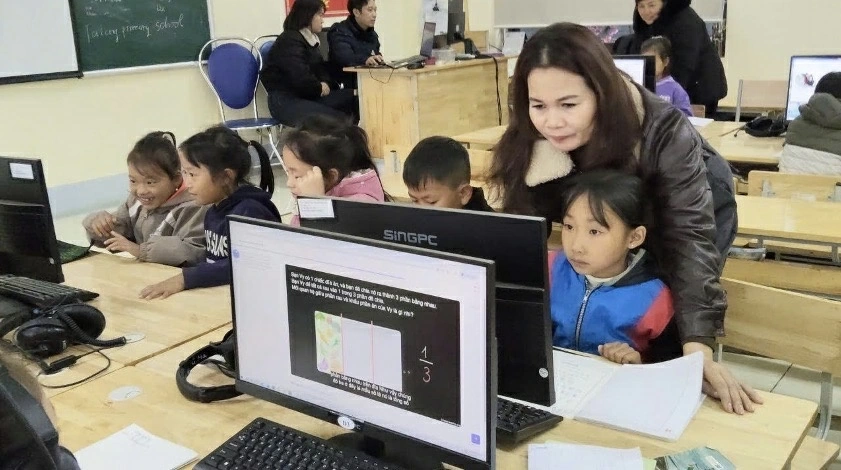 |
| Ta Leng students use an online learning platform to reinforce their knowledge. |
A smile may seem commonplace in any classroom, but at Ta Leng, it represents a meaningful step forward. Gia A Tung, a student in Class 3A1, said he enjoys going to the computer room because he does not have a computer at home. For him, the mathematics exercises on Khan Academy are like playing a game, making learning more enjoyable.
The experience at Ta Leng, as well as at Muong So Lower and Upper Secondary School, also in Lai Chau, shows that educational innovation does not begin with students alone. Bringing technology into the classroom requires teachers to overcome their own initial uncertainties and learn new skills.
Vu Thi Lan, a mathematics teacher at Muong So School, recalled that when she first began using digital learning platforms, she had to familiarise herself with various tasks, from creating accounts and assigning passwords to setting exercises, checking progress, and tracking students’ learning outcomes. When she encountered difficulties, she sought help from colleagues responsible for information technology. Issues that remained unresolved were also discussed during professional meetings.
Through practice, Ms. Lan gradually became more proficient. She also learned to use learning data to identify students who had not yet engaged with the platform and those struggling with particular concepts. The platform further introduced her to new approaches and exercises that she could explore, select, and adapt to her lessons.
“There are approaches I might not have thought of myself. But when I explore the platform, I find many interesting methods and ideas that I can learn from,” Ms. Lan said.
The change goes beyond mastering a digital tool. It has also broadened her perspective on teaching, encouraging her to observe each student's learning process more closely, identify knowledge gaps, and find more appropriate ways to provide support.
Understanding students through their learning journeys
At Phu Yen Primary School in Son La province, technology has also helped teachers gain a deeper insight into their students’ learning journeys.
Nguyen Thi Vu Huong, the school's head of professional affairs, was once surprised to discover that a student who appeared less attentive in class was, in fact, diligent in self-study at home. Weekly learning reports showed that the student consistently completed exercises and gradually improved their performance. When asked about it, the student replied innocently, “Yes, I really love learning!”
The response reminded Ms. Huong that observing a student in a single classroom lesson may not reveal the full extent of their abilities or efforts.
Tran Thi Mai Chi, a homeroom teacher of Class 4A1, also reflected on how her approach to assessing students had changed: “The most noticeable change is that I no longer focus solely on whether an answer is right or wrong. I pay much more attention to each student's learning process.”


