





Vietnam reaffirms strong commitment to marine and ocean protection under the BBNJ Agreement: Permanent Deputy FM
WVR - On the occasion of the implementation of the Agreement under the United Nations Convention on the Law of the Sea on the Conservation and Sustainable Use of Marine Biological Diversity of Areas beyond National Jurisdiction or BBNJ Agreement, commonly known as the High Seas Treaty, Alternate Member of the Party Central Committee, Permanent Deputy Minister of Foreign Affairs Nguyen Minh Vu, and Chair of the 35th Meeting of States Parties to the United Nations Convention on the Law of the Sea, shared his insights in a press interview. The World and Vietnam Report is honoured to present this interview.
Latest
On January 17, 2026, the High Seas Treaty officially comes into effect. Could you share the significance of this for the international community's joint efforts in managing and protecting the oceans?
The High Seas Treaty is the first comprehensive legal framework aimed at regulating activities related to marine biodiversity in areas beyond national jurisdiction—spaces that account for approximately 61% of the world's ocean area and 43% of the Earth's surface.
The treaty holds special significance as it is the first to affirm the application of the principle of “common heritage of mankind” to biodiversity resources in areas beyond national jurisdiction. It creates a mechanism for equitable benefit-sharing among nations and facilitates more substantial participation of developing countries in research, conservation, and sustainable use of marine biodiversity. This also helps build trust and active participation from developing countries in global ocean protection efforts amid the severe decline in biodiversity due to human impact.
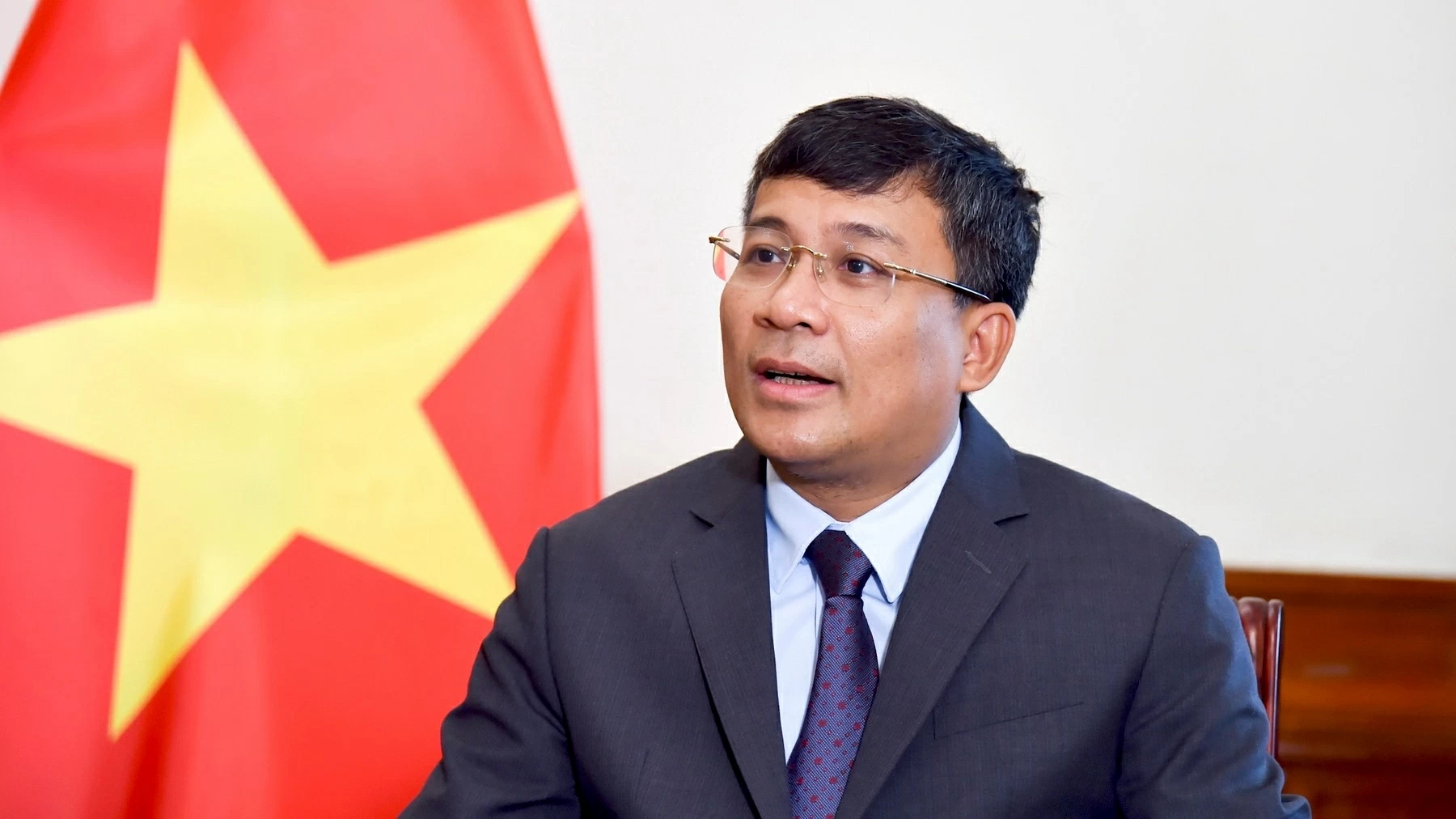 |
| Permanent Deputy Minister of Foreign Affairs Nguyen Minh Vu speaks to press on the occasion of the High Seas Treaty (BBNJ Agreement). (Photo: Bao Chi) |
The adoption and enforcement of the High Seas Treaty (BBNJ Agreement) not only reflect the international community's shared aspirations and determination to enhance ocean management and protection but also affirm the crucial role of multilateral mechanisms in promoting cooperation to address global issues based on international law, reinforcing the legal order at sea with the foundation being the 1982 United Nations Convention on the Law of the Sea (UNCLOS).
Could you share the challenges ahead in effectively implementing the treaty while ensuring harmony and consistency with UNCLOS?
The treaty's enforcement lays the groundwork for cooperation in conserving and exploiting biodiversity resources beyond national jurisdiction. However, to ensure this cooperation benefits all nations, several issues need continued discussion and resolution.
Firstly, member states of the treaty need to continue negotiations to agree on operational regulations for the treaty's mechanisms, including the rules of procedure for the Conference of the Parties, the establishment of specialized agencies, and the Secretariat. This is the basis for implementing more complex tasks such as establishing marine protected areas and methods for benefit-sharing from marine genetic resources in international waters.
Secondly, managing the “common heritage of mankind” requires the treaty to be a global legal framework. Currently, the treaty has 145 signatories and 81 member states. However, attracting further participation from countries, especially developed nations and those with significant activities in international waters, remains crucial for effective conservation regulations and capacity-building, technology transfer.
Thirdly, most developing countries lack the scientific, technical, and financial capacity to meaningfully participate in activities governed by the treaty, such as marine environmental impact assessments, marine scientific research, or accessing and sharing benefits from marine genetic resources. Therefore, enhancing direct support, capacity building, and implementing new financial models is essential.
Fourthly, implementing the treaty must ensure compliance with UNCLOS and harmonize with existing management mechanisms in the same area, including the International Seabed Authority—managing non-living resources in the international seabed and regional fisheries organizations. This requires close coordination to avoid overlap and enhance ocean governance efficiency.
 |
| The treaty's enforcement opens up unprecedented opportunities and cooperation spaces for Vietnam in marine biodiversity conservation and sustainable marine economic development. |
Could you specify the opportunities the treaty's enforcement will bring to Vietnam in marine biodiversity conservation, scientific research, and accessing international resources and technology? What priorities will Vietnam set to effectively implement the treaty?
The treaty's enforcement opens up unprecedented opportunities and cooperation spaces for Vietnam in marine biodiversity conservation and sustainable marine economic development. With early directives from the Politburo, the Secretariat, and the Government, Vietnam signed the treaty on the first day of opening for signatures, completed the approval procedures, and submitted the approval documents on June 9, 2025. Becoming an early member state demonstrates Vietnam's strong commitment and responsibility towards marine and ocean protection and the sustainable use of marine biodiversity.
For Vietnam, the treaty facilitates enhanced international cooperation, access to advanced knowledge, data, and technology, thereby improving marine scientific research, management, and environmental protection capabilities. This is also a crucial opportunity for Vietnamese scientists to actively participate in research activities, access, and share benefits from marine genetic resources in international waters and the deep seabed, contributing to promoting a modern marine economy model based on science and innovation.
As a member state of the treaty, Vietnam will actively, positively, and responsibly contribute to the effective implementation of the treaty by deeply engaging in mechanisms related to all four pillars: access and equitable benefit-sharing from marine genetic resources; establishment and management of marine protected areas; environmental impact assessments for activities in areas beyond national jurisdiction, and capacity building, marine technology transfer.
Simultaneously, as a developing country, Vietnam will also voice the legitimate interests of nations with limited capabilities and those significantly affected by climate change, ensuring alignment with UNCLOS. Vietnam will continue to review and complete the legal framework, enhance inter-sectoral coordination, mobilize the participation of scientists, businesses, and the public, ensuring the effective and substantive implementation of the treaty, serving the sustainable development of Vietnam's and the international marine economy, as per the spirit of Resolution 36-NQ/TW (2018) on the Strategy for Sustainable Development of Vietnam's Marine Economy to 2030, with a vision to 2045, and the 14th National Congress of the Party.


