



National Assembly President’s visit to Mongolia: Shared determination to deepen, substantiate, and enhance bilateral relations
WVR - According to Vietnamese Ambassador to Mongolia Nguyen Tuan Thanh, the visit of National Assembly President Tran Thanh Man to Mongolia demonstrates the determination of both countries to deepen, substantiate, and enhance the framework of Comprehensive Partnership; strengthening political understanding and trust between the two nations.
Latest
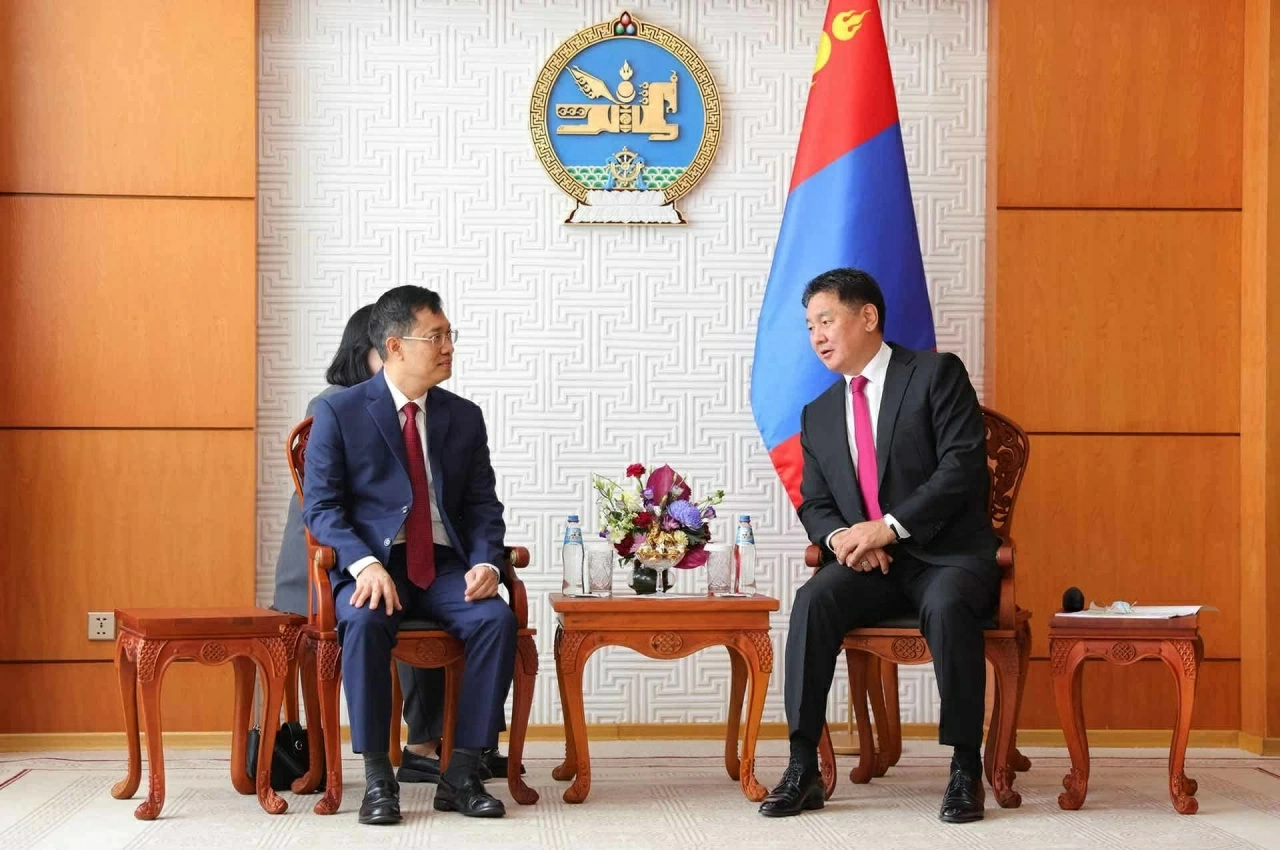 |
| Mongolian President Ukhnaagiin Khurelsukh receives Vietnamese Ambassador to Mongolia Nguyen Tuan Thanh on the occasion of the Ambassador's presentation of credentials, August 2024. (Source: Vietnamese Embassy in Mongolia) |
At the invitation of Mongolian Parliament Chairman Sandag Byambatsogt and spouse, National Assembly President Tran Thanh Man and spouse, along with a high-level Vietnamese delegation, will pay an official visit to the Republic of Korea and Mongolia from September 9-11. 2026.
On this occasion, Vietnamese Ambassador to Mongolia Nguyen Tuan Thanh gave an interview to The World and Vietnam Report about the significance of the visit and important milestones in the relations between the two countries.
Ambassador, could you assess the significance and importance of the upcoming visit of the National Assembly President in the context of Vietnam-Mongolia relations being upgraded to a Comprehensive Partnership? What impact is the visit expected to have in implementing the new relationship framework?
At the invitation of the Mongolian Parliament Chairman, National Assembly President Tran Thanh Man, his spouse and a high-level Vietnamese delegation, will visit Mongolia from September 9-11. During this visit, the National Assembly President will meet with the Parliament Chairman, the President, and the Prime Minister of Mongolia, and engage in many other important activities.
The official visit to Mongolia by National Assembly President Tran Thanh Man is the second visit by a Vietnamese National Assembly President since the establishment of diplomatic relations between the two countries in 1954. The visit holds significant importance as it takes place at a time when Vietnam-Mongolia relations are experiencing very positive developments and have just been upgraded to a Comprehensive Partnership.
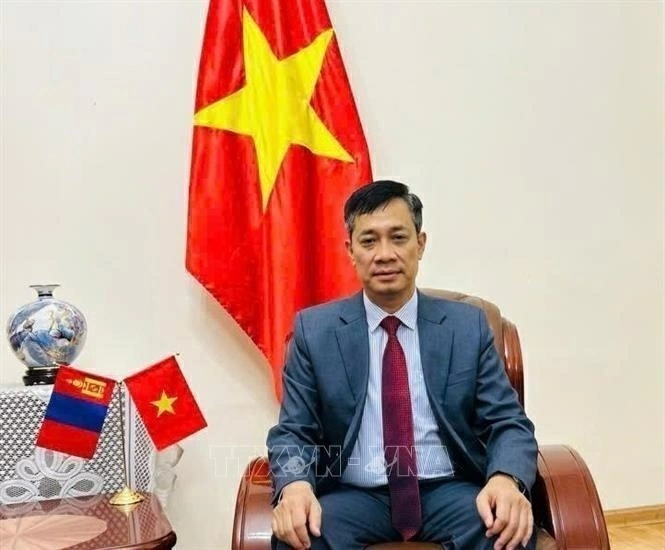 |
| Vietnamese Ambassador to Mongolia Nguyen Tuan Thanh. (Source: VNA) |
This is the first high-level visit by a key Vietnamese leader to Mongolia after the two countries upgraded their relations, providing an opportunity for both sides to concretize the commitments and major orientations agreed upon by high-level leaders.
It demonstrates the determination of both countries to deepen, substantiate, and enhance the framework of Comprehensive Partnership. The visit will strengthen political understanding and trust between the two nations. Vietnam and Mongolia have a long-standing traditional friendship, with many similarities in history, culture, and development aspirations.
In the context of many regional and international fluctuations, maintaining regular high-level exchanges and strengthening coordination and mutual support at multilateral forums is increasingly important.
Additionally, the visit holds special significance for consolidating relations between the two legislative bodies. The National Assembly is an important bridge in the bilateral relations, not only in politics but also in perfecting the legal framework, promoting economic, trade, investment cooperation, and people-to-people exchanges.
During the visit, the two legislative bordie are expected to sign cooperation documents, creating a framework and motivation to enhance the exchange of legislative experience, supervision, and decision-making on important national issues, while better promoting the role of parliament in advancing bilateral relations.
Notably, the visit is also an opportunity for both sides to have deeper exchanges on fields with great potential and space, such as trade, investment, agriculture, energy, tourism, transportation, and climate change response. Expanding cooperation fields will help the Comprehensive Partnership have more specific and sustainable “pillars”.
I believe that the most important point now is to transition from establishing the relationship framework to creating specific cooperation results, so that the people and businesses of both countries truly feel the benefits of the new cooperation framework.
It can be said that if the relationship upgrade to a Comprehensive Partnership is a milestone, then the visit of the National Assembly Chairman this time will be an important step to turn that milestone into specific programs, projects, and cooperation results.
I am confident that the visit will open a new development phase of Vietnam-Mongolia relations towards becoming increasingly substantive, effective, and bringing practical benefits to the people of both countries.
After 70 years of establishing diplomatic relations and especially after the State visit of General Secretary, President To Lam in 2024, how has the Vietnam-Mongolia relationship developed substantively, Ambassador?
After 70 years of establishing diplomatic relations and especially following the State visit to Mongolia by General Secretary, President To Lam in 2024, Vietnam-Mongolia relations are entering a very positive development phase, with many clear and substantive highlights.
Firstly, political and diplomatic relations are increasingly developing, close-knit, and trustworthy. Both sides regularly maintain high-level visits, contacts, and cooperation mechanisms such as the Intergovernmental Committee meetings, political consultations, security, and defense cooperation, thereby enhancing understanding, political trust, and coordination at regional and international forums. The upgrade of relations to a Comprehensive Partnership has opened a new framework, creating momentum to deepen and substantiate bilateral relations.
Secondly, economic, trade, investment, and tourism cooperation is gaining more new opportunities. The economies of the two countries complement each other and have much room for exploitation. Notably, cooperation in the energy sector is emerging as a new pillar in the economic relations between the two countries. The volume of goods exported to each country is increasing, including livestock products exported from Mongolia to Vietnam, contributing to the steady annual growth of bilateral trade turnover.
The opening and maintenance of direct flights have contributed to enhancing connectivity, facilitating trade, tourism, and people-to-people exchanges. Businesses on both sides are encouraged to proactively seek cooperation opportunities in potential fields such as agriculture, food, energy, minerals, tourism, logistics, and digital transformation.
Tourism development cooperation is also being promoted, with both countries enhancing promotion and attraction of each other to appealing tourist destinations, helping the number of tourists increase annually. Vietnam remains one of the top favorite destinations for Mongolian people.
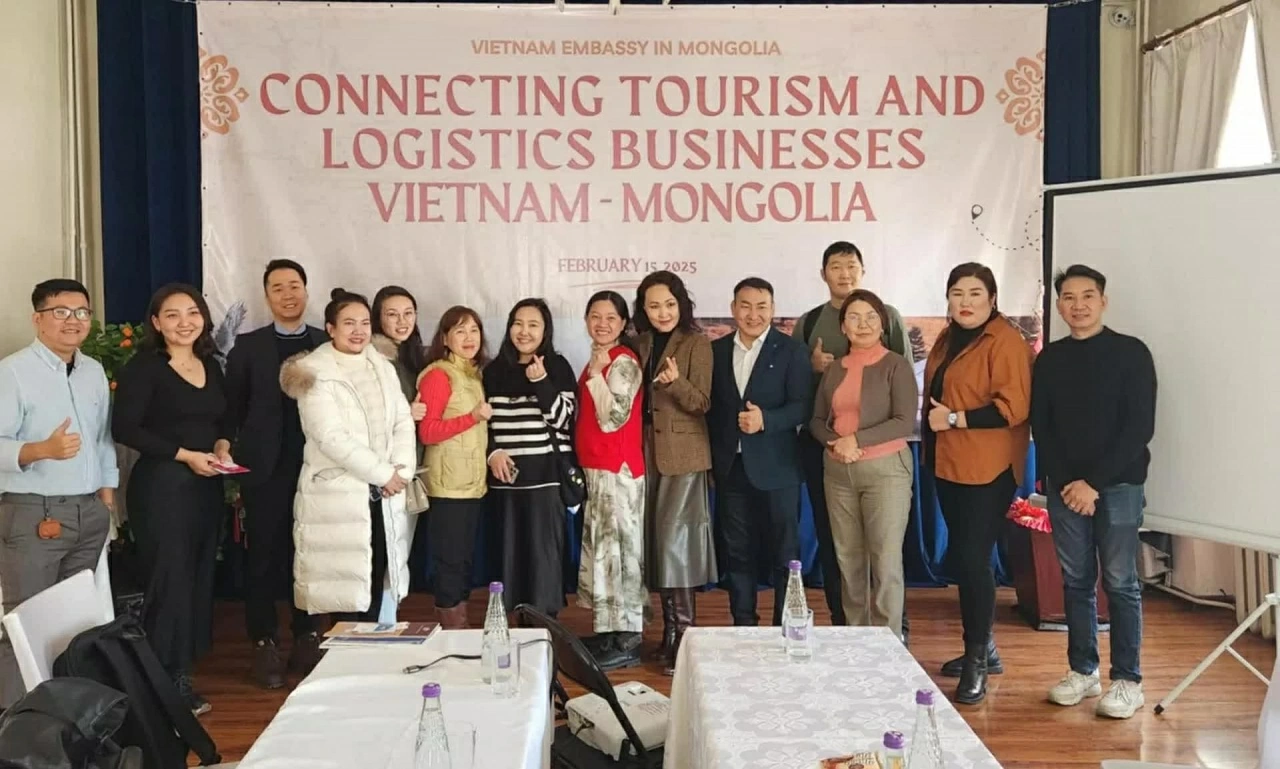 |
| The Vietnamese Embassy in Mongolia coordinated with the Mongolian National Chamber of Commerce and Industry (MNCCI) and the Vietnam Association of Foreign Invested Enterprises (VAFIE) to organize a business connection workshop for Vietnamese and Mongolian enterprises operating in tourism and logistics, February 2025. (Source: Vietnamese Embassy in Mongolia) |
Thirdly, cultural and educational cooperation continues to expand. Vietnam and Mongolia both have unique, rich cultural traditions. The upgrade of diplomatic relations has facilitated the promotion of cooperation in culture, education, and sports. Many specific cooperation programs have been implemented to increase understanding and bonds between the peoples of the two countries.
Accordingly, both sides have actively exchanged cultural and artistic programs, promoting the countries and peoples of each nation; many outstanding literary and cultural works of the two countries have been translated into each other's languages. Notably, since 1980, the Mongolian Government has named School No. 14 in the capital Ulaanbaatar after President Ho Chi Minh. This is a vivid symbol of the strong friendship between the two peoples, laying a solid foundation for increasingly developing educational cooperation.
Another noteworthy point is the increasingly vibrant local cooperation and people-to-people exchanges. Relations between localities of the two countries, including the twinning relationship between the capital Ulaanbaatar and Hanoi, between Tuv Province and Phu Tho Province, between Okhon Province and Dak Lak Province, are creating additional practical cooperation channels. Along with that are the activities of the Vietnamese community in Mongolia, contributing to making the relations between the two countries increasingly close and attached.
I believe that the visit of General Secretary, President To Lam in 2024 has created a very important impetus. The current Comprehensive Partnership framework is gradually being transformed into specific programs, projects, and cooperation results.
The visits, high-level contacts, and cooperation activities in recent times are continuing to concretize that impetus. With the foundation of friendly relations, political trust, and increasingly intertwined interests, Vietnam-Mongolia relations are very favorable for developing to a new height, more substantively, more effectively, and bringing practical benefits to the people of both countries.
Ambassador, could you share more about the cooperation potential between the two countries, especially in the fields of economy, trade, investment, and agriculture?
In my opinion, the cooperation potential between Vietnam and Mongolia is still very large, especially in the context of the two countries just upgrading their relations to a Comprehensive Partnership and entering a phase of vigorously implementing the agreements and commitments of high-level leaders. The important thing is for both sides to transform those potentials into specific projects and cooperation programs, bringing practical benefits to businesses and people of both countries.
Firstly, in terms of economy, the trade between the two economies has a clear complementary nature. Mongolia has strengths in minerals, energy, livestock, and some essential raw materials for Vietnam's production sectors; while Vietnam has strengths in processing, consumer goods production, agricultural products, food, pharmaceuticals, textiles, electronics... which are products in high demand in Mongolia. This is the basis for the two countries to expand goods exchange, diversify products, and gradually form suitable supply chains.
In the future, special attention should be paid to further facilitating businesses of both countries to access each other's markets, enhancing business connection activities, fairs, trade and investment forums; while researching suitable mechanisms to solve difficulties in logistics, payment, quality standards, and import-export procedures. Effectively exploiting transport routes and air connectivity between the two countries will also be very important for promoting trade, tourism, and people-to-people exchanges.
In terms of investment, there are many prospects in fields where both sides have strengths and needs, such as energy, minerals, processing industry, infrastructure, logistics, tourism, and services. Vietnam increasingly has large enterprises that have accumulated experience in implementing investment projects in the international environment. Mongolia also needs to attract more capital, technology, and experience to develop non-mining economic sectors. This is an opportunity for Vietnamese businesses to explore and participate more deeply in the Mongolian market. Notably, recently, a Vietnamese corporation has been making significant investments in the energy sector in Mongolia, opening a new, sustainable cooperation direction in the economic cooperation between the two countries.
Agriculture and livestock are fields with high expectations. Mongolia has a great strength in livestock farming, while Vietnam has experience in breeding, veterinary medicine, food processing, agricultural value chain development, and market building. Both sides can research cooperation from breeding, animal feed, veterinary medicine, processing, and preservation to brand building and product consumption. Especially, cooperation in deep processing of meat, milk, leather, and livestock products can create higher added value for both sides.
Additionally, the two countries can expand cooperation in climate-adaptive agriculture, combating desertification, efficient water use, and the application of science and technology in agriculture. These are also fields that match Mongolia's strengths and practical needs, while Vietnam has much experience to share.
I believe that with the Comprehensive Partnership framework, we should not only focus on traditional cooperation fields but also boldly open new fields with long-term potential and create new growth drivers. If we do a good job of connecting and resolving market, logistics, and information bottlenecks, I am confident that Vietnam-Mongolia economic cooperation will have much room to develop, becoming an important pillar of bilateral relations in the coming time.
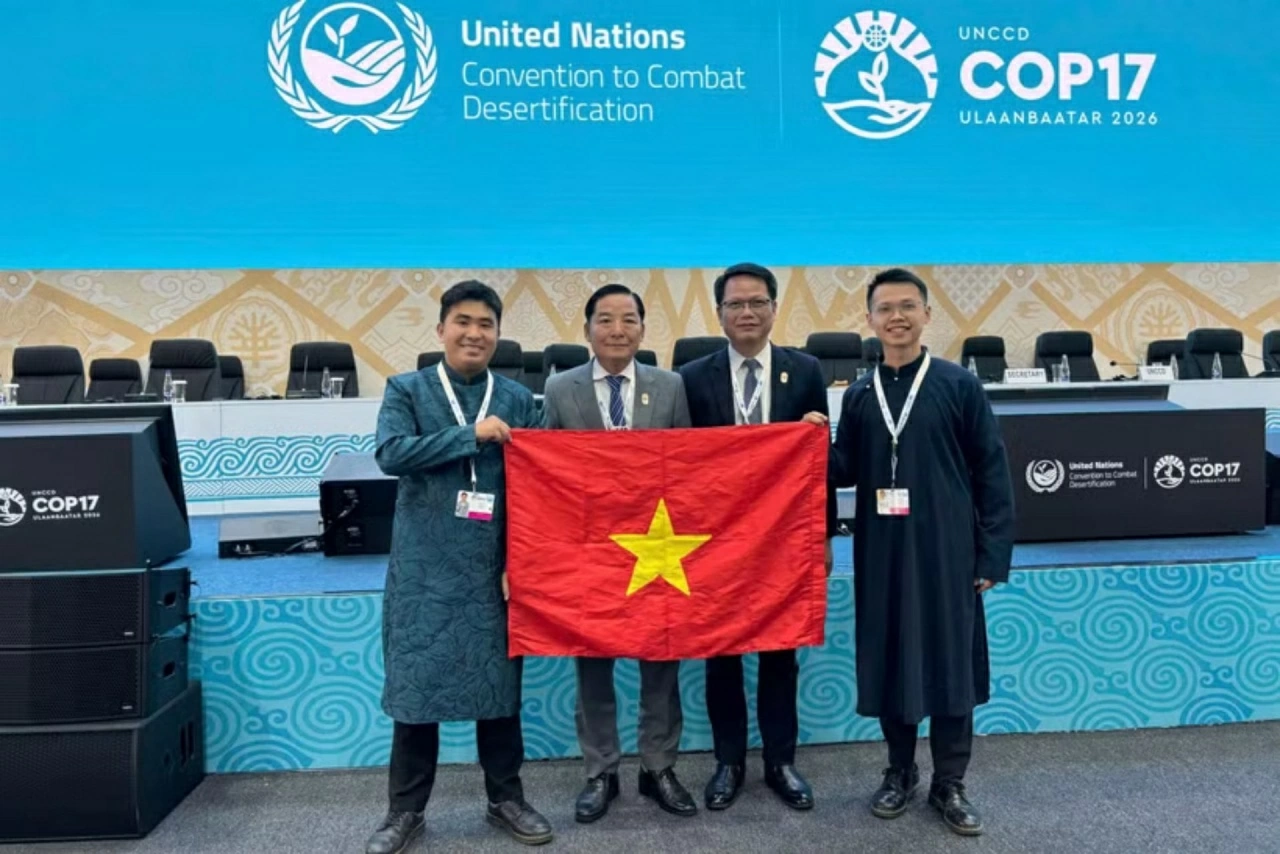 |
| The Vietnamese delegation attended the 17th Conference of the Parties to the United Nations Convention to Combat Desertification. (Source: Department of Forestry and Forest Protection) |
Mongolia hosted the 17th Conference of the Parties to the United Nations Convention to Combat Desertification in 2026 from August 17-28. Ambassador, how do you view the potential for cooperation between the two countries in responding to climate change, combating desertification, and sustainable development?
From July 17-28, Mongolia hosted the 17th Conference of the Parties to the United Nations Convention to Combat Desertification (COP-17). The conference saw the participation of high-level officials from many countries, reflecting the interest of parties in the issues of combating desertification and climate change. The Vietnamese delegation attended at the Department level of the Ministry of Agriculture and Environment.
I believe that Mongolia hosting the COP-17 on combating desertification this time shows that the country places great importance on land protection, combating land degradation, and adapting to climate change. This is a field with great cooperation potential and increasingly practical significance for both Vietnam and Mongolia.
Although the natural conditions of Vietnam and Mongolia are very different, both countries are experiencing increasingly clear impacts of climate change and extreme weather phenomena. In the context of facing significant challenges regarding climate change, desertification, and sustainable development, both sides have much space to share experiences and cooperate. Vietnam has experience in climate change response, adaptive agricultural development, and resource management; while Mongolia has much experience and needs cooperation in livestock, grasslands, and combating desertification. This can become a new, long-term cooperation direction.
In the future, the two countries can focus on several directions such as: Enhancing experience exchange, scientific research, and technology transfer on land restoration, afforestation, water resource management, and sustainable agricultural development; promoting specific cooperation projects between localities, research institutes, universities, and businesses of the two countries, especially in green agriculture, renewable energy, and environmental technology; coordinating and supporting each other at multilateral mechanisms, thereby contributing to the international community's joint efforts in combating desertification, responding to climate change, and achieving the United Nations Sustainable Development Goals.
I also believe that COP-17 in Mongolia is a good opportunity for Vietnam and Mongolia to deepen cooperation in this field and have specific projects. More importantly, we need to recognize that this is not only an environmental issue but also directly linked to people's livelihoods, food security, water security, and sustainable socio-economic development.
With the foundation of good friendly relations and the Comprehensive Partnership between Vietnam and Mongolia, cooperation on climate change, combating desertification, and green development will become a new field of cooperation with much potential in the bilateral relations in the coming time.
Thank you very much, Ambassador!