








AI toys and the threat to child development – A warning to parents and families
Talking dolls, listening stuffed animals, and child-specific chatbots are quickly becoming part of family life. Promoted as educational tools and ideal companions, AI toys promise to support the development of young children's brains. However, according to numerous scientific warnings, behind this allure lie serious risks that society has yet to recognise fully.
Latest
The Wave of AI Toys and Their Enticing Promises
Every week, the market sees the arrival of new products promising AI-driven companionship for children, including Barbie dolls that can call children by name, Curio stuffed animals that spark imaginative adventures, and child-specific chatbots developed by Meta and xAI. Even Disney has joined this race by investing $1 billion in OpenAI to bring familiar characters to new AI platforms.
Whether in the form of invisible voices, screen avatars, or cuddly stuffed toys, these products share a groundbreaking feature: they can speak, listen, and respond in ways that surprise many with their human-like qualities. Beyond entertainment, manufacturers promote them as tools to reduce screen time and enhance child interaction.
Interaction – The Foundation of Brain Development
Neuroscience shows that warm, responsive two-way interactions between humans foster the formation of up to one million neural connections in an infant's brain every second. These connections are directly related to language development, mathematical and spatial thinking, emotional control, and social skills.
Until now, such interactions have only been observed in humans. However, AI systems are being designed to mimic these very social responses. This places parents in a situation akin to the "Trojan Horse" story: at risk of accepting a seemingly harmless gift that harbours unforeseen consequences.
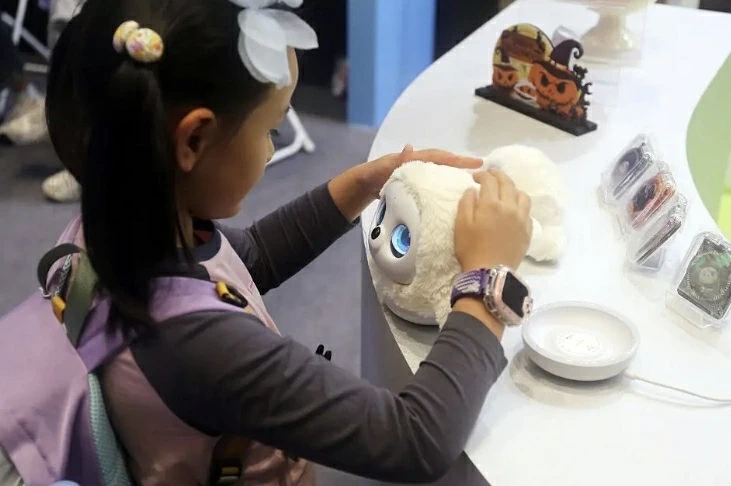 |
| AI Pet Robot Stuffed Toy Ropet in Shanghai, China (Source: Getty Images) |
Concerning Gaps
In reality, society currently lacks sufficient understanding of how AI toys for children are designed, how their algorithms operate, what their default settings are, or their short- and long-term impacts on developing brains.
Warning signs have emerged. The US PIRG Education Fund published a report noting several concerning conversations between children and AI toys, including content related to sexuality or suggestions on where to find knives. These findings indicate that the risks are not merely theoretical.
While adults increasingly form complex emotional relationships with "AI companions" and teenagers turn to chatbots for mental health support, a pressing question remains: how will this technology affect young children, whose brains are still developing and learning to build early relationships?
Developing Brains and the Risk of Delayed Maturity
According to Dr Dana Suskind, Professor of Surgery and Paediatrics at the University of Chicago, infants and young children are "programmed" to learn from rich emotional interactions between humans. This is the type of interaction AI systems are attempting to emulate – and initial results show they are doing quite well.
Research indicates that children as young as six months old respond to robots in much the same way as humans. Other studies suggest that children can form emotional attachments to social robots and responsive agents, viewing them as companions rather than machines.
This raises concerns not about "brain decay" as seen in adults overusing AI, but about the risk of delayed brain development in young children. When foundational neural circuits have not yet formed through human interaction, AI substitution experiences may leave lasting consequences.
Technology Is Not the Enemy, But Boundaries Are Needed
Dr Dana Suskind emphasises that the issue is not about opposing technology. AI, if designed based on scientific evidence and aimed at connecting people, can offer significant educational and therapeutic benefits. In fact, in the medical field, technology has opened up many opportunities for deaf children through implants and communication aids.
The concern is that technologies designed primarily for entertainment risk diminishing human social interaction – an irreplaceable factor in a child's development.
Four Guiding Principles for AI and Children
Based on the above analysis, Dr Dana Suskind proposes four foundational principles when considering children's exposure to AI:
- No algorithm can replace human interaction: Eye contact, shared laughter, and parental patience activate core neural circuits for connection.
- "Good enough" parenting is more important than perfect responses: Children grow through mistakes, adjustments, and emotional friction – something AI cannot fully replicate.
- Early experiences shape young brains: AI can directly impact the formation of neural circuits that determine future learning and relationships.
- AI should supplement, not replace, human interaction: Technological tools should only alleviate parental burdens or support understanding, not hinder human connection.
Responsibility Beyond Parents
While more time is needed for long-term studies to clarify AI's impact on children's brains, time is precisely what young children lack. Therefore, the responsibility to protect children cannot rest solely on the shoulders of parents.
Like food, medicine, or child safety devices, AI assistants and smart toys need independent safety checks before hitting the market, transparency about their operations, and clear labelling regarding their suitability for child development. Policymakers and regulatory agencies must establish legal frameworks to protect children, rather than allowing technology to encroach on childhood freely.
Looking at the "Stuffed Bear at the Gate"
The story of Troy serves as a familiar reminder of the cost of complacency. Unlike the ancient Trojans, today's society still has time to look inside the "stuffed bear" of AI being introduced into children's rooms. This is necessary to protect what matters most: irreplaceable human connections – the foundation of our very humanity.
| RELATED NEWS | |
 | US tariffs pose a threat to Vietnam’s exports and economic growth: Experts |
| US tariff threat leads Vietnam to seek agricultural growth scenarios |
(Source: Time)
Tags: