



 |
| “To pave the way for Vietnamese agricultural products to enter Saudi Arabia in particular and the Middle East in general, Vietnamese products need to have Halal certification, clear and reputable branding to build trust in this high-standard, important market”. |
| Vietnamese Ambassador to Saudi Arabia Hoang Huu Anh shared with The World & Vietnam Report some “pocket tips” for Vietnamese products to easily establish a foothold in the Saudi Arabian market, in particular, and the Middle East in general.
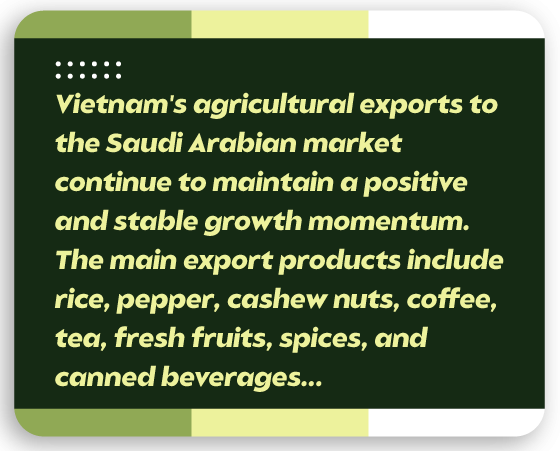
Could the Ambassador update us on the export situation of Vietnamese agricultural products to Saudi Arabia since the beginning of the year? According to the Ambassador, what are the highlights in the export of these products, and what potential can both sides continue to explore? First of all, it must be said that the relationship between Vietnam and Saudi Arabia is developing very positively and comprehensively in various aspects, as clearly demonstrated in bilateral trade exchanges. In the first ten months of 2025, the total trade turnover reached USD 2.72 billion, with Vietnam exporting approximately USD 1.71 billion, an increase of 29.3%, and importing USD 1 billion, a decrease of 14% compared to the same period. This indicates a promising growth rate in the export of Vietnamese goods to the Saudi Arabian market. Agricultural trade, in particular, and cooperation in the field of food and essential goods hold strategic significance when looking at the unique context of Saudi Arabia. This is a country with an area of over 2.1 million km² and 35 million people, but only about 1.5% of the land is arable, and the main water source (about 80%) depends on seawater desalination plants. Annually, Saudi Arabia imports about USD 35 billion in agricultural products. Therefore, this is a key market that Vietnamese businesses need to strive to exploit. |
|
It is important to note that this market is highly competitive. With over 15 million foreigners living and working there, accompanied by a dynamic network of multinational import businesses, Vietnamese agricultural products not only compete with each other but also face direct competition from strong contenders from the US, Europe, Oman, Yemen, Egypt, Turkey, Morocco... Each of these countries has its advantages and has established a certain position in the market.
Could the Ambassador share insights into the consumer preferences of Saudi Arabian people regarding imported agricultural products with clear branding? Saudi Arabian consumers have high incomes and stringent requirements for goods and products. Therefore, there are some prominent consumer preferences in this country as follows: Firstly, product quality is a decisive factor. Consumers here are willing to pay for products with superior quality, ensuring absolute freshness, food safety, and appealing appearance. Secondly, clear brand recognition. Saudi Arabian consumers highly value transparency. A product with professional packaging, clearly stating the origin, manufacturer information, and international certifications (such as Global G.A.P., HACCP) or a clear Halal certification will more easily gain trust. Thirdly, loyalty to reputable brands. Once they trust a brand, they tend to be very loyal. Therefore, building a reputation and maintaining consistent quality from the start is crucial. |
1-2-3. Vietnamese products are displayed and sold in Saudi Arabia.
| Could the Ambassador share some branding experiences from the host country that Vietnam can learn from? Saudi Arabia is also making great efforts to realise the Vision 2030 Plan. Accordingly, Saudi Arabian businesses at all levels and scales place great importance on building brands and reaching international levels. Firstly, it is about product quality. Next is the investment in packaging and brand identity. Successful brands in Saudi Arabia often have very luxurious packaging, sophisticated design, and high-quality printing with bilingual information in Arabic and English. Businesses build brand stories associated with core values because Saudi Arabian consumers highly appreciate stories about natural origins, clean and sustainable production processes. Additionally, Saudi Arabian businesses aim to build long-term strategic partnerships. This is very important because in a highly competitive and diverse environment, finding and building strong relationships with reputable local importers and distributors is key to survival. Finally, the government, businesses, and people of Saudi Arabia are working together with Muslims worldwide to promote a common brand – Halal. The goal of Halal is not only to certify according to Muslim consumer standards but also to be a symbol of green, clean products loved by global consumers.
From a local perspective, could the Ambassador share what efforts Vietnam needs to undertake to enable agricultural products to access the goods and services market according to Halal standards in Saudi Arabia? In recent years, the Government, Ministry of Foreign Affairs, and various ministries, sectors, localities, and businesses in Vietnam have paid great attention to the Halal market, which has at least 2 billion people and a scale of USD 2,500 billion, with Saudi Arabia being a market built entirely on Halal standards. To effectively access this market, Vietnam has actively implemented the “Enhancing International Cooperation to Build and Develop the Halal Industry in Vietnam by 2030” project. Accordingly, the focus should be on: Firstly, expanding and standardising the supply according to Halal standards. Currently, Vietnam has about 1,000 businesses in all fields (production, trade, processing, tourism...) with products recognised according to Halal standards. Vietnam needs to continue increasing the number of these businesses and gradually form a Halal ecosystem and link our ecosystem with the Saudi Arabian market in particular, the six countries in the Gulf Cooperation Council (GCC), and the global Muslim community in general. Secondly, reviving trade in products that Vietnam previously exported well to Saudi Arabia (such as aquaculture) and exploiting potential from new sectors (such as fresh flowers...). Saudi Arabia is a major importer of fresh flowers, especially for holidays, events, and high-end lifestyles. Meanwhile, Vietnam has the climate and technical advantages to produce many beautiful, high-quality flowers. Thirdly, increasing logistics and transportation connectivity, focusing on establishing direct shipping routes to Saudi Arabia. Currently, many Vietnamese products to the Saudi Arabian market have to be transshipped through ports in the United Arab Emirates (UAE) or Qatar, increasing costs, prolonging time, and increasing quality risks, especially with fresh and frozen goods. Therefore, Vietnam needs to promote aspects such as shipping companies opening direct cold container routes from major Vietnamese ports (such as Cai Mep, Hai Phong) to major ports in Saudi Arabia (such as Jeddah Islamic Port, King Abdulaziz Port Dammam); developing direct cargo flights, ensuring cold chains for high-value, perishable goods such as fresh flowers, premium fruits, or certain seafood... |
|
| Ambassador, what plans does the Vietnamese Embassy in Saudi Arabia have to continue promoting its role as a bridge in sustainable agricultural export to this gateway market of the Middle East? It must be said that now and in the future is an important period to create fundamental changes for comprehensive cooperation between Vietnam and Saudi Arabia. Vietnam is striving to rise, while Saudi Arabia is implementing Vision 2030. Saudi Arabia is opening up strongly to the world, while Vietnam has deeply integrated. Saudi Arabia is very dynamic and has a great demand for many goods and skilled labour that Vietnam can fully meet, especially in agriculture and agricultural products. To seize this trend, the Vietnamese Embassy in Saudi Arabia will implement the following key tasks in a synchronised and proactive manner: Firstly, continue to promote focused and effective trade promotion. Building on the success of the series of events in 2025, the Embassy will actively coordinate closely with domestic agencies such as the Ministry of Industry and Trade, the Ministry of Agriculture & Environment, industry associations, and the People's Committees of provinces and cities to organise more specialised trade promotion delegations for agricultural products and food. The events will be designed more in-depth, targeting strategic product groups and major distribution partners in Saudi Arabia. Secondly, provide detailed and timely market information. This information will be transformed into reports, thematic newsletters, and widely disseminated to the business community through various channels. Thirdly, support in resolving bottlenecks. The Embassy will actively work with the relevant authorities of both countries to remove technical barriers, accelerate the negotiation process to open the market for new Vietnamese agricultural products (such as aquaculture...) and promote mutual recognition of Halal certification. Fourthly, connect strategic investment. Besides trade, the Embassy will focus on connecting Saudi Arabian investors with potential in logistics, agricultural processing, and high-tech agriculture in Vietnam, aiming to build a closed, sustainable value chain and enhance the value of export agricultural products.
How should Vietnamese businesses connect with such programs, Ambassador? To make the most of the aforementioned opportunities, I believe Vietnamese businesses need to: Firstly, proactively seek information about the Saudi Arabian market, the business sector, and partners. Secondly, thoroughly prepare a capability profile, whereby businesses need to have a professional introduction profile in English or Arabic, quality certificates, Halal certification, and export-standard product samples. Thirdly, actively choose and register to participate in promotional activities both in Vietnam and in Saudi Arabia. Fourthly, directly contact the Embassy for updated information, as well as to receive advice and support in connecting with suitable partners. The Embassy always clearly defines its role as a reliable companion for businesses. With a methodical roadmap under the direction of the Government, the involvement of ministries, sectors, and localities, as well as the joint efforts of the business community, the Embassy believes that the path to bringing Vietnamese agricultural products to Saudi Arabia in particular and the Middle East in general will become increasingly open and sustainable. |
--------
Contact point of the Embassy:
Mr. Tran Trong Kim, Head of Vietnam Trade Office in Saudi Arabia
Phone: 966544326015
Email: [email protected]; [email protected].